x




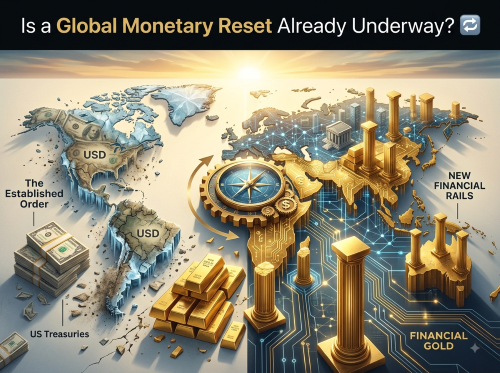
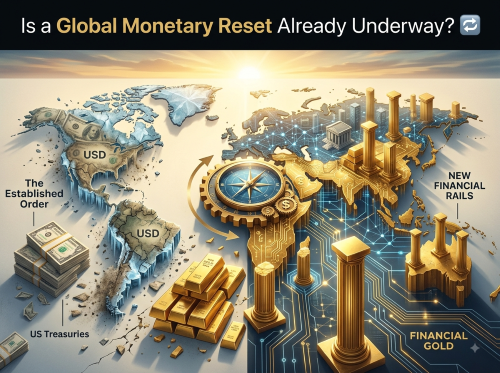
Popular culture often depicts financial crises with dramatic flair: stock markets plunging overnight, bank doors slamming shut, and paper currency turning worthless by lunchtime. While these apocalyptic scenarios make compelling cinema, economic history demonstrates that true structural transformations in the global financial order unfold far more subtly.
A genuine monetary reset is rarely an overnight crash. Instead, it is a gradual, structural reorganisation of how the world stores wealth, settles cross-border trade, and determines what constitutes a neutral reserve asset. It is an evolutionary process where confidence quietly migrates from one foundation to another. Rather than a violent, sudden collapse, a reset behaves much like melting ice—quiet, continuous, and fully noticeable only after significant change has already taken place.
Multiple indicators suggest that such a structural rebalancing is currently in motion across four distinct areas of the global economy.
To understand where the global monetary system is heading, one must examine how dominant reserve currencies have historically evolved. The transition from the British pound sterling to the United States dollar provides a clear historical precedent.
Sterling did not lose its position as the premier reserve currency during a single cataclysmic event. Instead, its dominant status faded over approximately four decades. Two world wars, persistent balance-of-payments challenges, and the steady contraction of Britain's share of international trade all eroded sterling’s position step by step. By the time the world officially recognised that the dollar had assumed the mantle, the shift had already been underway for years.
The lesson from history is clear: reserve currency transitions rarely announce themselves with sudden fanfare. They manifest as subtle shifts in counterparty risk, gradual portfolio adjustments by institutions, and incremental changes in trading preferences.
For decades, the United States Treasury market has functioned as the base layer for global financial valuation. Central banks, pension funds, and commercial institutions historically viewed U.S. government debt as the ultimate benchmark for risk-free assets.
However, persistent fiscal deficits have created an expanding supply of sovereign debt that requires constant market absorption. Simultaneously, foreign official sector appetite for these debt instruments has lost its historical momentum.
A monetary reset does not require a sudden bond market shock; it simply requires the long-term cost of servicing sovereign debt to remain elevated. As debt-servicing burdens grow, monetary authorities face narrow choices between financial repression, central bank market intervention, or adapting to a broader range of global reserve assets.
The clearest evidence of structural rebalancing can be found in the changing composition of central bank reserves. For nearly two decades leading up to the 2010s, central banks were net sellers of bullion, preferring interest-bearing sovereign debt. That trend has dramatically inverted.
Between 2022 and 2024, official institutions purchased well over 1,000 tonnes of physical gold per year—a sustained cadence of accumulation with no modern precedent. Even as record metal prices led to a slight moderation in overall volume during 2025, central bank accumulation remained substantially higher than historical decade averages, with dozens of nations expanding their reserves.
Data highlighted by the European Central Bank indicated that gold reached 27 per cent of global central bank reserve assets by late 2025, overtaking U.S. Treasuries, which stood at 22 per cent. While a significant portion of this shift was driven by asset price appreciation, the strategic direction remains unmistakable.
The primary driver behind this accumulation is the recalculation of counterparty risk. Geopolitical events demonstrated that fiat reserves held within external banking systems can be frozen or restricted. Physical gold, conversely, carries no default risk, cannot be sanctioned remotely, and sits entirely outside digital financial clearing networks. Central banks are not abandoning traditional currencies entirely, but they are actively diversifying away from single-issuer risk.
While sovereign institutions adjust their balance sheets, an unexpected dynamic has emerged within digital finance. Dollar-pegged stablecoins have grown into a multi-hundred-billion-dollar market, providing rapid global settlement rails for digital transactions.
Interestingly, the underlying asset backing for these digital rails reveals a compelling strategy. Tether, the largest issuer of dollar-pegged stablecoins, has accumulated massive reserves of physical gold alongside its cash and short-term Treasury holdings. Official records show that by early 2026, Tether held over 140 tonnes of physical gold, briefly becoming the single largest institutional buyer of gold worldwide in 2025—exceeding the net purchases of any single central bank during that period.
This represents a novel hybrid model: issuing digital tokens to maintain daily dollar liquidity on the surface, while anchoring the balance sheet with unencumbered hard assets underneath. It demonstrates how modern financial actors are building dollar infrastructure while simultaneously hedging against long-term fiat debasement.
Does this structural evolution mean the dollar is about to lose its global role? The short answer is no. The dollar still accounts for approximately 42 per cent of global foreign exchange reserves and continues to dominate global trade settlement and contract denomination. Neither the euro, the yuan, nor proposed regional trade units currently possess the market depth or institutional architecture required to replace the dollar at scale.
What is occurring is not a sudden replacement, but the emergence of a multipolar reserve framework. The dollar remains the primary medium for transactions and trade, while neutral physical assets like gold—supported by new digital rails—are re-establishing themselves as key anchors for long-term store of value.
Understanding this mechanism allows individuals and institutions to recognise that financial system shifts occur incrementally, long before the ultimate outcomes become obvious in daily life.
GoldSilver - The Reset Isn't A Crash. It's Already Happening
Megan walks through what a real monetary reset actually looks like, not a single dramatic crash, but a slow reshuffling of who trusts what. Reserve currencies don't die in a weekend. They fade the way ice melts, not the way glass shatters. Four quiet shifts are already underway: stress building in the Treasury market's plumbing, central banks buying gold at nearly double the old pace, a private stablecoin issuer now buying more gold than most nations, and currency itself becoming more digital and programmable while still saying "dollar" on the label.
~ Timestamps ~
0:00 The Myth of the Monday Morning Collapse
1:04 How Reserve Currencies Actually Fade
1:57 Cracks in the Treasury Market
3:39 Central Banks Are Buying Gold Again
5:58 The Quiet Revolution in How Currency Moves
7:48 Putting the Pieces Together
9:22 Closing Thoughts
Source: https://www.youtube.com/watch?v=twSGR6r8hYw
Disclaimer: This article is provided for informational purposes only, mistakes may be made, and it's not offered or intended to be used as legal, tax, investment, financial, or any other advice.