x




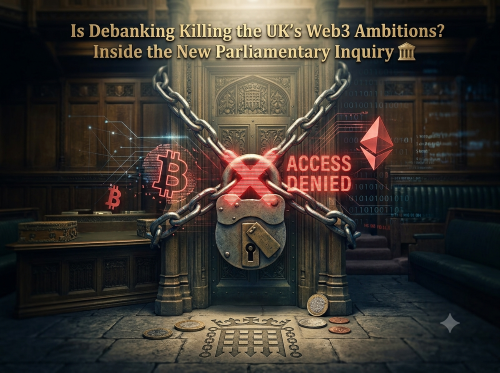
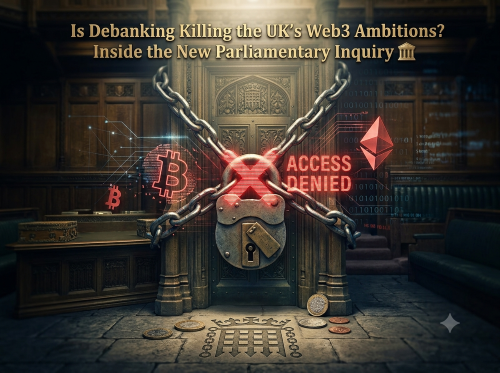
For several years, His Majesty’s Government has boldly declared its intention to turn the United Kingdom into a "global leader in digital assets." From comprehensive regulatory frameworks to sandbox initiatives, policymakers have pledged to create a fertile ecosystem where blockchain technology, Web3 ventures, and cryptocurrency firms can flourish.
Yet, beneath these grand international ambitions lies an embarrassing and persistent hurdle: crypto companies operating in Britain struggle to get—and keep—a basic business bank account.
This phenomenon, commonly referred to as "debanking," has reached a tipping point. A cross-party group of British parliamentarians has launched a landmark inquiry to investigate why mainstream financial institutions are freezing out crypto firms and whether this systemic friction is severely damaging the UK's economic future.
For legitimate startups and established digital asset exchanges alike, access to standard commercial banking services—such as holding deposits, paying staff payroll, or settling supplier invoices—is a fundamental operational requirement. However, major British high-street institutions, including HSBC, NatWest, Santander, Nationwide, and digital challenger Starling Bank, have spent years imposing strict limits or outright bans on crypto-related transactions and business accounts.
The consequences for the sector are far-reaching:
According to research published by the UK Cryptoasset Business Council earlier this year, banks were found to be blocking or delaying an estimated 40% of attempted transfers to crypto exchanges. Worse still, 70% of surveyed exchanges stated that these financial bottlenecks were actively suppressing their investment, hiring, and business expansion plans within Great Britain.
To tackle this mounting crisis, the Crypto and Digital Assets All-Party Parliamentary Group (APPG) has formally opened an investigation into the banking barriers confronting the digital asset sector.
Co-chaired by Lord Vaizey of Didcot, a former Digital Economy Minister, and Labour MP Gurinder Singh Josan, the inquiry aims to scrutinise whether bank-enforced restrictions are proportionate or whether they represent an uncompetitive drag on national innovation.
"Access to banking services is fundamental for any legitimate business, and where unnecessary barriers exist they have the potential to hinder growth, investment and innovation," Lord Vaizey and Gurinder Singh Josan stated in a joint release.
The parliamentary group is focusing its probe on several critical operational areas:
The inquiry arrives at a pivotal juncture. The UK government has only recently finalised its comprehensive regulatory roadmap for digital assets, bringing fiat-backed stablecoins and crypto trading platforms under the supervisory watch of the Financial Conduct Authority (FCA).
There is an obvious disconnect between regulatory oversight and practical banking access. HM Treasury has explicitly stated that compliant, regulated businesses should not face blanket rejections simply because of the industry sector to which they belong.
Addressing Parliament earlier this year, Economic Secretary to the Treasury Lucy Rigby reaffirmed that under the new regime, the Government does not expect FCA-licensed crypto firms to be subject to indiscriminate banking bans. Yet, high-street banks continue to treat the entire sector as a uniform high-risk category, overriding the government's policy objectives.
The UK's struggle with crypto debanking is far from an isolated case. As part of its research, the APPG is actively evaluating how other international hubs—including the United States, Hong Kong, Australia, and the European Union—are handling the delicate balance between banking access and risk mitigation.
The APPG is currently accepting written evidence from industry leaders, financial institutions, regulatory bodies, and affected consumers until 31 August.
Following this six-week consultation period, the parliamentary panel will compile a comprehensive report detailing policy recommendations for HM Treasury and the FCA. Crucially, these insights will arrive well before October 2027, when the UK’s fully mandatory crypto regulatory regime is scheduled to take full effect.
If the UK genuinely intends to secure its standing as a premier global fintech hub, bridging the gap between conservative banking practices and pioneering digital asset businesses is no longer optional—it is vital.
For more background and details regarding the original news report on this parliamentary inquiry, you can read the primary article on Decrypt:
👉 UK Lawmakers Launch Inquiry Into Crypto Banking Access
Disclaimer: This article is provided for informational purposes only, mistakes may be made, and it's not offered or intended to be used as legal, tax, investment, financial, or any other advice.