x




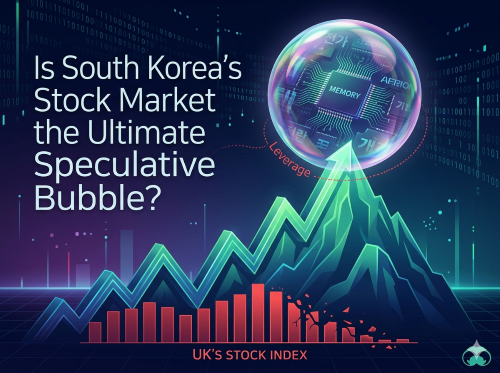
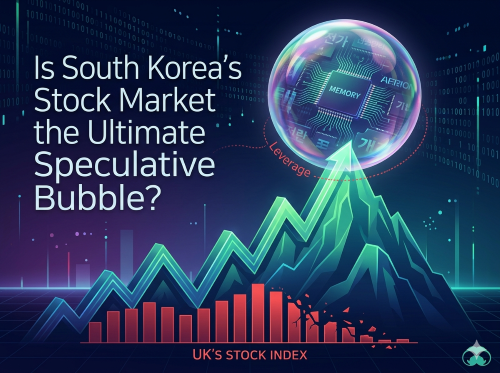
The global tech conversation has been dominated by fears of an artificial intelligence bubble. Critics frequently argue that Silicon Valley valuations have become stretched and that the massive infrastructure spend on AI may not yield immediate commercial returns. However, an entirely different financial phenomenon is unfolding in East Asia. The true epicentre of speculative mania in 2026 isn't America's tech sector; it is South Korea’s equity market.
The country's benchmark stock market index, the Kospi, has been moving like a highly leveraged rocket ship. Since the start of 2026, the Kospi has doubled, and over the past sixteen months, it has more than tripled. To put that into perspective, this rapid ascent outpaces the velocity of the infamous dot-com bubble of the late 1990s. This unprecedented surge has transformed South Korea into one of the world's largest equity markets, with its total listed market value recently overtaking that of the United Kingdom.
While the velocity of the market looks irrational, the rally did start with solid, tangible fundamentals. Unlike purely speculative historical bubbles, South Korea's boom is underpinned by a massive explosion in corporate earnings within the semiconductor sector.
The global demand for artificial intelligence infrastructure requires high-bandwidth memory chips, a hardware component central to the AI supply chain. South Korean tech giants, specifically Samsung Electronics and SK Hynix, virtually control this market. In April 2026, SK Hynix posted a record quarterly profit, driven entirely by frantic global demand for AI memory. This massive surge in profitability pushed the chipmaker's market capitalisation past the one trillion dollar mark, a staggering climb from its sub-one hundred billion dollar valuation just over a year prior.
However, this semiconductor success story highlights a massive structural vulnerability: extreme concentration risk. Together, Samsung Electronics and SK Hynix now account for over fifty per cent of the Kospi’s total market value. The entire South Korean index is essentially a proxy trade for just two chip stocks. If these two companies experience operational hitches or supply chain disruptions, the entire national index faces catastrophic fragility.
The fundamental bull case was further strengthened by a coordinated government campaign to eliminate the "Korea Discount." For decades, South Korean stocks traded at significantly cheaper valuations than their global peers. This discount was primarily blamed on the opaque governance of "chaebols"—the massive, family-run conglomerates that historically prioritised the wealth of controlling families over minority shareholders.
To rectify this, South Korea launched its "Corporate Value-Up" program, pushing listed companies to improve capital efficiency and boost shareholder returns. Legal reforms expanded board duties to protect minority investors, and discussions regarding inheritance tax restructuring suggested that controlling families would no longer have an incentive to keep stock prices artificially depressed.
This corporate facelift caught the attention of global finance. International hedge funds and emerging market investors began aggressively rotating capital out of other regions and piling into South Korean equities. A market once dismissed as frustrating and cheap suddenly became the hottest public AI trade on the planet.
While institutions provided the initial spark, South Korea's massive retail investor class turned a reasonable fundamental thesis into an absolute speculative frenzy. Locally referred to as "ants," these small individual market participants move collectively as a highly coordinated financial force.
Out of a national population of roughly fifty-two million people, South Korea boasts over fourteen million retail investors. More astonishingly, the country has logged over one hundred million active trading accounts. Stock trading has thoroughly permeated daily life, shifting from a wealth-building tool into a national obsession discussed in offices, cafes, and group chats.
This domestic enthusiasm has triggered a massive capital rotation. Wealthy citizens are actively cashing out traditional savings deposits, insurance policies, and pensions to purchase chip stocks. This frenzy is completely cross-generational. Investors over fifty hold the vast majority of margin loans at major brokerages, while the first quarter of 2026 saw a tenfold year-on-year jump in new stock accounts opened for minors.
The most alarming aspect of this market melt-up is the staggering reliance on borrowed money. Retail margin loans for stock purchases have climbed to a record thirty-six trillion won (approximately twenty-four billion US dollars).
To compound this risk, financial institutions have introduced highly volatile derivative products. In late May 2026, the market debuted its first single-stock leveraged Exchange Traded Funds (ETFs) for Samsung and SK Hynix, allowing retail traders to double the daily performance of these already volatile tech giants.
While leverage amplifies gains on the way up, it creates an incredibly hazardous trap on the way down. If chip prices experience a modest correction, declining asset values trigger automatic margin calls. This forces retail investors to liquidate their positions, driving prices lower and triggering a cascading chain reaction of forced selling. The market gave a warning sign of this structural fragility earlier this year, when a bout of volatility caused the Kospi to suffer a twelve per cent single-day crash—its worst single-day drop in history.
South Korea’s financial history reveals a consistent, unique pattern of speculative mania. The local population has long viewed speculative markets as a social escape hatch against a K-shaped economy and a worsening cost-of-living crisis.
During the pandemic era, this risk appetite manifested in a historic housing boom where young buyers took on extreme debt to purchase apartments. It also triggered a monumental crypto craze. By the end of 2024, South Koreans held roughly eighty billion dollars in cryptocurrency, equivalent to five per cent of the nation's gross domestic product. This intense local demand gave rise to the "Kimchi Premium," where digital assets traded at significantly higher prices within South Korea than on international exchanges due to strict capital controls.
The lengths to which this casino-style approach to finance has spread became apparent in 2026, when an audit revealed that a Seoul-based prepaid funeral services company suffered a thirty-three million dollar unrealised loss after investing corporate funds into a leveraged Ethereum ETF.
Politicians and global investment banks are heavily invested in keeping the momentum alive. South Korean regulators have promised a "one strike and you're out" policy against illegal short selling to reassure retail traders that the market is safe. Meanwhile, investment banks like Nomura have released wildly bullish forecasts, lifting their Kospi targets as high as ten thousand to eleven thousand points.
Yet history suggests that when retail leverage is stretched to its absolute limit, professional optimism acts as a lagging indicator. South Korea's own IT bubble collapse at the turn of the century saw the tech-heavy Kosdaq index plunge eighty-two per cent in a mere nine months, leaving behind decades of financial stagnation.
The underlying AI growth story and the memory chip supply crunch are entirely real. However, South Korea has transformed a legitimate technological advancement into an unstable, debt-fuelled national trading event. With twenty-four billion dollars in retail margin debt hanging over a highly concentrated index, even a minor hiccup in global AI spending could trigger an unwinding of leverage that ends, like all great speculative manias, in financial disaster.
Coin Bureau - AI isn't a bubble. South Korea is.
"South Korea’s stock market is going absolutely insane. The KOSPI keeps making record highs thanks to AI chip giants Samsung and SK Hynix and an unbelievable national appetite for stocks.
But beneath the rally, Korea’s market looks increasingly fragile: concentrated, leveraged, and politically charged. In this video, we look at why Korea keeps turning markets into casinos and why this boom is destined to end in tears."
~ TIMESTAMPS ~
0:00 South Korea's KOSPI Index Explained
2:03 History of Short Selling Bans in Korea
4:08 The AI memory Chip Bull Case
6:10 Corporate Value-up Program & Reforms
8:11 Rise of South Korea’s Retail "Ant" Investors
10:14 Shocking Growth in Margin Loans & Leverage
12:15 Risks of Single Stock Leveraged ETFs
14:17 2000 IT Bubble vs. Today's AI Mania
16:19 Household Debt & The "Kimchi Premium"
18:21 Foreign Capital Outflows & Volatility Warnings
Source 👉 https://www.youtube.com/watch?v=TLAVY52fy8c
Disclaimer: This article is provided for informational purposes only, mistakes may be made, and it's not offered or intended to be used as legal, tax, investment, financial, or any other advice.