x




On paper, the digital asset industry appears to be on the verge of its most significant legislative victory in a decade. The Digital Asset Market Clarity Act recently cleared the US Senate Banking Committee with a 15-9 vote, backed by a White House nod and an ambitious target for a floor vote. For an industry that has spent years begging for clear regulatory boundaries, this milestone looked like pure, unstoppable momentum.
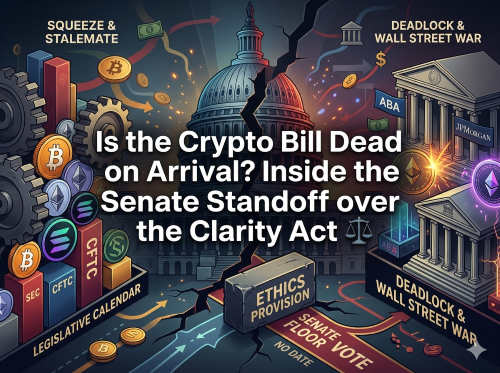
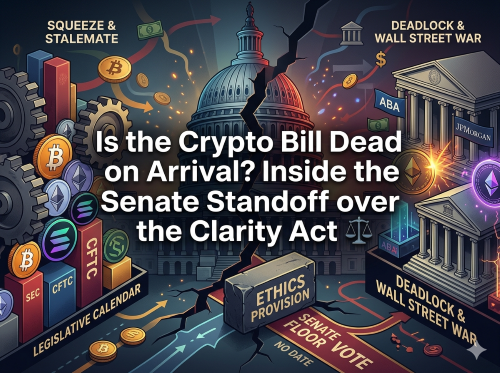
However, behind the celebratory press releases lies a stark political reality. The people who actually count the votes in Washington are growing increasingly nervous. Far from being on a smooth track to becoming law, the Clarity Act is currently being squeezed by a combination of brutal congressional arithmetic, an intense banking lobby, a high-stakes ethical deadlock, and a rapidly expiring legislative calendar.
The primary objective of the Clarity Act is to end the devastating "regulation by enforcement" paradigm that has plagued the cryptocurrency sector since 2015. For years, the Securities and Exchange Commission (SEC) and the Commodity Futures Trading Commission (CFTC) have been locked in a bitter turf war over who controls digital assets.
The Clarity Act aims to draw a definitive statutory line. It divests the SEC of total control by handing primary jurisdiction over spot digital commodity markets to the CFTC, whilst leaving digital securities under the SEC's purview. It systematically sorts every digital asset into one of three clear buckets: digital commodities (like Bitcoin), investment contract assets, or payment stablecoins.
Yet, clearing the committee is the easy part. Passing a bill into law requires floor time, and as it stands, the Senate has not scheduled a date to debate the bill. The cracks in the foundation are already showing amongst the bill's own supporters. Democratic Senator Ruben Gallego voted in favour during the committee stage but explicitly warned that his vote did not guarantee his support on the Senate floor. He noted that if key issues are not resolved by the time it reaches the chamber, he will not hesitate to vote no.
To understand why lawmakers are hedging their bets, one must look at the congressional mathematics. There are 53 Republican seats in the Senate. To break a filibuster and successfully bring the Clarity Act to a final vote, proponents need a 60-vote threshold. This leaves a seven-vote gap that must be filled by Democrats.
Currently, only two Democrats are loosely committed: Ruben Gallego and Angela Alsobrooks, both of whom have already signalended that their floor votes are not guaranteed. Proponents need to find at least five more Democratic senators in a highly charged election year, and there is no clear path to finding them.
Voting "yes" carries immense political risk for Democrats in 2026. Opponents can easily frame a supportive vote as a handout to the crypto industry or, more dangerously, as an action that protects the personal financial interests of the Trump family. Compounding this risk is a distinct lack of financial incentive; crypto-aligned political action committees (PACs) have spent over two hundred and seventy-one million dollars this cycle, yet a mere three per cent of those funds went to Democrats. Democratic senators are essentially being asked to absorb total political fallout for zero campaign cash.
Even if the vote math could be solved, a major political landmine sits directly in the middle of the negotiating table. Senators Elizabeth Warren and Kirsten Gillibrand are fiercely demanding strict conflict-of-interest guardrails. These rules would bar the president, vice president, and members of Congress from holding personal financial stakes in cryptocurrency businesses whilst holding public office.
The target of this provision is blatantly obvious: World Liberty Financial, a crypto venture co-founded by Donald Trump and his sons. The financial exposure is substantial, featuring a forty-nine per cent stake sold to a UAE-linked entity for five hundred million dollars just prior to the 2025 inauguration. The family is further tied to various memecoins, a Bitcoin mining enterprise, and a stablecoin known as USD1.
Senator Gillibrand has drawn a hard line, stating that no one will vote for the bill without an ethics provision. Conversely, the White House has flatly refused to cooperate with targeted rules, insisting that any ethical mandates must apply across the board to every federal employee and intern, rather than singling out one family. Senator Cynthia Lummis has also warned that if the bill is weaponised against the president, it will face an immediate veto. Because neither side can compromise without losing face, negotiations have frozen entirely.
Whilst the internal political battles rage, a secondary offensive has been launched from the outside by traditional financial institutions. Following the committee vote, the American Bankers Association (ABA) initiated a massive emergency campaign, flooding Senate offices with letters opposing the legislation and backing it with a reported two-and-a-half-million-dollar media blitz.
The banking sector is directing its fury at two specific areas: the bill's market structure rules that expand CFTC jurisdiction, and the stablecoin yield provisions. Bankers have aggressively branded these yield rewards as "unregulated deposit theft" and "fake bank deposits." JPMorgan Chase CEO Jamie Dimon publicly vowed to oppose the bill until the bitter end, arguing that banks will not tolerate crypto platforms offering interest-like rewards without being subject to the strict regulations that traditional banks must follow.
The underlying fear for Wall Street is deposit flight. The ABA claims the bill could trigger over one trillion dollars in deposit losses, potentially reducing community bank lending by up to twenty per cent. However, this panic stands in sharp contrast to data from the Council of Economic Advisers, which estimates that a full yield ban would alter bank lending by a mere 0.02 per cent.
Furthermore, critics have pointed out the inherent hypocrisy of the banking lobby's position. While JPMorgan Chase actively fights yield-bearing crypto products, the bank is simultaneously constructing its own tokenised deposit platform, Kexus, which already facilitates more than one trillion dollars in annual transfers. Traditional banks do not want to stop the digital asset game; they simply want to ensure they are the only ones permitted to play.
Ultimately, the greatest threat to the Clarity Act is not the banking lobby or the ethics deadlock—it is the calendar. The Senate's summer session leaves roughly four usable weeks in June to merge competing committee bills, resolve the Trump ethics dispute, flip crucial Democratic votes, and survive the banking onslaught.
The White House's hope for a July 4th signing ceremony is widely viewed by political analysts as an impossibility. Control over the bill's fate rests entirely with Senate Majority Leader John Thune, who manages the floor schedule and has yet to assign the bill a date.
The stakes of this delays are permanent. Senator Lummis warned that if the window closes this month, the industry may have to wait until 2030 for another realistic shot. The 2026 midterms risk flipping the House majority, which would completely dissolve the bipartisan coalition that originally passed the bill through the House in 2025. If the bill fails now, the entire legislative process will have to restart from scratch under a potentially hostile Congress.
The Digital Asset Market Clarity Act is not dead, but it is no longer the statistical favourite to pass. To gauge whether the bill can defy the odds, market participants should keep a close eye on four specific signals over the coming weeks:
If Washington fails to act, the status quo of regulation by enforcement will persist, prompting an estimated 60 to 70 per cent of stablecoin and digital asset developers to permanently relocate their operations offshore. The next few weeks will ultimately decide whether 2026 is remembered as the historic year crypto finally got its rules, or simply the year it ran out of time.
Coin Bureau - The Clarity Act is in Trouble.
"The biggest US crypto bill in a decade is on the ropes. It cleared committee with White House support, but now faces a brutal vote gap, a Trump-linked ethics deadlock, and fierce bank opposition. Insiders warn even key supporters may walk.
We break down why this bill is stalled and why your digital assets could be stuck in limbo for years if it fails. Here’s what’s next, who’s blocking it, and the stakes if US crypto regulation is delayed until 2030."
~ TIMESTAMPS ~
0:00 - Why The Biggest Crypto Bill In A Decade Could Still Fail
2:42 - The Senate Vote Math Looks Brutal For Crypto
4:37 - The Trump Ethics Fight Blocking The Bill
7:14 - Why Big Banks Are Fighting Crypto Rules
10:20 - The July Deadline That Could Kill The Bill
12:18 - What Happens If Crypto Regulation Fails
14:00 - 5 Signals That Decide The Bill’s Future
Source 👉 https://www.youtube.com/watch?v=F8GJE2FmaoY
Disclaimer: This article is provided for informational purposes only, mistakes may be made, and it's not offered or intended to be used as legal, tax, investment, financial, or any other advice.