x






The global commodities market witnessed a dramatic shake-up as gold prices suffered a punishing weekly sell-off. For months, the yellow metal enjoyed a spectacular bull run, buoyed by geopolitical instability and aggressive central bank buying. However, a sudden convergence of robust economic data from the United States, rising Treasury yields, and a resurging US dollar has shattered gold's near-term momentum.
With spot gold tumbling over 4% across the week to finish at $4,327.88 per ounce, the sentiment surrounding the asset has shifted dramatically. Financial heavyweights on Wall Street have overwhelmingly flipped to a bearish outlook, while retail investors on Main Street are watching the breakdown with growing pessimism.
The week began with a glimmer of hope for gold bulls. As trading opened, safe-haven demand pushed prices toward a weekly high of $4,545.55 per ounce. Traders were reacting defensively to escalating tensions in the Middle East, specifically surrounding Iran and the crucial shipping lanes of the Strait of Hormuz.
However, the geopolitical premium quickly evaporated. Reports indicating that Tehran was stepping back from active negotiations triggered a swift reversal. Oil prices fluctuated, the US dollar strengthened, and investors began pivoting away from non-yielding assets like gold.
The definitive blow landed on Friday morning with the release of the highly anticipated US non-farm payrolls report for May. The data revealed that the American economy added 172,000 jobs, comfortably outperforming market forecasts. Upward revisions to previous months further solidified the narrative that the US labor market remains remarkably resilient.
For the gold market, this positive economic data was bad news. A stronger economy effectively removes the urgency for the US Federal Reserve to cut interest rates. Policy-sensitive Treasury yields surged, and algorithmic trading programs immediately triggered mass sell orders. Within hours, gold broke through critical technical support levels, plummeting to a weekly low of $4,311.93 per ounce.
Friday's sharp decline was not just notable for its speed, but for its structural significance. For the first time since November 2023, gold prices closed below their 200-day moving average, which sat at approximately $4,428 per ounce.
In technical analysis, the 200-day moving average is widely considered the line in the sand separating long-term bull markets from bear markets. Slipping below this threshold has caused serious concern among institutional analysts.
According to market experts, the frequent testing of this support zone over recent weeks signalled a structural exhaustion among buyers. With the breach now formalised, technical analysts are predicting further downside. The next immediate targets for sellers sit at the May low of $4,367, followed by a potential retest of the March support zone near $4,250, where the 50-week moving average resides. Some institutional analysts believe a deeper drop to test the March low of $4,128 is entirely possible before fresh buyers find value.
The physical price drop has mirrored a stark realignment in market sentiment, captured vividly in the latest Kitco News Weekly Gold Survey.
Institutional analysts on Wall Street, who were overwhelmingly bullish just a week prior, have completely inverted their outlook. Out of fifteen participating experts, a staggering 74% predicted that gold prices would continue to lose ground in the coming week. Only 13% held onto a bullish forecast, with the remaining 13% expecting a period of sideways consolidation.
Retail investors on Main Street are also losing faith, though they remain slightly more optimistic than the professionals. In Kitco’s online poll, 47% of retail traders still anticipated a price rise, while 37% braced for further losses, and 16% expected a neutral trend.
This divergence highlights a growing anxiety among everyday investors who bought into the late stages of the gold rally, only to find themselves caught in a rapid correction.
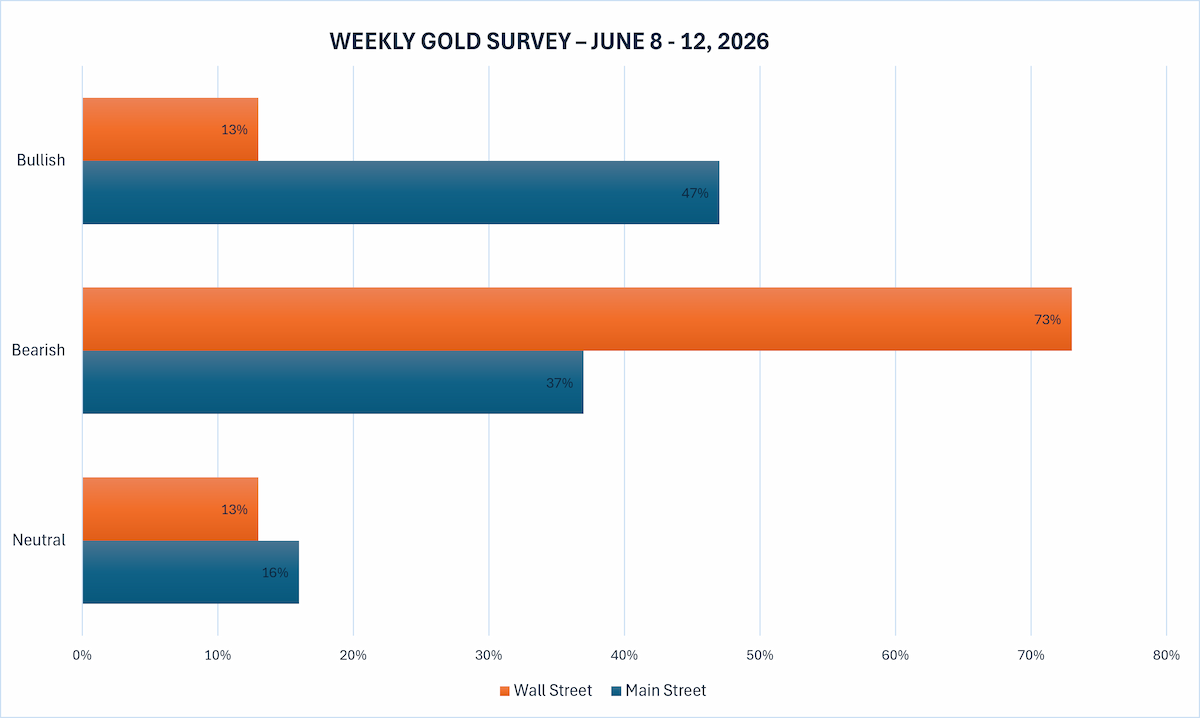
Image Source: Kitco News
Despite the glaring bearishness on trading desks, independent analysts urge caution before declaring the definitive death of the gold bull market. What the market is currently experiencing may not be the birth of a long-term bear market, but rather a fierce tug-of-war between two distinct financial forces.
On one side stands short-term speculative capital. In May alone, global gold Exchange-Traded Funds (ETFs) witnessed capital outflows of approximately $2 billion. Investors have actively taken profits on their gold positions, reallocating those funds into higher-yielding US government bonds and ultra-short term paper to capture reliable yields.
On the other side stands long-term strategic demand from sovereign nations. While speculative capital flees, global central banks are quietly continuing their accumulation strategy. Following a brief pause in March, central banks returned to net purchasing in April, adding 17 tonnes to international reserves.
Faced with a weaponised global financial system and ballooning Western debt, sovereign institutions are systematically replacing US Treasury bonds with gold as a primary reserve asset. This institutional floor means that while a short-term correction is actively underway, the fundamental macroeconomic narrative supporting gold remains intact.
A critical factor compounding the current price weakness is a lack of liquidity and open interest in precious metals futures.
Market commentators note that during the height of gold's multi-year rally, central banks were driving the momentum. However, as prices stretched to historic highs above $4,500, those institutional buyers paused, waiting for better value.
Without central banks chasing the highs, the market stalled. Open interest—the total number of outstanding futures contracts—has eroded significantly. The active August futures contract stands at a relatively thin 263,000 contracts.
Because the market is thin on both sides, the recent sell-off may not represent a panicked mass liquidation by long-term holders. Instead, it is likely driven by speculative short-selling from computer algorithms exploiting a vacuum of buyers. The market is effectively searching for a price floor that will entice central banks and major institutional players back into the game.
With employment figures successfully shifting market expectations away from near-term monetary easing, investors are turning their undivided attention to upcoming inflation metrics to judge the future path of interest rates.
The economic calendar for the upcoming week is packed with high-stakes events that could trigger further volatility across commodities and currencies. Traders will be dissecting the following key releases:
If these inflation metrics come in hotter than expected, any lingering hopes for a Federal Reserve rate cut this year will be firmly off the table. In such a scenario, cash yields will remain highly attractive, maintaining heavy pressure on gold. Conversely, a surprise cooling in inflation could provide the exact spark needed for gold to reclaim its 200-day moving average and stage a swift recovery.
For a deeper dive into the original data, market surveys, and expert technical breakdowns, read the full report on Kitco News:
Disclaimer: This article is provided for informational purposes only, mistakes may be made, and it's not offered or intended to be used as legal, tax, investment, financial, or any other advice.