x




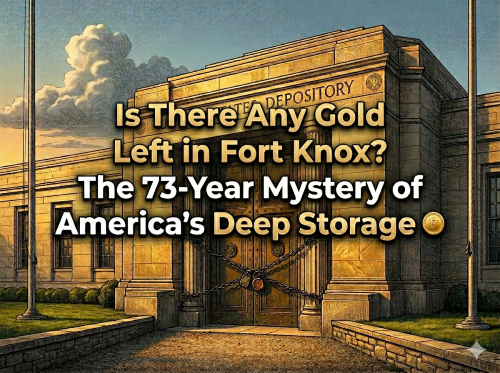
The United States official bullion depository at Fort Knox is supposed to hold the largest gold reserve on Earth. Specifically, it is the custodian of 147.3 million troy ounces of gold, which accounts for roughly 56% of all American sovereign gold. In today’s market, that equates to an astonishing valuation of over $660 billion.
Yet, behind the heavily fortified doors lies an unsettling truth that continues to fuel intense global debate: nobody has properly counted or independently verified the gold inside Fort Knox for over seven decades.
The last truly comprehensive, independent physical examination of the US gold reserves took place during the Eisenhower administration. Since then, over a dozen presidential administrations across both major political parties have effectively blocked, delayed, or diluted every serious attempt to open the vaults for a transparent forensic audit.
When modern officials reassure the public that the gold is safe and sound, they are referring to a very specific institutional process. Under the Treasury Department’s continuing audit program, the Office of the Inspector General and independent accounting firms conduct annual checks. However, these checks do not involve opening the vaults, weighing the massive bars, or performing chemical assays to test the metal's purity.
Instead, the process consists of verifying that the tamper-evident seals on the vault doors remain unbroken. In plain terms, the government is auditing the stickers on the doors rather than the physical gold sitting behind them.
The mystery deepens when examining historical archives. Financial transparency advocates have highlighted that multiple audit reports from the late twentieth century are entirely missing from the National Archives and Treasury records. Furthermore, historical data indicates that during the 1980s, several vault compartments that had been sealed decades prior were inexplicably opened and resealed without any public explanation or new physical audits being conducted.
Occasional political visits are often staged to quieten public speculation, but they rarely amount to rigorous accounting. High-profile photo opportunities featuring government officials standing inside the depository offer visual reassurance, but they lack the methodology of a formal forensic inventory.
The debate surrounding Fort Knox resurfaced with renewed intensity when political figures called for a comprehensive audit, even suggesting a live-streamed walkthrough of the facility to guarantee complete transparency.
This momentum culminated in the introduction of the Gold Reserve Transparency Act in the US House of Representatives. The bill aimed to mandate the Comptroller General to execute a full physical assay and inventory of all American gold within nine months of enactment, repeating the process every five years. Crucially, the legislation also required the public disclosure of every single US gold transaction, lease, swap, and loan spanning the past fifty years.
Despite the initial public momentum, the bill stalled within the House Financial Services Committee. The political landscape shifted further when the primary congressional author of the transparency legislation was defeated in a highly contested and expensive primary election, leaving the future of formal gold accounting deeply uncertain.
The question of whether the gold physically exists in Fort Knox is not merely an academic concern or a topic for internet conspiracy theories; it has massive implications for the global monetary system.
The Book Value Gap
The US government continues to record its sovereign gold on its official balance sheet at a statutory price of $42.22 per troy ounce—a fixed rate set by Congress in 1973 that has never been updated. At this historical book value, the Fort Knox reserves are valued at just over $6 billion. The staggering disparity between this artificial book price and the actual free-market spot price represents hundreds of billions of dollars in unbacked accounting value.
Financial Rehypothecation
Within the intricate machinery of the international bullion banking system, central banks frequently lease their physical gold to commercial banks. These institutions can sell the metal, reinvest the proceeds, or use the gold as financial collateral. When collateral is rehypothecated, multiple global parties can end up holding legal claims to the exact same physical bar of gold. This creates a critical distinction that every modern investor must understand: there is a profound difference between physically owning gold and merely holding a paper claim to it. The stalled transparency legislation specifically targeted these leasing agreements, suggesting that lawmakers consider the systemic risks of gold rehypothecated claims to be a very real hazard.
While Washington resists a formal count, foreign central banks are taking no chances. For over a decade, a clear trend of gold repatriation has swept across international finance as monetary authorities vote with their feet.
Sovereign nations are increasingly removing their physical bullion from US custody, specifically from the vaults of the New York Federal Reserve, and flying it back to their own soil.
The global shift is undeniable. In recent years, the percentage of international central banks that choose to store their gold reserves primarily onshore has risen dramatically. The New York Federal Reserve vault, which looked after over 12,000 metric tons of foreign-owned gold at its twentieth-century peak, has seen its holdings drop by nearly half.
The institutional defence against a modern Fort Knox audit relies on practical arguments: a full forensic audit would take tens of thousands of man-hours, the facility is an active military installation with strict security protocols, and the current seal-verification program is legally sufficient.
However, critics argue that an economic superpower capable of managing multi-trillion-dollar fiscal policies and advanced space exploration certainly possesses the operational capacity to weigh and test its own metal reserves.
Ultimately, after more than seventy years of secrecy, missing records, and an international financial community that is systematically reclaiming its physical assets, the burden of proof increasingly rests with the institutions holding the keys. Until a transparent, independent physical audit takes place, the true contents of Fort Knox will remain one of the world's greatest financial mysteries.
Coin Bureau - Is There Any GOLD Left in Fort Knox (You’ll Never Know)
"For 73 years, nobody has properly counted the gold at Fort Knox and no US President has allowed a full audit since Eisenhower in 1953. Today, we're digging into why every serious attempt to open the vaults has been stalled, delayed, or reduced to a political show, while the official 'audits' only check door seals, not the gold behind them.
We'll break down the timeline of failed audits, vanished records, and why key political figures and bills to force a real count keep getting sidelined, right as other countries are rushing to pull their gold out of US custody. If you've ever wondered what the US government is hiding, and why nations worldwide are demanding physical gold rather than promises, this story matters.
Watch now to find out what's really at stake inside Fort Knox."
~ TIMESTAMPS ~
0:00 - Fort Knox Gold Audit Mystery Explained
1:41 - Last Real Fort Knox Audit Since 1953
3:22 - Missing Treasury Records And Reopened Vaults
5:03 - Trump’s 2025 Fort Knox Audit Demand
6:43 - Gold Reserve Transparency Act Explained
8:24 - Why The Government Resists A Full Fort Knox Audit
10:05 - US Gold Value: Book Price vs Market Price
11:46 - Central Banks Repatriating Gold From The US
13:27 - Gold Leasing, Swaps And Rehypothecation Risk
15:08 - Is Fort Knox Hiding A Bigger Gold Problem?
👉 Source: https://www.youtube.com/watch?v=T29HQtIvCfI
Disclaimer: This article is provided for informational purposes only, mistakes may be made, and it's not offered or intended to be used as legal, tax, investment, financial, or any other advice.