x




Ever stood at a jewellery counter or browsed online precious metal shops and found yourself scratching your head over "karat" and "carat"? You are certainly not alone. They sound identical, look almost interchangeable on paper, and both pop up when you are shopping for fine rings, necklaces, or coins.
Whether you are buying a glittering engagement ring or investing in physical gold, understanding the distinction between these two terms will save you from a confusing and potentially costly mix-up. Here is everything you need to know about Karat vs Carat in precious metals and gemstones.
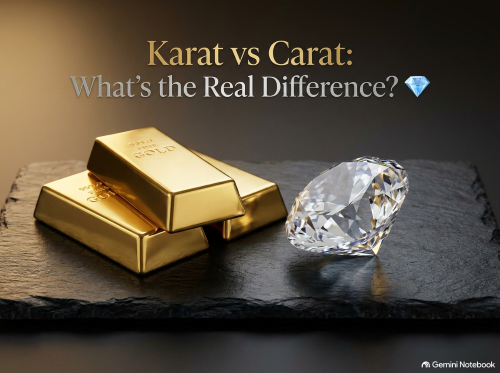
At its simplest, the difference comes down to what you are measuring: gold purity versus gemstone weight.
Karat (abbreviated as K or kt) measures the proportion of pure gold in a piece of metal, calculated on a 24-part scale. Pure gold is rated 24 Karats.
Carat (abbreviated as ct) measures the physical weight of diamonds and other precious stones, where one metric carat equals exactly 0.2 grammes (200 milligrammes).
If you want to dive deeper into how these metrics function in the precious metals market, check out this detailed guide on Karat vs Carat.
Part of the linguistic puzzle lies in geography. In American English, the spelling is strictly divided: "karat" is reserved for gold purity, whilst "carat" is used for gem weight.
In the UK, Australia, and across much of the Commonwealth, "carat" is traditionally used for both gold fineness (such as 18ct gold) and gemstone weight (such as a 1ct diamond).
As highlighted in Merriam-Webster’s analysis of carat vs karat, using "carat" to indicate gold fineness actually dates back to the 16th century in Britain. So, if a British jeweller tells you a ring is made of 18 carat gold set with a 1 carat diamond, they are using the exact same word for two entirely separate measurements!
Pure gold is naturally soft, malleable, and prone to bending or scratching. Because 24-karat gold is 100% pure (or 99.9%+ in practice), it is ideal for investment bars and bullion coins, but far too delicate for daily jewellery wear.
To make gold durable enough for everyday items like engagement rings and watches, jewellers alloy pure gold with stronger metals such as copper, silver, zinc, or palladium. The karat rating tells you how much pure gold is in the blend out of 24 parts:
You will often see millesimal fineness numbers stamped on hallmarked gold alongside karats. For instance, "750" means 750 parts per thousand (75%), which corresponds directly to 18ct gold.
When dealing with diamonds, rubies, or sapphires, carat is strictly a measurement of weight, not size or purity.
One metric carat equals 0.2 grammes—roughly the weight of a standard paperclip. Each carat is divided into 100 "points", allowing jewellers to measure smaller gems precisely. For example, a 50-point diamond weighs half a carat (0.50ct).
It is important to remember that carat weight does not always equal visual size:
For a quick visual walkthrough on how these factors affect value, you can watch this jewellery buying guide video on Karat vs Carat.
Karat vs Carat Explained! 💎 Gold Purity vs Diamond Weight | Jewellery Buying Guide
"Karat vs. Carat – what’s the difference? 🤔
These two words sound the same, but they mean completely different things in the world of jewellery! In this video, we break it all down in an easy, fun, and informative way:"
Where did these strange terms come from in the first place? Both words trace their roots back to the humble carob tree seed—known as keration in Greek and qīrāṭ in Arabic. Ancient Mediterranean traders used carob seeds as convenient counterweights on balance scales because they were small, plentiful, and relatively uniform in weight.
The 24-part gold purity scale links back to ancient Rome. Emperor Constantine introduced a pure gold coin called the solidus, which weighed 24 carob seeds (siliquae). From then on, a gold item’s fineness was judged by how many twenty-fourths of pure gold it contained.
Gemstone weights followed their own path until 1907, when the metric carat was officially standardised at 200 milligrammes, establishing a reliable global baseline for gem trading.
Next time you pop into a jeweller's shop or browse gold bullion online, you can shop with complete confidence. Just remember: Karat (or ct for metal fineness) measures how pure your gold is, while Carat measures how much your gemstone weighs!
Disclaimer: This article is provided for informational purposes only, mistakes may be made, and it's not offered or intended to be used as legal, tax, investment, financial, or any other advice.