x




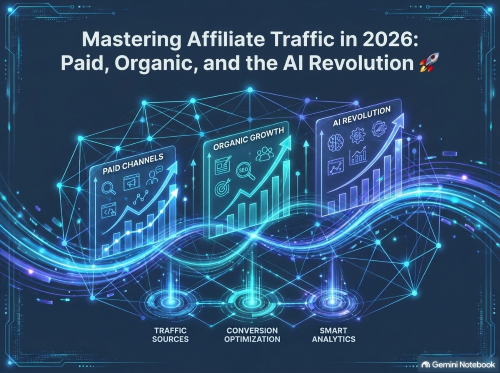
Choosing the right traffic source is the single most critical decision an affiliate marketer or digital entrepreneur makes. Every campaign begins with a fundamental question: what specific audience does your offer actually require, and how do you capture their attention effectively?
In the modern digital landscape, the options appear endless. Search engines, social networks, email newsletters, and programmatic ad channels all promise a steady stream of prospective buyers. Yet, many marketers struggle not from a lack of options, but from a failure to understand how different traffic channels behave under the surface. A flood of website visitors means very little if those clicks fail to translate into qualified leads and meaningful revenue.
To build a resilient, scalable online business, you must look beyond raw traffic volume. True marketing mastery requires a clear understanding of paid versus organic acquisition, a rigorous framework for evaluating channel performance, and an adaptable strategy that leverages cutting-edge technology.
At a fundamental level, paid and organic traffic differ in how distribution is acquired, managed, and scaled. Neither model is inherently superior; rather, they serve distinct strategic purposes within your overall marketing mix.
Paid Traffic: Velocity, Control, and Immediate Feedback
Paid traffic relies on direct financial spend to buy placement and reach a targeted audience. Whether you are running Google Ads, paid social campaigns, or native placements, paid channels offer immediate feedback. Within hours of launching a campaign, you can gather real-time data regarding click-through rates, landing page engagements, and initial conversion metrics.
The primary advantage of paid traffic lies in control. You maintain direct authority over your daily budget, geographic targeting, demographic parameters, and ad creatives. If a campaign is performing well, scaling can often be achieved by increasing your ad spend or broadening target parameters. However, this control comes at a continuous financial cost. The moment you pause your ad budget, your traffic stream stops entirely.
Organic Traffic: Compounding Reach and Long-Term Equity
Organic traffic is earned through search engine visibility, social media discovery, video content recommendations, and subscriber relationships. Growth on organic channels takes time, patience, and persistent effort. You cannot simply turn on a tap and expect instant volume.
However, organic distribution possesses a powerful compounding effect. A high-quality blog article or an engaging YouTube video published today can continue to attract, educate, and convert visitors months or even years down the line without requiring additional media spend for every click.
It is vital to dispel the common industry myth of "free traffic". Organic distribution does not carry a direct cost per click, but it is far from free. High-ranking content demands substantial investment in market research, copy editing, search engine optimisation, graphic design, video production, and ongoing maintenance. When comparing paid and organic strategies, smart marketers compare the total cost required to produce a qualified result over time, rather than falling for the illusion of cost-free visits.
Not all organic traffic behaves the same way. Understanding user intent at the moment of discovery dictates how you should structure your content and evaluate success.
Search Engine Optimisation and Content Marketing
Search traffic captures existing demand. When someone types a query into a search engine, they are actively looking for a solution, a comparison, or an answer. However, search intent varies dramatically across the buyer's journey.
An informational query such as "how to improve email deliverability" attracts users in the early research phase. Conversely, a high-intent query such as "best autoresponder software comparison" attracts visitors who are close to making a purchase decision. While an informational article might generate thousands of visits, a focused comparison page with a fraction of the traffic will frequently produce significantly higher conversion rates and far more affiliate commissions.
YouTube and Video Media
YouTube operates as a hybrid between a search engine and a discovery platform. Video content allows entrepreneurs to demonstrate complex products, explain nuanced concepts, and build authentic visual trust before encouraging a viewer to click an external link. A well-crafted video demonstration often bridges the gap between passive curiosity and active purchasing better than text alone.
Social Media and Subscriber Email Networks
Organic social media relies heavily on algorithmic discovery. Content must capture attention quickly within crowded feeds. Here, metrics like reach and impressions reveal how widely your message is distributed, but outbound click-through rates determine actual marketing value.
Email marketing, by contrast, engages a warm, owned audience. Subscribers have already expressed trust by joining your list. While social channels attract cold prospects, email excels at converting warm leads through continuous value and tailored follow-up sequences.
When running paid acquisition, media metrics like Cost Per Click (CPC) and Click-Through Rate (CTR) tell only half the story. The true test of a paid campaign lies in downstream qualification.
Paid Search vs Paid Social
Paid search platforms like Google Ads target users with active search intent, making them exceptionally effective for high-value affiliate offers. However, choosing campaigns based solely on the cheapest CPC is a frequent mistake. A low CPC campaign often brings lower-quality visitors who fail to convert, resulting in a higher ultimate Cost Per Qualified Action. Paying a premium CPC for high-intent traffic almost always yields superior return on investment.
Paid social media interrupts users while they browse. Success depends heavily on creative resonance and precise audience alignment. A high ad CTR simply indicates that your visual or headline caught attention; it does not guarantee that those visitors will take meaningful action once they land on your page.
Native and Display Placements
Native advertising blends sponsored content into editorial websites, often using pre-sell articles to bridge the gap between curiosity and an affiliate offer. When testing native ads, measuring the drop-off at every stage of the funnel is critical. If readers click your ad but drop off before reaching the primary offer, the friction lies within your bridge content, not necessarily the traffic channel itself.
To build a sustainable digital business, you must evaluate traffic through a clear analytical lens.
Measuring What Matters Most
Relying exclusively on surface-level metrics like raw visits or basic conversion rates leads to flawed decisions. A comprehensive evaluation framework tracks four vital indicators:
A traffic source delivering half the volume of a competing channel can actually be twice as profitable if its qualification rate is significantly higher.
Methodical Testing and Channel Diversification
When testing a new traffic source, hold your landing pages, offers, and qualification criteria constant. Isolating variables ensures that you are measuring the traffic channel's true performance rather than environmental changes. Furthermore, gather a statistically meaningful sample before deciding to scale or kill a campaign.
Relying entirely on a single traffic channel creates severe concentration risk. Search algorithms change, ad costs fluctuate, and platform policies shift without warning. Diversifying across multiple measured channels protects your business from sudden traffic collapses.
Avoid common analytical traps such as treating organic production costs as zero, evaluating campaigns solely on raw visit counts, or blending warm email subscribers with cold paid traffic in the same performance benchmark.
The speed of development across the artificial intelligence sector is fundamentally transforming how digital marketing operates. What used to require dedicated teams of copywriters, graphic designers, data analysts, and media buyers can now be orchestrated with unprecedented speed.
For independent entrepreneurs, affiliate marketers, and small business owners, the modern digital landscape presents an overwhelming challenge: managing a fragmented stack of disconnected tools. Subscribing to separate platforms for email marketing, page building, content creation, graphic design, and social media scheduling creates immense operational friction, soaring monthly costs, and fragmented workflow routines.
As AI technology accelerates, the future belongs to integrated ecosystems that unify these capabilities into a seamless, intelligent workflow.
This is precisely where Markethive is redefining the future of inbound marketing and social networking. Operating on a decentralised blockchain infrastructure, Markethive is a comprehensive market network designed specifically for entrepreneurs, affiliate marketers, and business professionals.
Unlike traditional platforms that sell your data and force you to stitch together multiple external services, Markethive combines a robust social network with an enterprise-grade inbound marketing suite under a single login. Powered by its native cryptocurrency, Hivecoin, the platform rewards active engagement while giving marketers total sovereignty over their digital assets.
Markethive has embedded advanced AI capabilities directly into its core infrastructure to handle the heavy lifting of modern digital promotion:
By unifying content creation, automated blogging, email marketing, media generation, and lead capture within a decentralised, blockchain-secured ecosystem, Markethive removes technical barriers and levels the playing field. Entrepreneurs and affiliate marketers can finally amplify their message, drive targeted visitors to their products and services, and scale their online businesses with unprecedented efficiency.
Disclaimer: This article is provided for informational purposes only, mistakes may be made, and it's not offered or intended to be used as legal, tax, investment, financial, or any other advice.