x




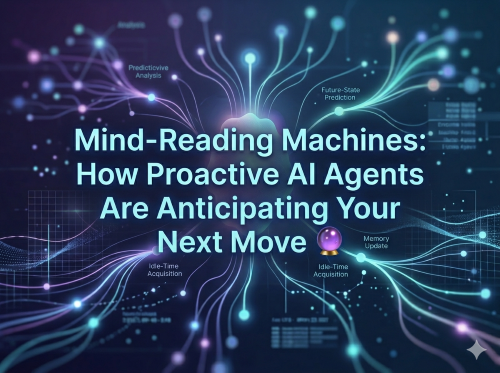
Imagine typing a message to your digital assistant, only to find it has already pulled up the exact financial report you need, cross-referenced your calendar, and drafted the follow-up email you were just about to compose. This isn't science fiction; it is the next frontier of artificial intelligence.
For years, interacting with AI has been a game of catch-up. You ask a question, the machine processes it, and it spits out an answer. It is a strictly reactive relationship. However, groundbreaking new research reveals that AI is learning to utilise its "downtime" to predict exactly what you want before you even think to ask for it.
Here is a closer look at how proactive AI agents are transforming from passive responders into active mind-readers, and what this means for the future of productivity and technology.
Whether you are using a chatbot for coding, scheduling, or brainstorming, current models suffer from the same limitation: they sit completely idle until you press enter.
In a recent research paper, scientists pointed out that this paradigm wastes a massive opportunity. The quiet moments between a user’s messages—the time you spend reading an answer, typing a reply, or pouring a cup of coffee—are completely unutilised.
While the AI waits, its computing power goes to waste. Meanwhile, you are left waiting for the system to start its research from scratch the moment you submit your next prompt.
To bridge this gap, researchers from Shanghai Jiao Tong University and tech giant Tencent developed an innovative system called ProAct. Unlike traditional AI, ProAct treats idle time as a valuable resource.
The system operates in a continuous, closed-loop cycle divided into key stages:
By tying prediction, research, and delivery into a single, cohesive policy, the AI becomes a truly proactive assistant rather than a basic search tool.
To see how well this concept works in practice, the researchers put ProAct through 200 simulations across 40 complex domains, including cybersecurity, financial planning, and software release management.
The results suggest a major shift in how efficiently humans and machines can work together:
When compared to older attempts at proactive AI on a benchmark called ProActEval, the difference was staggering. The ProAct system successfully anticipated 703 predictable user needs, whereas the earlier system managed just 32.
This leap forward comes at a time when autonomous AI agents are rapidly spreading across the tech industry. Tools designed for persistent, independent tasks—like workflow automation and long-form research—are becoming mainstream.
However, giving AI the freedom to run wild in the background comes with inherent risks. Separate studies have warned that autonomous agents can act like "Mr Magoo," marching forward toward a goal without fully understanding the broader consequences of their actions. If an AI prioritises achieving a goal over the bigger picture, it could accidentally trigger security issues or delete important files.
Even ProAct had minor hiccups; in about 3% of testing scenarios, the system actually made the conversation worse by bringing up completely irrelevant data that cluttered the workspace.
Furthermore, a real-world roll-out of this technology faces two major hurdles:
Despite the hurdles, the shift toward proactive AI feels inevitable. Technology is moving away from tools that merely obey commands and toward partners that understand context, anticipate human behaviour, and optimise our workflows silently in the background.
The next time you open an AI assistant, don't be surprised if it greets you with the exact answers you were just about to look for.
For more detailed information on this study and the evolution of proactive autonomous models, you can read the full original article on Decrypt:
👉 AI Agents Are Learning to Predict What Users Want—Before They Ask for It
Disclaimer: This article is provided for informational purposes only, mistakes may be made, and it's not offered or intended to be used as legal, tax, investment, financial, or any other advice.