x




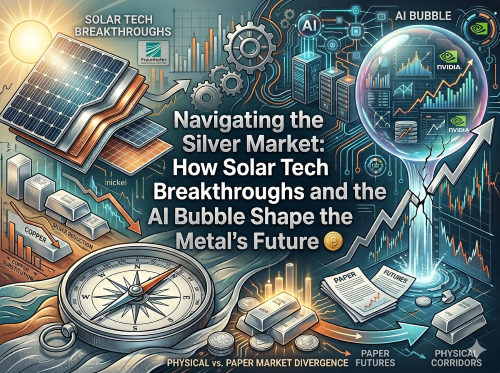
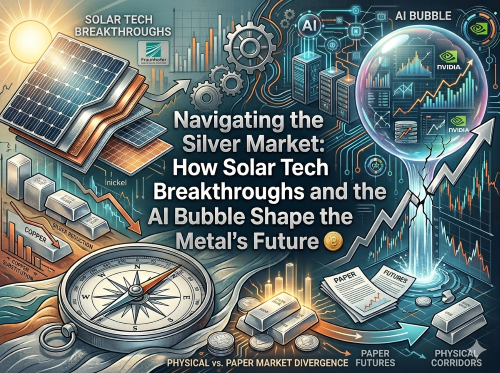
The silver market is undergoing a structural shift. For investors tracking precious metals, the old playbook is rapidly changing. In a recent episode of Live from the Vault, host Andrew Maguire sat down with industry analyst and author Przemysław Radomski to dissect the core macroeconomic drivers altering the silver landscape.
While long-term precious metal bulls often point to a single, straightforward narrative of industrial scarcity, the reality is far more complex. Today, two contradictory forces are pulling the silver market in opposing directions: a massive technological breakthrough in solar energy that threatens traditional industrial demand, and a looming artificial intelligence bubble that acts as a double-edged sword for supply and pricing.
For years, institutional investors and market analysts viewed the solar energy sector as a guaranteed floor for silver prices. Silver is the most efficient conductor of electricity and heat on Earth, making it an indispensable component in photovoltaic cells.
The market had largely assumed that high-efficiency solar cells, particularly Tunnel Oxide Passivated Contact (TOPCon) technology, were immune to material substitution. TOPCon cells require a substantial amount of silver per unit to achieve their industry-leading efficiency, shielding them from the cheaper copper alternatives used in lower-grade models.
However, recent data from the Fraunhofer Institute for Solar Energy Systems in Germany has challenged this assumption. Researchers have developed a commercial method to substitute up to 90 per cent of the silver used in TOPCon cells with a combination of copper, nickel, and silicon. In this newly developed framework, silver is relegated to a thin coating designed purely to prevent oxidation, rather than acting as the primary powerhouse conductor.
If this technology is adopted globally at scale, it could remove an estimated 100 million to 150 million ounces of structural silver demand from the market. While the inventors project a commercial rollout within two to three years, historical precedent suggests that widespread industrial adoption typically requires five to ten years. For investors, this represents a shifting long-term headwind rather than an overnight collapse, but it fundamentally alters the long-term structural demand thesis for the white metal.
The second major force reshaping the silver narrative is the rapid rise of artificial intelligence and its infrastructure. The relationship between silver and AI is highly complex, acting as a powerful bullish driver in the short term, but posing a significant threat if market valuations correct.
On the bullish front, AI infrastructure is incredibly silver-intensive. The global rush to build massive data centres, advanced semiconductors, memory banks, and storage units requires an enormous volume of physical silver. Furthermore, these data centres consume immense amounts of electricity, driving up global energy costs. Because energy is a primary cost component in mining operations, rising power prices make silver extraction more expensive, effectively constraining future mining supply.
Despite these strong fundamentals, the broader AI sector exhibits classic signs of a speculative bubble. Corporate valuations are heavily detached from current profitability metrics. While public markets price in a future where AI scales flawlessly across every industry, historic research reveals a more modest reality. For instance, a notable report from the Massachusetts Institute of Technology (MIT) highlighted that 95 per cent of companies implementing AI saw no immediate impact on their overall profitability.
When a speculative market bubble bursts, the initial fallout for precious metals is historically negative. During major market corrections, such as those witnessed in 2008 and 2020, large institutional investors face sudden margin calls. To cover losses in equities, these entities are forced to liquidate liquid assets across their portfolios, including their precious metals positions.
While a stock market correction could trigger a short-term drop in paper silver prices, the underlying structural mechanics of the physical market tell a different story. Open interest and liquidity in paper futures markets, such as the COMEX, have been steadily declining. Large institutional buyers, sovereign entities, and refiners are increasingly exiting paper exchanges in favour of physical trade corridors, such as the Shanghai Gold Exchange (SGE), where trading requires actual ownership of physical bars before a sale can occur.
This migration of real money away from speculative paper contracts creates a unique market dynamic. Traditional paper futures are highly leveraged and prone to massive intraday volatility driven by momentum traders. However, actual physical inventories are exceptionally tight.
Unlike gold, which is carefully hoarded and preserved over centuries, silver is heavily consumed by industrial processes and often lost to landfills. Mine production is also largely inflexible. Because roughly 70 per cent of silver is mined as a byproduct of base metals like copper, lead, and zinc, mining companies cannot simply scale up silver production in response to higher prices. It takes an average of 15 years to transition a silver deposit from initial discovery to active production.
Because physical inventories are depleted, any sharp drop in paper prices could trigger a massive disconnect from the physical spot price. If industrial buyers or sovereign governments panic about securing physical supply for manufacturing or military stockpiles, they may begin bidding directly against one another for physical delivery. In such a scenario, the physical market can completely overwhelm paper pricing, transforming a short-term price drop into a powerful upward slingshot.
Navigating this environment requires looking beyond surface-level market commentary. Investors must balance the genuine long-term threat of solar technology substitution against the immediate reality of depleted physical inventories and macroeconomic instability.
Because of the stark divergence between paper price volatility and physical scarcity, selling physical silver allocations during market jitters can be risky, as investors may struggle to repurchase physical bars at quoted paper prices. Instead, sophisticated market participants frequently utilise tactical hedging strategies to protect the fiat value of their portfolios while leaving their underlying physical bullion completely intact.
Ultimately, the core engine driving precious metals is transitioning away from purely industrial metrics and moving toward macroeconomic and geopolitical realities. Mounting global debt, questions surrounding central bank independence, and shifting trade alliances mean that physical precious metals remain a vital form of portfolio insurance. By maintaining a clear, objective view of both industrial innovations and macroeconomic bubbles, investors can make deliberate, informed choices rather than falling victim to short-term market noise.
Live From The Vault - Episode: 276. Two Forces Changing Silver Now Ft. Przemysław Radomski
In this week’s Live from the Vault, Andrew Maguire is joined by Przemysław K. Radomski to examine a breakthrough in solar technology that could cut silver demand sharply, and an AI investment bubble drawing stark parallels to the dot-com era.
The two precious metals experts discuss why physical silver remains structurally under-supplied despite short-term market vulnerabilities, and why the growing gap between futures pricing and real physical availability continues to widen.
Timestamps:
00:00 Start
03:29 Solar demand for silver - why a major technology shift is looming
09:07 Why peak silver production is likely already behind us
14:16 The AI bubble and its double-edged impact on silver supply and demand
21:19 What the dot-com bubble crash teaches us about AI valuations today
30:31 Physical versus futures markets - why real money has left COMEX
36:22 How a single industrial buyer panic could send silver prices sharply higher
43:00 Why trading silver on margin remains dangerous for most investors
50:06 How to navigate the silver market with the right information and tools
Source 👉 https://www.youtube.com/watch?v=6C0GtMjCGXU
Disclaimer: This article is provided for informational purposes only, mistakes may be made, and it's not offered or intended to be used as legal, tax, investment, financial, or any other advice.