x




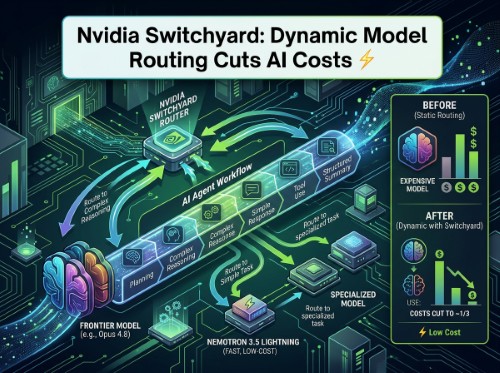
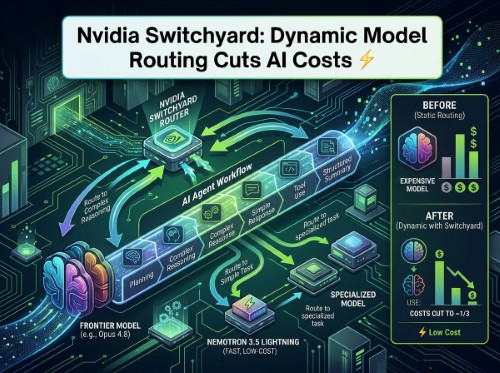
Deploying always-on enterprise artificial intelligence agents presents an exhausting balancing act for technology leaders. Relying exclusively on flagship frontier models guarantees high reasoning quality, but it quickly yields eye-watering API bills. Conversely, hardcoding static rules to send simple routines to smaller models creates fragile software infrastructure that requires constant maintenance whenever workflow steps evolve.
Nvidia’s latest release targets both sides of this equation simultaneously. By introducing Nemotron 3.5 Lightning alongside NeMo Switchyard, Nvidia offers a unified, open-source stack designed to dynamically reshuffle model allocations mid-task, delivering high-level task execution at roughly a third of traditional operating costs.
Traditional AI model routers operate statically, assigning an incoming prompt to a model based purely on initial classification. However, agentic tasks are rarely uniform from start to finish. A single agent interaction might begin with complex planning, transition into mundane code formatting, encounter a simple tool execution, and conclude with structured summaries.
NeMo Switchyard redefines this process by operating dynamically at every step of an agent's state transition. Rather than locking an agent into one backend engine throughout its task lifecycle, Switchyard evaluates live signals—such as tool responses, error flags, and sub-task complexity—to swap backend models on the fly.
Crucially, cost considerations are built into the decision engine. Switchyard assesses model verbosity and token generation predictions prior to making API calls, steering predictable or routine steps toward leaner engines before costs stack up.
While Switchyard provides the orchestration logic, Nemotron 3.5 Lightning acts as the dedicated, high-volume workhorse. Positioned as a 30-billion-parameter open mixture-of-experts (MoE) model, Lightning extends Nvidia's hybrid Mamba-Transformer architecture.
Lightning is intentionally not positioned as a general-intelligence leader. Instead, it is crafted specifically for speed, specialised agent sub-tasks, and budget efficiency:
To avoid creating another isolated tool developers must manually maintain, Nvidia has integrated Switchyard directly into established gateway architectures and agent frameworks. Developers using frameworks like LangChain, Cognition, and Nous Research, or AI gateways such as Kong AI Gateway, LiteLLM, and OpenRouter, can adopt Switchyard routing algorithms directly within their existing environments.
Early benchmark testing across corporate partners highlights significant cost reductions:
The launch comes amid a shift in the open-weights AI landscape. With model quality across global labs converging, competitive advantage is shifting from relying on a single mega-model to deploying an intelligent system of models.
By offering both the lightweight model layer and the orchestration routing engine under an open-source framework, Nvidia provides a streamlined path for enterprises seeking to scale AI agents sustainably. As agentic workflows become standard across software operations, adaptive multi-model routing is rapidly moving from an experimental optimisation strategy to a fundamental requirement.
Disclaimer: This article is provided for informational purposes only, mistakes may be made, and it's not offered or intended to be used as legal, tax, investment, financial, or any other advice.