x




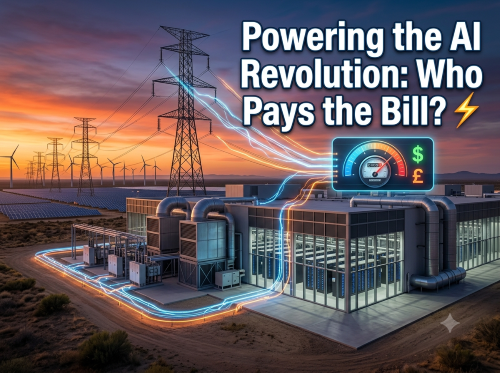
Behind every seamless conversation with an artificial intelligence chatbot, every generated image, and every automated analytical breakthrough lies a physical infrastructure of astounding proportions. Hyperscale data centres housing hundreds of thousands of high-performance graphics processing units (GPUs) are humming around the clock. However, this artificial intelligence boom comes with a staggering tangible cost: an insatiable appetite for electrical power.
As utility operators struggle to keep pace with the exponential growth of tech giants, a critical political and economic battleground has emerged over who should foot the bill for upgrading regional energy infrastructure.
Unlike traditional web browsing or basic cloud storage, training and running modern generative artificial intelligence models requires massive computational power. Processing complex queries and running deep learning algorithms demands significantly more electricity per interaction than a conventional search engine query. Multiply this by hundreds of millions of daily queries globally, and the result is an unprecedented surge in demand for raw electricity.
In major technology hubs, data centres are swallowing up an increasingly dominant share of total power grid capacity. Local energy providers face immense pressure to deliver gigawatts of continuous base-load electricity. This sudden shift has raised valid fears that existing power grids, already under strain from broader electrification efforts, could face severe destabilisation unless substantial investments are made swiftly—prompting severe measures in some regions, such as data centre approvals being paused pending grid audits.
The central point of friction between technology companies, utility providers, and government officials revolves around economic fairness. As highlighted in recent Associated Press reporting on rising electricity costs, communities are increasingly questioning who will pay for the massive network upgrades required to support hyperscale facilities.
Historically, when power companies build new sub-stations, high-voltage transmission lines, or generation facilities to expand grid capacity, those capital expenditure costs are distributed across all consumers on the network. Under these traditional models, everyday households and small local businesses risk subsidising the massive energy expansion required by technology conglomerates through higher monthly electricity bills. As consumer living costs remain a sensitive issue, political leaders and energy regulators are stepping in to prevent domestic ratepayers from bearing the financial burden of Big Tech's rapid infrastructure drive.
In response to public concern and regulatory scrutiny, landmark voluntary pledges and legislative frameworks are beginning to take shape. Following recent coverage on voluntary pledges to shield consumers from AI energy costs, energy providers and political leaders are crafting binding agreements designed to keep domestic bills stable.
Under these emerging frameworks, technology companies are being encouraged and required to take direct responsibility for their power footprints. Key strategies include:
Direct Funding for Infrastructure Upgrades: Requiring data centre developers to pay upfront for dedicated sub-stations, specialised transmission lines, and grid connection costs rather than passing them on to the public grid network.
Dedicated Clean Energy Procurement: Encouraging tech firms to build or contract their own off-grid power sources, such as dedicated solar, wind, battery storage, or nuclear projects, to ensure their operations do not cannibalise local residential power supplies.
Demand-Response Agreements: Contracting data centre operators to temporarily throttle non-essential computational workloads during periods of extreme grid stress or peak demand, helping to prevent blackouts in nearby residential neighbourhoods.
These pledges mark a pivotal shift towards responsible technological development, ensuring that digital progress does not come at the direct expense of energy affordability for local communities.
Resolving the energy challenges posed by artificial intelligence requires long-term structural solutions alongside short-term policy agreements. Beyond regulatory pledges, the technology sector is increasingly investing in next-generation zero-emission energy sources, including Small Modular Reactors (SMRs) and deep geothermal energy, to provide reliable, round-the-clock power without reliance on fossil fuels.
Simultaneously, computer scientists and hardware engineers are focusing on creating more energy-efficient microchips, optimised software architectures, and advanced liquid cooling technologies. By reducing the physical wattage required per computation, the industry aims to decouple technological capability from unsustainable power consumption.
The artificial intelligence revolution holds immense potential to drive innovation across healthcare, scientific research, and industry. However, its expansion must not compromise fundamental public utilities or impose unfair financial burdens on ordinary consumers. By holding technology companies accountable for their power demands and establishing robust infrastructure pledges, energy leaders and policymakers are taking essential steps towards a more equitable and sustainable digital future.
Disclaimer: This article is provided for informational purposes only, mistakes may be made, and it's not offered or intended to be used as legal, tax, investment, financial, or any other advice.