x




Gold’s recent volatility reflects a clash of short-term macroeconomic forces rather than any fundamental change in its long-term role, with rising energy prices and inflation fears pushing expectations of higher interest rates and increasing the opportunity cost of holding a non-yielding asset. While geopolitical uncertainty continues to support gold, its behaviour has shifted somewhat, showing more sensitivity to market liquidity and profit-taking as it increasingly acts like a financial asset, with price movements broadly mirroring global equities rather than operating independently.
At the same time, emerging signs of a stagflationary environment, marked by slowing growth and persistent inflation, are reinforcing the importance of diversification, where real assets like gold can play a stabilising role. Although other commodities such as energy and industrial metals may offer more direct exposure to growth and inflation trends, gold still serves as a defensive anchor within portfolios, particularly in periods of heightened uncertainty, with longer-term demand for commodities also supported by structural trends like artificial intelligence and the green energy transition. Source
Federal Reserve officials expressed growing uncertainty about the economic impact of the Iran conflict, with the balance of risks now seen as evenly split between higher inflation and weaker growth, making a rate hike just as likely as a cut. Rising energy prices have pushed up inflation expectations and short-term Treasury yields, while equity markets have fallen and volatility has increased, reflecting weaker investor confidence. Despite solid GDP growth and stable unemployment, inflation remains elevated, and financial conditions have become less supportive, prompting a more cautious outlook.
Looking ahead, policymakers expect moderate growth and inflation gradually returning towards 2 percent, but with heightened uncertainty driven by geopolitical tensions, policy changes and technological developments. Officials stressed the need for flexibility, noting that prolonged conflict could either dampen growth and justify rate cuts or sustain inflation and require further tightening. Most members supported holding rates steady for now, although one dissented in favour of a small cut, as the Fed continues to monitor evolving risks and adjust policy accordingly. Source
Copper is expected to emerge as the strongest-performing metal in the current commodity cycle, driven by a widening gap between supply and demand alongside powerful long-term trends such as electrification, green energy expansion and infrastructure investment. While gold has benefited from safe-haven demand and central bank buying, copper’s structural advantages position it for greater upside, with historical comparisons suggesting the potential for a significant price surge as global demand continues to strengthen.
At the same time, supply constraints are becoming more acute, with limited new projects, rising costs and long development timelines restricting output, potentially pushing prices far beyond typical forecasts and as high as $20 to $30 per pound by the end of the decade. Silver is also supported by strong industrial demand, particularly from solar energy, but sits between gold and copper in terms of outlook. Despite short-term volatility and geopolitical disruptions, the broader fundamentals for all three metals remain positive, with mining equities seen as undervalued and likely to benefit from a recovery as market conditions stabilise. Source
Gold’s sharp decline in March, its weakest month in nearly 13 years, was driven primarily by deleveraging and liquidity pressures rather than any fundamental weakness, according to the World Gold Council. Outflows from global ETFs, unwinding of COMEX long positions, CTA selling, and broader cross-asset liquidations combined to create a rapid selloff, while disruptions in the Middle East had little direct impact on global prices. Central bank activity, bond market reactions, and retail positioning also amplified the move, but gold’s underlying demand from geopolitical uncertainty, inflation concerns, and central bank accumulation remained intact.
Looking ahead, early signs suggest a stabilisation of gold’s market, with positive ETF flows, medium-term hedging demand, and renewed retail and wealth management interest supporting prices. However, near-term risks persist, particularly if oil prices remain elevated and further cross-asset deleveraging occurs, meaning gold’s price action is likely to remain sensitive to liquidity dynamics rather than fundamental shifts alone. Source
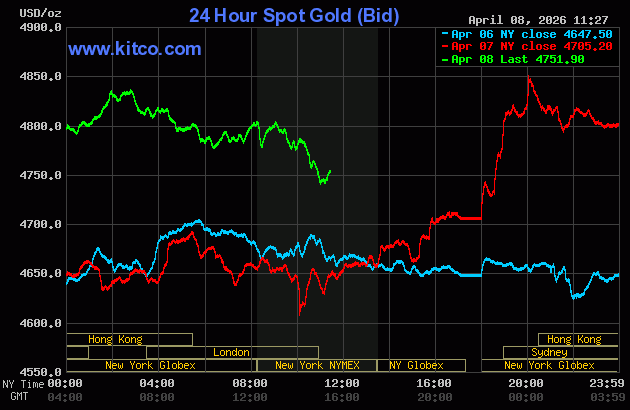
Image Source: Kitco News
Gold and silver prices showed mixed early U.S. trading, with gold slightly higher and silver slightly lower, reflecting conflicting market pressures ahead of a U.S.-imposed deadline for Iran to reopen the Strait of Hormuz. Gold futures were down modestly at $4,673, while silver fell to $72.07. The market is influenced by rising crude oil prices, a slightly stronger U.S. dollar, and benchmark Treasury yields, alongside geopolitical tensions in the Middle East that continue to affect investor sentiment.
China’s central bank has continued to support gold, buying five tons in March, marking 17 consecutive months of accumulation, which reinforces a key pillar of demand even as other central banks, such as Turkey, have sold gold to defend their currencies. Technical levels for gold indicate resistance around $4,750 to $4,825 and support near $4,626 to $4,580, while silver faces resistance at $75 to $76 and support at $70 to $67.70, suggesting both metals remain sensitive to geopolitical developments and market positioning. Source
Central banks continue to expand their gold reserves despite recent volatility, with 72.6% of surveyed institutions investing in the precious metal, up from 69.4% last year. Fifteen central banks are actively buying gold, while three more plan to increase holdings within the next five to ten years. Forecasts from 60 central banks suggest a mean gold price of $5,354 per ounce by the end of 2026. Interest in silver remains limited, with only a handful of banks holding or considering it. The drive toward gold is largely influenced by geopolitical uncertainty, with nearly 70% of central banks citing it as their top economic concern, particularly amid ongoing conflicts in the Middle East.
While the U.S. dollar remains the dominant reserve currency, its role is increasingly questioned, with 16% of respondents neutral and 4% disagreeing on its continued supremacy. Central banks are diversifying portfolios and locations of assets but show minimal interest in cryptocurrencies, with no current investments and only a small fraction considering stablecoins or other digital currencies over the next decade. Inflation and interest rates are expected to be key factors shaping reserve management strategies in the coming years. Source
The Bank of France engineered a profitable manoeuvre by selling 129 tonnes of its U.S.-held gold in New York at peak prices and repurchasing it in Europe, resulting in a tidy $15 billion gain. The move allowed the central bank to turn a previous EUR 2.9 billion loss into an EUR 8.1 billion profit for fiscal year 2025, primarily through realised foreign exchange gains. By selling older, less pure bars in the U.S. and buying bars meeting updated standards in Europe, the bank avoided diplomatic complications, transatlantic transport costs, and security fees, while significantly boosting its net equity to EUR 283.4 billion.
The total volume of France’s gold reserves remained unchanged at roughly 2,437 tonnes, now fully stored at the Banque de France’s underground vault in La Souterraine. The bank emphasised that the decision to keep the gold in Paris was not politically motivated, and the transaction strengthened its financial position while complying with technical guidelines for gold holdings. Source
Gold surged more than 2% to $4,809 an ounce following news of a potential two-week ceasefire between the U.S. and Iran, with markets reacting positively to hopes of a lasting peace deal in the Middle East. The ceasefire announcement also pushed silver above $76 an ounce, while crude oil futures fell sharply and U.S. equity futures rose. Analysts noted that gold breaking through the $4,800 resistance level could attract further bullish attention, with $5,000 per ounce cited as a key benchmark. The rise comes after gold experienced its worst monthly decline in decades due to liquidity needs and rising interest rate expectations driven by inflation fears.
The temporary easing of geopolitical tensions could allow central banks, including the Federal Reserve, to consider rate cuts later in the year, providing further support for precious metals. However, analysts caution that it remains uncertain how much global economic damage has been done by the conflict and higher energy prices, which could influence inflation and growth. Market sentiment now hinges on the durability of the ceasefire, as any re-escalation could reverse gains, pushing oil higher, the dollar stronger, and pressuring metals and other assets. Source
Central banks, particularly those in BRICS+ nations, are rapidly increasing their gold holdings, reflecting a broader structural shift away from the U.S. dollar. BRICS+ countries now hold 17.4% of global gold reserves, up from 11.2% in 2019, with Russia and China together controlling nearly three-quarters of the bloc’s total. Gold purchases by central banks have surged since 2022, reaching over 1,000 tonnes annually, driven by policy decisions to protect reserves from potential seizure and geopolitical risk. Overall, gold now represents more than 23% of official reserve assets, more than doubling since 2015, while the dollar’s share of global reserves has fallen to its lowest level since 1994.
The concentration of sovereign gold demand has created a structural floor for prices, with forecasts for 2026 ranging from $5,400 to $6,300 an ounce, supported by ongoing central bank, institutional, and retail buying. Analysts highlight Saudi Arabia as a potential major buyer whose increased allocation could match projected global central bank demand for 2026, signalling further upward pressure. The trend is reinforced by policy-driven, price-insensitive purchases, with more than 3,000 tonnes moved into sovereign vaults since 2022, indicating that the move from dollar reserves to gold is a durable, long-term phenomenon rather than a speculative bet. Source
Gold is positioned for further gains, potentially surpassing $6,000 per ounce, driven by geopolitical tensions in Iran and rising defence spending in the U.S. and Europe, according to Chris Mancini of Gabelli Funds. Gold’s appeal lies in its liquidity and independence from government liabilities, unlike Treasuries or other sovereign bonds, making it a preferred asset during crises. The recent conflicts and policy actions, including the U.S. freezing Russian Treasuries, have accelerated the de-dollarisation of global reserves, increasing gold’s role as an alternative store of value.
Mancini argues that as countries reconsider lending to the U.S. through foreign exchange surpluses, gold is set to emerge as the primary alternative to the dollar. While the price has experienced short-term volatility, including dips below $4,610 per ounce, the broader medium-term trend remains bullish. The combination of geopolitical risk, global shifts away from the dollar, and the protective, non-liability nature of gold underpins expectations for continued upward pressure on prices. Source
Central bank activity continues to shape the gold market, with China adding 5 tonnes in March, marking its largest monthly purchase since February 2025 and extending a 17-month consecutive buying streak. China’s total gold holdings now reach 2,313 tonnes, reflecting its long-term strategy to bolster the yuan and strengthen its position as a potential global reserve currency. Analysts note that central bank demand is generally price-insensitive, though purchases can be opportunistic during market corrections, such as last month’s 11.5% drop in gold prices.
In contrast, Turkey has been reducing its gold reserves, with a drawdown of over 118 tonnes in March, the largest since 2013. Much of this has been monetised through swap agreements to provide liquidity for lira and foreign currency purchases, helping to stabilise its economy amid the ongoing Iran conflict. The war in the Middle East continues to disrupt global supply chains, particularly in energy, contributing to higher inflation and increasing the economic pressure on countries that rely on central bank gold reserves. Source
Gold and silver spiked following the announcement of a two-week ceasefire between the U.S. and Iran, brokered by Pakistan, with gold reaching $4,855 an ounce and silver nearly $77 before moderating. The initial rally reflected relief over lower oil prices and reduced inflation concerns, which eased pressure on interest rates and supported non-yielding assets like precious metals. Market activity, however, remained cautious as violations of the ceasefire were reported almost immediately, highlighting the fragility of the agreement and uncertainty over its duration.
The short-term surge is driven by expectations that a durable ceasefire could reverse central bank selling pressure, particularly from countries like Turkey, Poland, and Russia, which have monetised gold reserves to stabilise currencies amid the conflict. Analysts noted that the longer-term outlook for gold remains constructive if peace holds, with potential targets near $5,900 per ounce by late 2026, while silver continues to amplify gold’s movements. However, if hostilities resume, rising oil prices and rate-hike pressures could continue to suppress precious metals, making the next several weeks a highly binary scenario for investors. Source
Disclaimer: These articles are provided for informational purposes only. They are not offered or intended to be used as legal, tax, investment, financial, or any other advice.