x




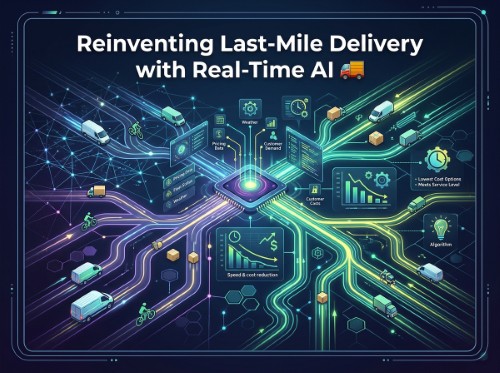
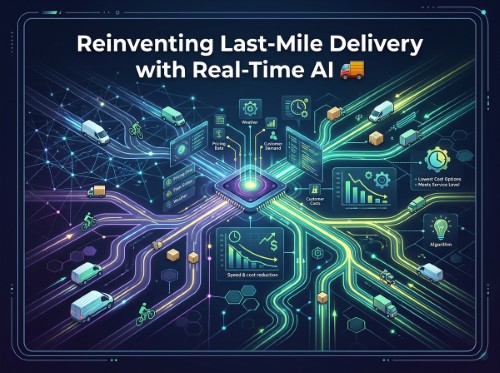
In modern retail, wholesale, and distribution management, last-mile fulfilment remains the most expensive, unpredictable, and friction-heavy phase of the entire supply chain. Striking a balance between tight delivery windows, rising fuel prices, and unpredictable road conditions has historically forced logistics providers into tough trade-offs between profit margins and customer satisfaction. However, a major technological leap is redefining what is possible in real-time supply chain management.
Logistics orchestrator OneRail has introduced its latest innovation, OmniSTAR—an advanced delivery platform leveraging high-performance Nvidia artificial intelligence to optimise last-mile routing and delivery-mode selection dynamically. By shifting from sluggish, static planning methods to GPU-accelerated computing, the platform empowers organisations to make split-second execution decisions that directly protect bottom-line profitability.
For decades, logistics networks have relied on rigid business rules or manual planning tools to determine how orders travel from distribution centres to final destinations. In a live operational environment, this latency creates substantial inefficiency. When calculations take upwards of twenty minutes—or even days for massive enterprise networks—logistics managers are forced to assign orders based on outdated snapshots of traffic, weather, and fleet availability. As industry leaders note, failing to make lightning-fast decisions inevitably leads to sacrificed margins.
OmniSTAR addresses this speed bottleneck by incorporating Nvidia’s accelerated computing stack, specifically the cuOpt decision optimisation engine and the cuDF data processing library. The results are remarkable: computation times have been reduced by up to ten times. Complex routing calculations that previously consumed twenty minutes can now be completed in under two minutes, while massive weekly calculations are compressed down to roughly two days. This drastic reduction in processing time allows logistics platforms to evaluate thousands of candidate routes and fulfilment modes in real time before committing an order to a driver.
The system functions by decoupling predictive forecasting from operational decision-making—a distinction supported by contemporary operational research in dynamic vehicle routing.
First, OneRail's machine learning models analyse vast historical and live datasets to predict crucial execution variables. These include estimated service times, lateness risk, the probability of first-attempt delivery success, and expected carrier price ranges.
Second, these predictive outputs feed directly into the core decision engine powered by Nvidia cuOpt—an open-source, GPU-accelerated mathematical solver designed for complex vehicle routing problems. Rather than exhaustively testing every theoretical combination, cuOpt utilizes GPU-accelerated heuristics to generate and refine high-quality solutions rapidly. It processes critical real-world constraints, including vehicle capacities, driver working hours, starting locations, delivery time windows, and complex cost functions based on distance, time, or direct monetary expenses.
Alongside cuOpt, the platform uses Nvidia cuDF for rapid tabular data processing, handling tasks like dataset filtering, joining, and aggregating at scale. By continuously digesting real-time pricing and performance metrics across OneRail's extensive network—which encompasses over 1,000 logistics partners and 12 million drivers—OmniSTAR can evaluate every order against available transportation modes, ranging from internal fleets to local couriers and national parcel carriers.
A fundamental challenge in last-mile logistics is that conditions on the ground change constantly. Driver call-outs, sudden traffic gridlock, vehicle breakdowns, and urgent high-priority orders regularly disrupt pre-planned routes.
Because Nvidia cuOpt operates as a stateless engine, logistics teams can immediately re-model and submit problem sets whenever conditions shift. OmniSTAR continually re-evaluates delivery scenarios as live variables like fuel costs, weather, and traffic change, ensuring that operations remain fully optimised throughout the working day rather than falling apart when unexpected disruptions occur.
The financial impact of real-time last-mile optimisation is already becoming evident across enterprise deployments:
This technology is also expanding through high-profile industry partnerships, such as FedEx's launch of FedEx SameDay Local in collaboration with OneRail, connecting retail customers to a vast national network of delivery providers.
In an industry where razor-thin margins can easily be wiped out by inefficient routing, lightning-fast decision-making has transformed from a competitive luxury into an operational necessity. By harnessing GPU-accelerated AI to unify predictive analytics and real-time decision optimisation, logistics leaders can finally eliminate last-mile friction, protecting profits while delivering superior service.
Disclaimer: This article is provided for informational purposes only, mistakes may be made, and it's not offered or intended to be used as legal, tax, investment, financial, or any other advice.