x




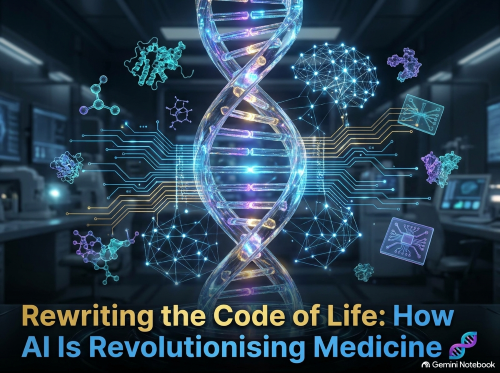
For decades, drug discovery has remained one of humanity’s most arduous scientific endeavours. Bringing a single new medicine from the research bench to a patient's bedside has traditionally taken upwards of 10 to 15 years, cost billions of pounds, and suffered from notoriously high failure rates along the way. Yet, behind the doors of modern laboratories, a quiet revolution is underway.
While much of the public conversation around artificial intelligence focusses on chatbots and generative media, AI's most profound real-world impact is happening in biotechnology and life sciences. By treating biological systems as computational languages, researchers are moving away from brute-force trial and error towards predictive, engineered medicine—fundamentally reshaping how we understand, target, and treat disease.
At the heart of this shift is the ability to model the fundamental building blocks of life. Proteins are the molecular machines that drive almost every biological process, but predicting how they fold and interact with potential drug candidates used to require years of painstaking laboratory work.
Today, frontier AI models specifically trained on complex biological structures can predict molecular interactions in seconds. Pioneer entities such as Isomorphic Labs, an Alphabet spin-off born out of DeepMind’s landmark AlphaFold breakthroughs, are applying these computational design engines to map out target proteins and generate novel therapeutic molecules with astonishing precision.
This structural intelligence is radically compressing early-stage discovery timelines. Phases that once took four to five years—such as target identification, hit generation, and lead optimisation—are now being executed in a matter of months.
Rather than working in isolation, technology leaders and frontier AI developers are forming strategic alliances across the healthcare ecosystem. Collaborative efforts involving AI pioneers like Anthropic, major pharmaceutical titans such as Eli Lilly, and leading healthcare providers are merging high-throughput biological data with frontier foundation models. By screening billions of potential molecular configurations in silicon before synthesising a single compound in a wet lab, researchers are filtering out non-viable candidates before they ever consume clinical resources.
The real promise of AI-driven drug discovery lies not just in speed, but in capability. Traditional drug development has often struggled with intractable biological targets—the so-called "undruggable" proteins involved in aggressive cancers, neurodegenerative conditions, and rare genetic disorders.
By leveraging generative biological design, scientists can now craft custom molecules tailored down to the sub-angstrom level. Instead of searching for a needle in a haystack, AI acts as a precision architect, building molecules designed specifically to dock with complex disease targets.
This approach is altering the trajectory for therapies aimed at hard-to-treat conditions:
Recent industry developments tracked on pharmaphorum’s biopharma AI news watch illustrate how rapidly this ecosystem is moving. From autonomous, AI-powered laboratory systems to multi-billion-pound R&D alliances, biopharma leaders are aggressively embedding algorithmic design into every stage of their therapeutic research programmes.
Transforming a digital prediction into an effective medicine requires a bridge between computational science and deep clinical expertise. No single institution holds all the answers, which is why cross-industry collaboration has become the cornerstone of modern biotech.
Major pharmaceutical organisations are increasingly turning to dedicated AI platforms to reinvigorate their R&D pipelines. As detailed on Isomorphic Labs’ strategic partnerships page, collaborations with global leaders like Novartis, Eli Lilly, and Johnson & Johnson bring together state-of-the-art computational design engines and decades of clinical development experience. These multi-target partnerships focus on unlocking disease pathways that were previously out of reach, tackling small molecules and biologics alike.
This synergy allows biopharma teams to explore vast, previously inaccessible chemical spaces. By combining predictive models with high-throughput experimental feedback, laboratories create a continuous learning loop: wet-lab experiments generate real-world biological data, which is immediately fed back into AI models to refine the next generation of drug candidates.
Despite the astonishing speed of computational discovery, bringing a novel therapeutic safely to patients remains a rigorous process. Predicting how a molecule binds to a target protein in a computer simulation is a crucial first step, but it must be followed by extensive laboratory validation, toxicology testing, and clinical trials.
The industry is now entering a critical phase of empirical proof. As highlighted in an in-depth analysis of Isomorphic Labs’ timeline and research results on Healthcare Discovery, while advanced algorithms like AlphaFold 3 have set new benchmarks for structural accuracy, the ultimate test lies in moving these candidate molecules into human clinical trials.
Over the coming years, as the first wave of fully AI-designed molecules progresses through Phase 1 safety trials and Phase 2 efficacy studies, the biopharma sector will gain invaluable data on how well computational predictions translate to real human biology.
We are standing at the threshold of a fundamental paradigm shift in medicine. Drug discovery is evolving from an empirical art reliant on trial, error, and serendipity into an engineering discipline grounded in predictive data science.
By shrinking discovery timelines from years to months and opening up previously untreatable biological targets, AI-driven biotech is laying the foundation for a future where life-saving treatments for complex cancers and rare diseases can be developed with unprecedented speed. The journey from digital code to clinical cure is just beginning, but its trajectory promises to extend and improve millions of lives worldwide.
Disclaimer: This article is provided for informational purposes only, mistakes may be made, and it's not offered or intended to be used as legal, tax, investment, financial, or any other advice.