x




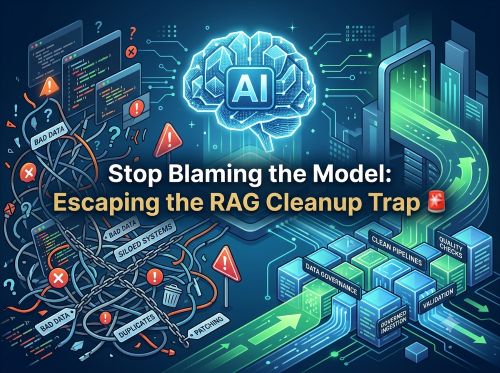
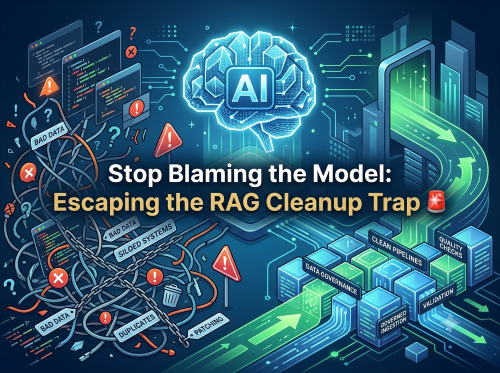
Over the past few years, enterprise technology teams have invested millions into generative AI pilots. Demo environments look astonishing, boardrooms are enthusiastic, and prototype chatbots answer complex prompts with impressive ease.
Yet, when the time comes to push these systems into live production environments, an alarming number of initiatives stall out completely.
When an enterprise AI project fails to deliver, leadership often points fingers at the Large Language Model (LLM): The context window was too small. The latency was too high. The model lacks reasoning capability.
However, data engineers building the scaffolding behind these applications see a very different picture. Generative AI rarely fails in production solely because of model limitations. It fails because the enterprise data foundation underneath it is fundamentally unprepared.
This brings us to a pervasive trap in modern software architecture: The Cleanup Trap.
The Cleanup Trap is the false belief that an organisation can feed fragmented, inconsistent, and ungoverned legacy data into an AI orchestrator and simply "fix" or patch the quality issues downstream at the retrieval layer.
To understand why this fails, we have to look at Retrieval-Augmented Generation (RAG).
In a standard RAG architecture, a vector database searches through company documents, databases, and operational logs to pull relevant context. It then passes this context to the LLM to ground its response in real enterprise facts.
Because setting up a basic vector store and embedding pipeline has become relatively simple, leadership teams frequently assume that the underlying data engineering challenge is solved.
It isn't.
When an embedding model receives raw, unvalidated data directly from operational silos, the resulting vector space inherits all the structural noise, duplicate records, and conflicting details present in the source systems.
If your core data pipeline suffers from silent issues — such as unannounced schema updates, missing fields, or delayed synchronisation — that degradation flows directly into your vector store.
An AI application cannot accurately synthesise customer intelligence if the pipeline behind it serves stale, contradictory records across separate storage layers.
The Hard Truth: No amount of prompt engineering, semantic re-ranking, or vector hyperparameter tuning can compensate for a broken ingestion pipeline. If the foundation is compromised, the downstream application will hallucinate, expose unauthorised details, or fail to deliver reliable value.
To escape the Cleanup Trap, enterprise data teams must stop treating data quality as a post-processing step. Data readiness for AI must be handled with the exact same rigour applied to traditional financial transaction processing.
Here are three programmatic guardrails needed before data ever reaches an AI orchestration layer:
1. Hardened Ingestion Pipelines
Data quality checks cannot exist as a nightly batch afterthought. If an enterprise AI application relies on real-time data to assist staff or customers, validation must happen inline.
Teams should implement explicit schema checks at the earliest ingestion point — such as the streaming ingress layer or the landing zone of a medallion architecture. If an upstream database alters a schema without warning, the pipeline must quarantine those anomalous payloads immediately rather than allowing corrupted metadata to pollute downstream vector stores.
2. Multi-Tiered Algorithmic Validation
Static row-count checks are no longer enough for AI readiness. True data health requires a multi-layered approach:
If a pipeline suddenly experiences an unexpected spike in empty string variables or structurally unusual records, automated alerts should pause updates to the vector database automatically.
3. Decoupling Security from the Model
An LLM should never be the arbiter of data access control or security. Attempting to enforce row-level security or personal data filtering purely through system prompts creates an enormous compliance risk.
Security must be enforced within the data infrastructure tier itself. Enterprise data systems must apply strict role-based access control, tokenisation of sensitive identifiers, and rigorous lineage tracing before information is indexed into vector stores or injected into an agent’s context window.
If you are mapping out your organisation's AI infrastructure roadmap, evaluate your data pipelines against these three questions:
The honeymoon phase of generative AI experimentation is over. Executive teams now demand measurable, predictable, and secure business results from their AI investments.
Moving from isolated, impressive demos to resilient, production-grade AI requires shifting focus. Stop focusing exclusively on which LLM vendor to choose. The true competitive differentiator lies in the engineering discipline, governance, and resilience of the data pipelines built to feed those models.
In the production era of AI, data engineering is no longer just a backend support function — it is the primary control plane for enterprise intelligence.
Further Reading. For more details and original context on this topic, read the full source article on VentureBeat:
👉 The cleanup trap: Stop asking RAG to fix bad data
Disclaimer: This article is provided for informational purposes only, mistakes may be made, and it's not offered or intended to be used as legal, tax, investment, financial, or any other advice.