x




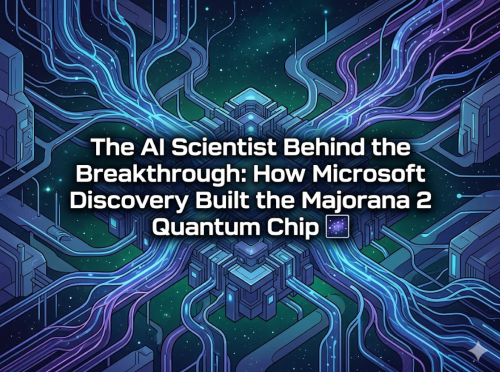
The quantum computing race has just shifted gears, and the numbers coming out of Redmond are frankly hard to wrap your head around. Microsoft recently unveiled its Majorana 2 quantum chip, boasting qubits that are 1,000 times more reliable than its first-generation models. Even more startling is its mean qubit lifetime of 20 seconds—a lifetime that looks like an eternity next to the fleeting microseconds managed by the rest of the industry.
To put that into perspective, keeping a quantum state stable is notoriously difficult; most modern quantum chips lose their computational grip in a fraction of a second. Majorana 2 can hold its state for up to a minute. Microsoft uses a brilliant analogy here: imagine a smartphone battery that, instead of dying after a single day, keeps running for nearly three years on one charge.
As a direct result of this breakthrough, Microsoft has aggressively compressed its timeline, pulling forward its target for a commercially scalable quantum computer from 2033 to 2029.
Yet, as massive as this hardware milestone is, the real story might not be the chip itself. It is the brilliant digital scientist that helped build it: Microsoft Discovery.
Launched into general availability alongside the chip, Microsoft Discovery is an agentic AI platform designed specifically for scientific research and development. The Majorana 2 chip is essentially Microsoft’s grand proof of concept, demonstrating exactly what happens when you unleash autonomous AI agents on the world's toughest engineering problems.
When a headline links AI with scientific breakthroughs, the default assumption is usually that a supercomputer clicked its fingers and generated a flawless blueprint. The reality of the Majorana 2 development is far more nuanced, and far more fascinating.
The most critical breakthrough on the hardware side was the decision to switch the chip's superconducting material from aluminium to lead. This single material swap is what Microsoft credits for the monumental leap in reliability. However, this change did not come from an AI prompt. It was the fruit of years of traditional, painstaking materials research conducted by human scientists.
The magic happened when Microsoft Discovery’s autonomous agents were introduced to supercharge everything around that discovery.
For nearly two decades, quantum research data had been locked away in isolated silos. No single human brain, no matter how brilliant, could possibly hold, cross-reference, and analyse that volume and variety of information simultaneously. Microsoft Discovery’s agents were able to break down these barriers, ingestion massive datasets, and surface hidden correlations that humans simply could not see.
By running advanced simulations, the AI could point researchers directly toward the most probable target. Instead of relying on endless, exhausting trial-and-error in the physical lab, scientists could use AI insights to narrow down their focus, meaning they ideally only had to run a physical experiment once.
One of the most concrete victories for the agentic AI platform involved solving a notorious bottleneck in quantum development: the measurement problem.
To detect quantum states, researchers must determine whether there is an even or odd number of billions of electrons sitting on a microscopic semiconductor wire. When human scientists do this manually, adjusting voltages and mapping the environment, the process drags on for weeks. Microsoft actually tried to automate this loop a few years ago using traditional machine learning models, but the technology just wasn't ready.
Microsoft Discovery changed the game by building dynamic, three-dimensional maps of qubit conditions. The AI agents succeeded where previous systems failed because they could handle parallel voltage adjustments across hundreds of parameters simultaneously. While human researchers are brilliant at linear, structural thinking, managing hundreds of moving variables at the exact same time is an operational nightmare. The AI agents automated the process seamlessly, turning weeks of manual calibration into a fraction of the time.
With Microsoft Discovery now generally available to enterprise customers, we are entering a new world order for scientific discovery. The platform combines highly specialised AI agents tailored for scientific enquiry, a powerful 'Discovery Engine' designed for complex research and reasoning workflows, and robust enterprise-level security and governance to protect sensitive proprietary data.
For independent researchers and developers eager to experiment, Microsoft has also released a free Microsoft Discovery app in early preview, which can be run locally using a GitHub Copilot account.
While the tech world is understandably energised by Microsoft's accelerated 2029 quantum timeline, a healthy dose of industry realism is always wise. Quantum roadmaps have historically been prone to optimistic compression, and Microsoft’s 1,000-fold reliability claim is a benchmark against its own Majorana 1 chip, rather than a direct comparison with competing architectures from tech titans like IBM or Google.
Nevertheless, as Zulfi Alam, corporate vice president for quantum at Microsoft, neatly summarised: "Where are we relative to last year? We’re 1,000 times better."
The partnership between human hypothesis and agentic AI execution has officially arrived. If Microsoft Discovery can help unlock the secrets of stable quantum computing in a matter of years, one can only wonder what complex global challenges—from climate modelling to molecular biology—it will dismantle next.
To dive deeper into the technical specifications of the chip and the deployment of agentic AI workflows, you can read the full original report on Artificial Intelligence News:
👉 Microsoft’s Majorana 2 quantum chip is also a case study for agentic AI in R&D
Disclaimer: This article is provided for informational purposes only, mistakes may be made, and it's not offered or intended to be used as legal, tax, investment, financial, or any other advice.