x





Gold has recovered above $4,700 an ounce after its largest monthly drop since the early 1980s, but technical analyst Avi Gilburt warns the correction may not be over. He identifies two potential scenarios: one where prices encounter resistance near current levels and decline, and a more deceptive path where a break above $4,800 could push gold to $5,200 before a sharp downturn toward $3,800, representing a further 20% drop. Silver is expected to follow a similar pattern, with downside risk toward $53.50 if recent highs are not breached. Gilburt suggests that support levels could provide buying opportunities for investors, while the subsequent price action will determine whether the market enters a longer-term bear phase.
Gilburt also sees long-term value in silver under $60 and highlights selective opportunities in mining equities, which may outperform the metals themselves during future rallies. He notes some mining stocks have already bottomed, while others remain in corrective patterns. Looking at broader commodities, he expects near-term gains in oil followed by a potential decline below $50 later this year. His outlook is primarily based on technical analysis rather than macroeconomic trends, with critical inflection points for gold, silver, equities, and commodities anticipated in the coming months. Source
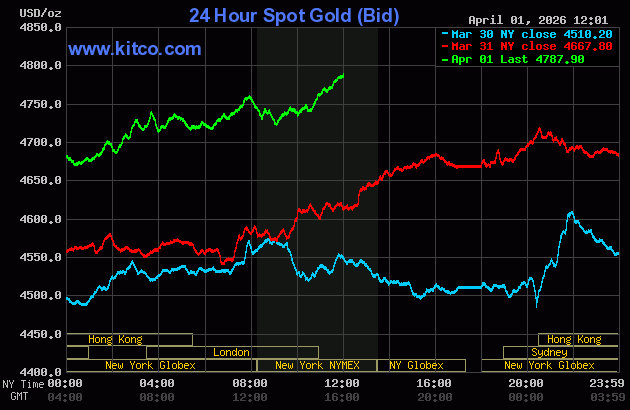
Image Source: Kitco News
Gold and silver are both rising in U.S. trading, with gold gaining $130.50 to $4,808.70 and silver up $0.936 at $75.86. The rally is supported by a weaker U.S. dollar index and a rebound in global government bond prices, which have shifted after earlier concerns about higher energy costs from the Iran conflict prompting inflation fears. The bond market has recently swung to anticipate slower economic growth and potential rate cuts by central banks, highlighting the unpredictability of trader sentiment. Crude oil is trading weaker around $100 a barrel, while the yield on the 10-year U.S. Treasury note stands near 4.3 percent.
Technically, June gold futures are trending higher, with bulls aiming to break resistance at $5,000 and bears targeting support below $4,300. Immediate resistance levels are at $4,850 and $4,900, with support at $4,700 and $4,600. Silver futures face resistance at $77.50 and $80.00, with support at $72.00 and $70.00, while the next downside target for bears is the March low of $61.21. The Wyckoff Market Ratings are 6.0 for gold and 5.5 for silver, indicating moderately bullish technical momentum. Source
Gold has held above $4,700 despite stronger-than-expected U.S. manufacturing data, with spot gold trading at $4,744.80 an ounce, up 1.65% on the day. The ISM Manufacturing Purchasing Managers Index rose to 52.7 in March, signalling continued growth in the sector, though components of the report were mixed. New orders fell to 53.5, production rose to 55.1, and the employment index slipped slightly to 48.7. Inflation pressures were highlighted by the Prices Index jumping to 78.3 from 70.5.
The report noted expanding manufacturing activity for the 17th consecutive month but also pointed to rising uncertainty, with business panellists citing the Iran conflict and ongoing U.S. economic policy concerns as negative factors. Despite the stronger headline reading, gold’s momentum remains largely driven by broader market dynamics rather than immediate reactions to the ISM data. Source
Gold remains supported despite stronger-than-expected U.S. retail sales, trading at $4,735.90 an ounce, up nearly 1.5% on the day. February retail sales rose 0.6% following a revised 0.1% decline in January, exceeding expectations of a 0.5% drop, while annual growth reached 3.7% compared to 3.2% the previous month. Core sales, excluding vehicles, rose 0.5%, beating forecasts, and the control group feeding directly into GDP also increased 0.5%, surpassing estimates.
Despite the positive economic data, gold has not experienced notable volatility, as traditional market logic would suggest higher retail sales support U.S. economic resilience, potentially allowing the Federal Reserve to maintain interest rates for longer. However, gold continues to attract buyers, reflecting ongoing demand and market dynamics that outweigh short-term economic indicators. Source
Gold is trading at its highest level in 10 sessions, holding above $4,700 an ounce, following stronger-than-expected U.S. private-sector job growth. ADP reported 62,000 jobs created in March, exceeding forecasts of 41,000, with February revised slightly higher to 66,000. Hiring remains steady, particularly in industries like health care, and job-changers saw a boost in pay, with annual wages for those workers rising to 6.6%, while pay for employees who stayed in their positions remained unchanged for three months.
Despite the positive labor data, gold has maintained its gains, reflecting ongoing demand and market resilience rather than reacting sharply to economic indicators. The price stability indicates that investors continue to view gold as a safe haven amid broader economic uncertainty and selective wage growth. Source
The silver market has stabilised around $75 an ounce, but analysts are cautioning against the hype surrounding extreme out-of-the-money silver call options, particularly those with a $1,000 strike price for December. Despite social media suggesting these trades represent “smart money” betting on higher year-end prices, experts describe them as unrealistic and largely untraded. Carley Garner, co-founder of DeCarley Trading, noted that there is currently no open interest in these contracts, meaning they have not been bought, and that their appeal is mainly due to retail investors seeking lower-cost ways to participate in the market.
Garner explained that these options are partly a response to high costs for at-the-money calls and silver futures, making the $1,000 calls an affordable, albeit highly speculative, alternative. She also highlighted the potential for more manipulative motives, drawing parallels with Reddit-fuelled trading strategies like the GameStop squeeze, where mass buying of out-of-the-money calls can temporarily push prices higher. Overall, she remains bearish on silver, warning that such speculative activity drives temporary volatility that often precedes a trend reversal. Source
Gold prices remain above $4,500 an ounce, but Mike McGlone, Senior Market Analyst at Bloomberg Intelligence, warns that the January peaks for both gold and silver could mark generational highs. He highlights that gold’s early-year rally pushed it to historic levels relative to the Bloomberg Commodity Spot Index and its 60-month moving average, with volatility more than double that of the S&P 500. McGlone compares the current rally to the 1980 peak, which held for decades, suggesting that the recent parabolic rise may be unsustainable as speculative momentum has turned gold into a risk asset rather than a safe haven.
Silver’s January surge to $120 an ounce is also seen as potentially historic, with its ratios to oil and copper hitting unprecedented highs. Despite his caution, McGlone notes that geopolitical developments, particularly the ongoing war with Iran, could significantly influence prices. A prolonged conflict or ceasefire might keep gold above $5,000 an ounce, whereas signs of resolution could push it back toward $4,000. Source
Gold has faced short-term pressure from the recent spike in global energy prices, with liquidity driving initial pullbacks as investors sell the metal to free up cash. Amy Gower, metals and mining strategist at Morgan Stanley, notes that gold is particularly vulnerable due to its high liquidity, and technical selling has been offset by support at key moving averages. The current oil shock differs from past events because of its potential impact on inflation and central bank interest rate policies, which could influence gold’s price trajectory, alongside a strengthening dollar.
Central banks and exchange-traded funds remain the primary drivers of gold demand, but their activity is sensitive to shifts in U.S. Federal Reserve policy, and potential selling could weigh on prices. While some nations, such as Turkey and potentially Poland, could sell gold reserves, Morgan Stanley expects ongoing support from ETF inflows, central bank purchases, and retail investment driven by safe-haven demand. Despite volatility, the firm remains optimistic on gold, citing historical gains following Fed rate cuts, strong institutional interest, and a weakening dollar supporting continued upside. Source
Gold has behaved more like a risk asset in 2026, falling sharply despite heightened geopolitical tensions and expectations of a rally, with HSBC analysts attributing this to a stronger US dollar, hawkish interest rate repricing, and increased participation from retail and leveraged buyers who may liquidate in times of stress. Traditional relationships between gold and real interest rates have weakened, and recent volatility reflects both parabolic gains earlier in the year and shifts in market dynamics, including central bank and retail demand.
Despite the short-term setbacks, HSBC sees a long-term investment case for gold, driven by ongoing global de-dollarisation and central bank purchases that have significantly outpaced historical averages. Analysts stress that gold remains a quality asset and a hedge within diversified portfolios, but volatility will continue to characterise the market in 2026, shaped by Fed policy, dollar movements, and broader geopolitical and economic developments. Source
Gold has rebounded above $4,500 an ounce, but extreme volatility is keeping many retail investors and traders hesitant, creating potential downside pressure in the near term. Carley Garner, co-founder of DeCarley Trading, notes that rapid price swings and elevated margins have sidelined many participants, making positioning in futures and options complex and high-risk. While leveraged trading has declined, even physical bullion and ETF markets face stress, and declining liquidity is exacerbating overall market volatility.
Garner remains cautious on gold, preferring to sell rallies and warning that recent levels may not hold. She expects any short-term recovery could present selling opportunities rather than a sustained rally. Energy markets, particularly crude oil, are driving broader commodity dynamics, influencing metals, agriculture, and currencies. In agriculture, correlations with oil are limiting upside potential for grains such as wheat, corn, and soybeans. Overall, defensive strategies and low-risk positions are prevailing, with many investors better off staying on the sidelines until volatility eases. Source
Gold rebounded after holding support at its 200-day moving average, ending a three-week losing streak, and Commerzbank has upgraded its bullish outlook for the precious metal. The bank forecasts gold reaching $5,000 an ounce by year-end and $5,200 by the end of 2027, citing anticipated US Federal Reserve rate cuts of 75 basis points through mid-2027 and falling real interest rates, which reduce the opportunity cost of holding gold. While elevated energy prices and a strong dollar have posed headwinds, gold’s role as a safe-haven and monetary asset remains intact, particularly once the Iran conflict eases and markets reprice monetary policy expectations.
Commerzbank is also positive on silver, projecting it to rise to $90 by the end of this year and $95 by the end of 2027, supported by tight market fundamentals. Analysts highlight that the current crisis differs from past economic crises, as inflation concerns have so far limited traditional safe-haven flows into gold, though these pressures are expected to shift with the Fed’s rate-cut cycle, supporting further gains in both metals. Source
The Canadian dollar strengthened against the U.S. dollar, rising 0.2% to 1.3885, supported by optimism over a potential ceasefire in the Middle East. The easing of geopolitical tensions has outweighed weaker domestic data, including a decline in Canada’s manufacturing PMI to 50.0, the lowest in three months, as tariffs and global uncertainty dampened output and raised input costs. Oil prices, a key export for Canada, fell 2.2% to $99.11 a barrel, reflecting the reduced threat to shipping through the Strait of Hormuz.
Analysts expect that Canada could become a more attractive destination for investment in oil and gas once the conflict stabilises, providing a tailwind for the loonie. Meanwhile, the Bank of Canada has indicated it will rely more on its own judgment for rate decisions amid global uncertainty, and Canadian bond yields showed mixed movements across a steeper curve, with the 10-year rising slightly to 3.485%. Source
The International Energy Agency, International Monetary Fund, and World Bank have announced the formation of a coordination group to address the economic and energy consequences of the Middle East war. The conflict, triggered by U.S. and Israeli strikes on Iran and subsequent regional attacks, has caused major disruptions in energy supplies, elevated oil, gas, and fertiliser prices, and affected global supply chains, particularly for commodities like helium, phosphate, and aluminium. The group aims to monitor developments, align analysis, and coordinate support for policymakers, with potential measures including targeted policy advice, financial support, and risk mitigation tools.
The organisations emphasised that the impact of the war is global but uneven, disproportionately affecting energy-importing and low-income countries. They noted rising market volatility, currency weakness in emerging economies, and inflation concerns, which could lead to tighter monetary policies and slower growth. The coordination effort seeks to safeguard global economic stability, strengthen energy security, and support affected countries through reforms, financing, and other mechanisms to sustain recovery, growth, and employment. Source
In this video, Jeffrey Christian of the CPM Group discusses the factors driving the recent upward trends in gold and silver prices, attributing the gains to global geopolitical instability, such as conflicts involving Iran, Israel, and the United States, as well as shifting interest rate expectations. He provides a detailed analysis of the Russian Central Bank's recent gold sales, explaining that these actions are a standard method for the government to manage its finances amidst international sanctions rather than a sign of market weakness. A significant portion of the presentation is dedicated to the importance of sophisticated hedging strategies for both investors and mining companies, where Christian argues that many firms lack the financial expertise to lock in current high profit margins effectively. He concludes by critiquing traditional bank-led hedging structures and promotes more flexible models that protect against price drops while allowing participants to retain the majority of the benefits from potential future price surges.
Why gold and silver prices are rising again
Disclaimer: These articles are provided for informational purposes only. They are not offered or intended to be used as legal, tax, investment, financial, or any other advice.