x





Gold is continuing to struggle to maintain momentum above 4,800 dollars an ounce, with spot prices recently slipping to around 4,794 dollars, down nearly 1% on the day. Despite a softer US dollar and improved broader market sentiment driven by growing hopes of a long-term peace deal in the Middle East, gold has failed to benefit in the way many investors might expect from a traditional safe-haven asset. Analysts suggest that the metal is currently behaving more like a high-risk asset, with its movements less tied to conventional drivers such as the dollar or real yields, and more influenced by shifting investor sentiment. The 4,800 level is seen as an important technical and psychological barrier that needs to be broken for stronger bullish confidence to return, particularly as markets continue to digest earlier speculative buying that pushed prices to record highs.
Looking ahead, gold’s direction is expected to depend heavily on whether geopolitical tensions continue to ease, alongside broader macroeconomic resilience, particularly in the United States. The US economy is viewed as relatively well positioned to absorb external shocks, supported by strong consumer health and ongoing wealth effects from equity market recovery. In contrast, the UK and European Union face greater vulnerability due to their reliance on energy imports, raising concerns about potential policy missteps from central banks as they balance inflation control with slowing growth. In this environment, gold could still find support as a hedge against downside economic risks, particularly if growth concerns intensify or policy tightening begins to weigh more heavily on activity. Source
The gold market is recovering after what was described as its worst monthly loss in decades, with some analysts arguing that the recent selloff simply reflected gold performing its intended role rather than failing. The move was linked to heightened global uncertainty following geopolitical tensions involving the U.S. and Israel and Iran, which drove demand for liquidity and led to selling pressure in assets such as gold as investors sought cash during a period of economic stress. This has been interpreted by some market participants as evidence that gold continues to function as a key source of emergency liquidity in times of crisis.
At the same time, the London Bullion Market Association and the World Gold Council are stepping up efforts to strengthen gold’s position within the global financial system by supporting its recognition as a high-quality liquid asset. Their initiative focusses on providing data to demonstrate gold’s liquidity during periods of market stress, challenging its historical exclusion from top-tier regulatory classifications under Basel III rules. Industry figures argue that gold behaves in a similar way to government bonds in crisis conditions, allowing holders to raise cash quickly, while also reinforcing its role as a strategic reserve asset. Central bank buying and broader investor interest are also seen as supporting this evolving view of gold as an essential component of diversified portfolios in an increasingly uncertain global environment. Source
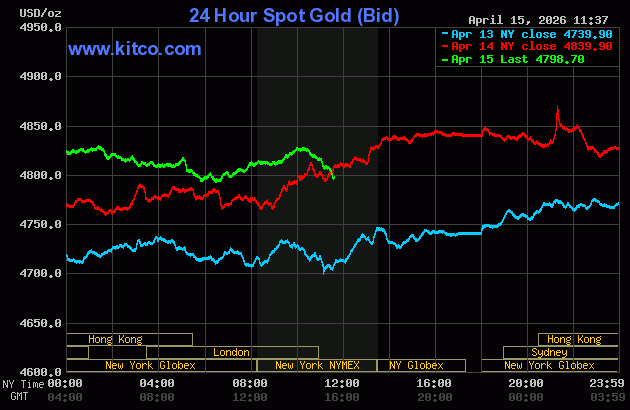
Image Source: Kitco News
Gold prices eased slightly while silver posted modest gains around midday Wednesday, with both metals experiencing choppy trading after reaching three-week highs overnight. The pullback in gold was mainly attributed to mild profit-taking from short-term futures traders, with June gold last down around 20.60 dollars at 4,830 dollars, while silver rose by about 0.402 dollars to 79.99 dollars. Despite the softer tone in gold, broader market developments provided some support for precious metals, including growing expectations of a weaker US dollar as hedge funds turn increasingly pessimistic on its outlook amid signs of potential diplomatic progress between the US and Iran.
The US dollar has recently reversed some of its earlier strength, with analysts pointing to expectations of medium-term weakness against major currencies such as the euro, yen, and Swiss franc, alongside commentary suggesting the dollar may still be significantly overvalued. Outside markets showed firmer crude oil prices near 92.50 dollars a barrel, a slightly weaker dollar index, and a US 10-year Treasury yield around 4.25%. Technically, gold faces resistance near 5,000 dollars, with support around 4,800 and 4,750 dollars, while silver traders are watching resistance near 85 dollars and support around 77 dollars. Overall, the metals remain in a volatile but broadly range-bound environment influenced by shifting currency expectations and ongoing geopolitical developments. Source
Gold prices are holding above the 4,800 dollars an ounce level even after stronger-than-expected US manufacturing data from the New York Federal Reserve suggested resilience in the regional economy. The Empire State Manufacturing Survey rose sharply to 11 in April from -0.2 in March, significantly beating expectations and marking the strongest reading since March. The report showed broad-based improvement, with new orders, shipments, and employment all increasing, although it also highlighted rising input costs and weakening business confidence about future conditions.
Despite the upbeat data, gold markets showed little immediate reaction, with spot prices slightly lower at around 4,812 dollars an ounce. Analysts continue to focus on the 4,800 dollar level as a key technical support zone that gold needs to maintain in order to build momentum towards the 5,000 dollar mark. While stronger economic data can reduce gold’s safe-haven appeal, it may also support expectations that the Federal Reserve could cut interest rates later in the year, which would reduce the opportunity cost of holding gold. Rising inflation pressures within the report add further complexity, reinforcing uncertainty about the policy outlook and helping to keep gold broadly supported. Source
The article argues that a prolonged disruption of the Strait of Hormuz could act as a severe global economic shock, triggering inflation, tightening liquidity and forcing a broad repricing of financial assets. It explains that gold’s recent sharp decline during a period of geopolitical tension was driven mainly by forced selling and liquidity stress rather than any weakening of its long-term investment case. The sell-off is framed as a consequence of investors and institutions raising cash during market strain, particularly as energy disruptions and geopolitical risks intensified financial instability across sovereign bond markets, currencies and equities.
Over the longer term, the piece suggests that gold’s role strengthens rather than weakens in such environments, as central banks and governments face constrained policy choices between supporting growth and controlling inflation. As energy scarcity feeds through into higher inflation and weaker growth, policymakers may be forced toward liquidity injections, which historically support gold as a monetary asset. The article also describes how prolonged disruption could fragment global trade settlement systems, increasing demand for neutral reserve assets like gold. In this scenario, gold shifts from a short-term liquidity source into a core monetary anchor, while silver is also highlighted as benefiting from structural demand linked to energy security and accelerated solar adoption. Source
Gold prices fell sharply in March, with a 12% drop in USD terms and an 11% decline in China, driven by shifting expectations around US interest rate cuts and broader macroeconomic uncertainty, though the metal still ended Q1 up around 7%. In China, weaker prices encouraged opportunistic buying, with wholesale demand rebounding seasonally to 134 tonnes in March as jewellers and refiners restocked, helping lift Q1 demand to 345 tonnes, slightly higher year on year but still well below long-term averages, reflecting continued weakness in jewellery consumption.
Investment demand was far stronger, with Chinese gold ETFs recording their seventh consecutive month of inflows and attracting a record 59 billion yuan in Q1, equivalent to about 50 tonnes, pushing assets under management to record levels. The People’s Bank of China also added to reserves for a 17th straight month, increasing holdings by 5 tonnes in March, while imports rose strongly early in the year. Futures trading activity eased month on month but remained above historical averages, and while Q2 is typically a quieter period for jewellery demand, investor behaviour is expected to remain sensitive to price stability, yields and alternative domestic investment options. Source
Gold is testing resistance above $4,800 as easing geopolitical tensions and softer-than-expected inflation data weaken the US dollar, which has fallen to a six-week low. Analysts note that improved risk sentiment, partly driven by hopes of progress in US–Iran relations, is reducing demand for the dollar as a safe-haven currency, although uncertainty remains over whether diplomatic progress will hold and how US monetary policy will evolve.
Despite short-term pressure from a firmer risk appetite, gold remains supported by expectations that US interest rates are unlikely to fall further this year unless inflation weakens more decisively. Inflation data has come in lower than forecast in some recent releases, easing pressure on the Federal Reserve, while investors are gradually returning to gold-backed ETFs after March outflows, with holdings rising in April. However, analysts caution that gold remains in a consolidation phase, with prices sensitive to any shifts in geopolitical developments or sudden changes in market sentiment. Source
Gold and other commodities are expected to remain supported by ongoing geopolitical risks and supply-demand imbalances, with UBS highlighting that tensions in the Middle East and uncertainty around energy flows continue to add volatility and upside pressure, particularly in oil markets. While some of the geopolitical risk premium may fade over time, analysts argue that underlying fundamentals such as tight inventories, inflation risks and structural demand trends still point to strength across commodities, especially if interest rate expectations begin to ease.
UBS commodities analyst Giovanni Staunovo said gold could rally significantly if geopolitical uncertainty persists while interest rates move lower, though recent rate expectations have weighed on sentiment and kept prices below previous highs. The bank maintains a positive long-term outlook, projecting gold could reach around $5,900 to $6,200 per ounce by 2026, driven by central bank buying, diversification away from the US dollar and broader macroeconomic risks such as high debt levels and inflation. However, in the short term, stronger energy prices and concerns about potential rate hikes could limit upside, leaving gold in a consolidative phase despite continued investor interest. Source
Gold’s traditional role as a safe-haven asset has come into question, with Robin Brooks of the Brookings Institution arguing that it has recently behaved more like a high-beta asset that amplifies rather than cushions market moves. He points to recent weeks in which gold has fallen around 10% during a broader risk-off period, outpacing declines in equities and suggesting it is no longer reliably acting as a hedge during market stress.
Brooks attributes this shift to possible selling by some investors and the impact of a so-called “debasement trade”, where earlier gains driven by geopolitical tensions and expectations of easier US monetary policy attracted more speculative buyers. He argues that this newer investor base may be more likely to exit positions during shocks, causing sharper downside moves. While he suggests this behaviour could be temporary and linked to market positioning, he notes that recent data shows gold has become more pro-cyclical, moving in line with broader risk assets rather than against them. Source
Silver prices have pulled back from earlier record highs above $120 an ounce but are now seen as holding an elevated base around the $70 level, with analysts describing the current phase as consolidation after a sharp rally. Nate Miller of Amplify ETFs said this stabilisation reflects a structural shift in the market, where silver is no longer trading in its long-term historical range and is instead maintaining higher levels that support both investor confidence and mining economics.
Miller said silver’s next major move will likely depend on macroeconomic conditions, especially inflation, with persistent inflation potentially reigniting its appeal as a store-of-value asset alongside gold. If inflation remains subdued, he expects more modest upside driven mainly by industrial demand, potentially keeping prices in a $70 to $80 range. He also highlighted silver’s role as a diversifier in portfolios and noted that higher but stable prices are encouraging mining investment and project development, while silver equities remain highly sensitive and volatile but potentially rewarding. Source
In this video, Jeffrey Christian from CPM Group provides a detailed analysis of the current state of the precious metals markets, specifically focusing on gold, silver, and platinum. He discusses two primary scenarios for gold prices over the coming quarters: a midyear plateau influenced by seasonal trends or a continued price rise driven by ongoing economic and political instability. The analysis highlights how central bank activities, such as those by Poland, France, and Turkey, are influencing market dynamics. Christian notes that while some banks are increasing their gold reserves to distance themselves from geopolitical risks, others are engaging in swaps or sales to manage foreign exchange needs or address domestic economic pressures.
The presentation also delves into broader macroeconomic indicators, including inflation data and shifting employment figures in the United States. Christian points out that while unemployment remains low by historical standards, a stagnation in job creation suggests underlying economic weakness that could lead to recessionary conditions. He debunks popular narratives regarding the dumping of the US dollar by central banks, providing data that shows foreign holdings of US Treasury securities are actually at record highs. The video concludes with an overview of upcoming reports and forums from CPM Group, advising short-term investors to remain cautious during this period of high volatility and uncertainty in global markets. Source
The article argues that escalating geopolitical tensions involving a US–Iran conflict and a blockade of the Strait of Hormuz could shift global markets away from traditional war dynamics towards stagflation, driven by rising energy disruptions, weaker demand and increased economic uncertainty. It suggests this environment would be particularly supportive for precious metals, especially gold, as higher fuel prices and supply chain pressures could weigh on corporate earnings and broader economic growth while reinforcing inflationary risks.
The commentary frames gold as a key beneficiary of what it calls a “fiat currency” crisis, arguing that fiscal expansion and political instability in Western economies are undermining confidence in traditional financial systems. It promotes a bullish long-term outlook for gold, silver and mining equities, highlighting technical support zones as attractive buying opportunities and suggesting that investors should adopt a more accumulation-focused mindset similar to that of Asian markets. Overall, it presents precious metals and related equities as strongly positioned for gains in a stagflationary, debt-heavy global environment. Source
In this week’s Live from the Vault, Andrew Maguire is joined by Dr Stephen Leeb to discuss gold taking on a central role in the global monetary system as power shifts away from the dollar amid rising geopolitical tension and energy supply pressures.
The two precious metals experts explore how BRICS expansion, rising physical gold accumulation, and widening divergence between physical and paper markets are reinforcing gold’s position as the core neutral settlement asset in global trade.
In this episode of Live from the Vault, Andrew Maguire and Dr Stephen Leeb discuss the shifting global financial landscape and the limitations of the current US dollar-led order. The conversation highlights the critical role of gold as a foundational asset for a new, cooperative monetary system, especially as the world faces a private credit crisis and massive debt levels. Dr Leeb argues that commodities like natural gas and helium have become vital strategic assets for the US, potentially serving as a bridge to a more stable economic future. Both experts emphasise that true financial stability and individual freedom require a return to gold-backed currencies, with China and Russia already making significant moves in this direction. Ultimately, they suggest that the only path forward for the global economy is one of international cooperation centred on physical gold rather than rehypothecated paper derivatives.
Disclaimer: These articles are provided for informational purposes only. They are not offered or intended to be used as legal, tax, investment, financial, or any other advice.