x




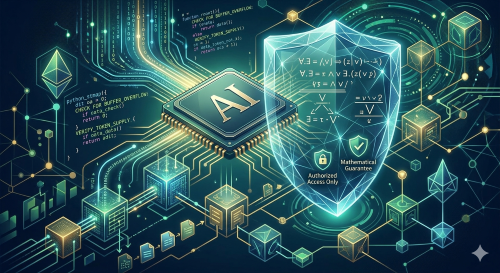
The cryptocurrency ecosystem has long been a digital Wild West. Unlike traditional banking, where a fraudulent transaction can be reversed or a compromised account frozen, blockchain transactions are absolute and irreversible. In decentralized finance (DeFi), a single misplaced line of code can allow an attacker to drain millions of pounds from a liquidity pool in a matter of minutes.
As software attacks grow increasingly sophisticated, Ethereum co-founder Vitalik Buterin has championed a compelling defensive strategy: combining Artificial Intelligence (AI) with formal verification.
But can the pairing of AI and mathematical logic truly eliminate smart contract bugs, or are we chasing an impossible standard of perfection?
To appreciate why this matters, it helps to understand how formal verification differs from standard software testing.
Traditional testing essentially asks: "Does this code work correctly in the specific scenarios we have selected?" Developers run the software through a series of simulated environments to see if it behaves.
Formal verification, by contrast, asks a much deeper question: "Can this code break the rules under any imaginable condition?"
Instead of merely checking for expected outcomes, developers write precise mathematical descriptions of how a system must behave. Specialised software tools then analyse the code against these mathematical proofs to ensure compliance. For a crypto protocol, formal verification might mathematically guarantee that:
This rigorous method is not new; it has been used for decades in high-assurance industries like aviation, defence systems, and nuclear engineering, where a software glitch could result in catastrophic real-world consequences. Now, the blockchain industry is eagerly adopting it.
If formal verification is so powerful, why isn’t all software built this way? The simple answer is that it is notoriously difficult, expensive, and time-consuming.
Writing mathematical proofs for software requires a rare blend of advanced computer programming and high-level mathematical logic. Developers must be fluent in specialised proof-oriented tools and theorem provers. Often, writing the proofs takes significantly more effort and time than writing the actual software itself.
This is where Buterin believes AI can shift the balance of power.
In the modern cybersecurity landscape, malicious actors are already using AI to scan codebases and uncover vulnerabilities at unprecedented speeds. To counter this, defenders need a scalable way to build stronger mathematical armour.
Buterin envisions a workflow where developers write code using proof-oriented languages, whilst AI models handle the heavy lifting: generating the mathematical proofs, spotting inconsistencies, and validating the correctness of the code with minimal manual intervention. By accelerating and automating this gruelling workflow, AI could make formal verification affordable and accessible to standard Web3 projects, rather than just well-funded enterprise systems.
Crypto platforms are uniquely vulnerable to software flaws because they operate on strict, deterministic logic. Complex systems like Zero-Knowledge Rollups (ZK-Rollups), decentralized bridges, and post-quantum cryptographic protocols involve immense mathematical complexity. Manual audits by human eyes simply cannot scale to meet the demand or catch every edge-case scenario.
While professional code audits look for known attack vectors and common vulnerabilities, formal verification attempts to prove that entire categories of failure are fundamentally impossible under a given set of assumptions. Buterin highlights areas like STARKs and ZK-EVMs as ideal candidates for AI-assisted verification because their core infrastructure is inherently mathematical.
Despite the profound promise of AI-assisted verification, Buterin urges the crypto community to remain grounded. A mathematical proof is only as flawless as the assumptions it is built upon. If the human developer creates an incomplete or unrealistic model specification, the verified code can still fail spectacularly in the real world.
Formal verification tests the code in a vacuum, but blockchains exist in a messy reality. A mathematically "perfect" smart contract can still collapse due to risks outside the scope of its mathematical model, such as:
Furthermore, relying heavily on AI introduces its own set of distinct challenges. Large language models (LLMs) are notorious for "hallucinations"—generating answers or code that look completely convincing but are mathematically incorrect. If developers blindly trust AI-generated proofs without strict human oversight, they risk introducing a false sense of security.
There is also an ideological risk. If these AI-driven verification tools become so convoluted that only a tiny elite of technical specialists can interpret them, it threatens the core Web3 ethos of open-source transparency and decentralised verification.
Ultimately, the goal of integrating AI into formal verification is not to achieve an unachievable, completely bug-free ecosystem. Instead, it is about shifting the economics of blockchain security.
By making formal verification faster and more scalable, AI can drastically reduce the likelihood of catastrophic software failures across layer-2 networks, stablecoin infrastructures, and crypto wallets. It provides defenders with a vital tool to keep pace with automated cyber threats.
However, "mathematically proven" must never be misconstrued as "immune to failure." A blockchain is a complex tapestry woven from code, human psychology, financial incentives, and governance structures. AI-assisted formal verification is an incredibly powerful shield for the code, but it cannot eliminate the inherent unpredictable nature of the human elements surrounding it.
For a deeper dive into Vitalik Buterin’s insights on blockchain security, you can read the original coverage on Cointelegraph:
👉 What is formal verification, and why does Vitalik Buterin think AI can help?
Disclaimer: This article is provided for informational purposes only, mistakes may be made, and it's not offered or intended to be used as legal, tax, investment, financial, or any other advice.