x




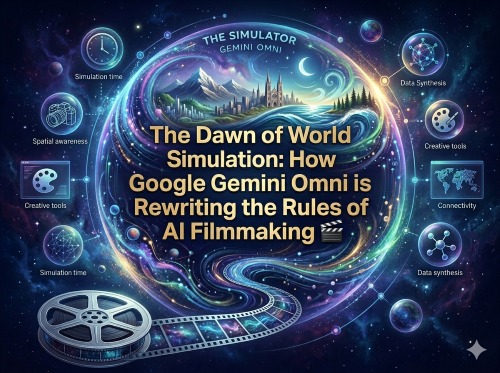
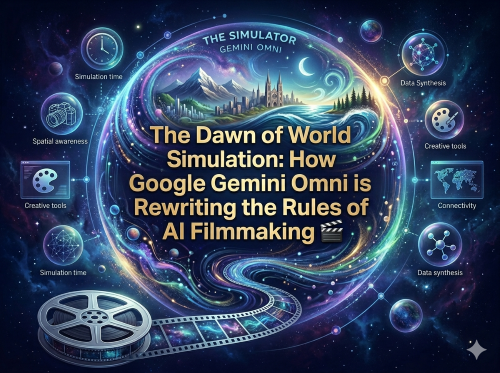
The boundaries between human imagination and digital reality have just blurred significantly. At the recent Google I/O 2026 conference, tech enthusiasts and creators witnessed what could arguably be the most monumental leap in generative artificial intelligence since the inception of large language models. Google officially unveiled Gemini Omni, a next-generation AI video builder designed not just to render clips, but to literally 'simulate the world'.
Described by DeepMind Chief Executive Officer Demis Hassabis as a significant step towards artificial general intelligence (AGI), Gemini Omni is a powerhouse model built to generate high-fidelity video, music, and multimedia from almost any input conceivable.
If you thought AI-generated content was limited to uncanny-valley short clips and static images, Google’s latest breakthrough is here to prove otherwise. Here is a detailed look into how Gemini Omni works, the technology powering it, and what it means for the future of digital creativity.
At its core, Gemini Omni is a multimodal AI model that unifies Google’s advanced reasoning intelligence with its elite suite of media-generation tools. Instead of treating text, imagery, video, and audio as separate entities, Gemini Omni processes and synthesises them under one cohesive architecture.
According to Hassabis, the model combines the core analytical brain of Gemini with specialized creative systems developed by Google, including:
The result is what Google calls a "world model AI"—a system capable of understanding physical laws, spatial depth, and contextual continuity to simulate realistic environments and narratives.
The initial rollout will see Gemini Omni Flash launch first, becoming available exclusively to Google AI subscribers through the company’s flagship creative platforms, Flow and Flow Music.
To understand the hype surrounding Gemini Omni, one must look at Google's recent track record. Last year, the tech giant found massive success with Nano Banana, an AI image-editing model that took the internet by storm. Widely adopted for meme generation and intuitive, conversational image editing, Nano Banana propelled the Gemini app to the top of Apple’s App Store in September. For the first time since OpenAI launched ChatGPT in 2022, Google temporarily overtook its main rival in app downloads and global search interest.
More recently, head-to-head testing revealed that Nano Banana 2 vastly outperformed OpenAI’s GPT Image 2 in complex anime illustration and spatial composition, though OpenAI retained a slight edge in text rendering and photorealism.
With Gemini Omni, Google is taking the conversational, user-friendly editing features that made Nano Banana a viral sensation and scaling them up into the far more complex dimension of video.
Creating AI video is notoriously difficult because of a flaw known as temporal inconsistency. In traditional AI video generators, characters might morph unexpectedly, backgrounds shift between frames, and objects lack physical weight or logic.
Gemini Omni tackles this problem head-on using Gemini’s deep reasoning capabilities. During the Google I/O presentation, the company demonstrated the model’s prowess by generating a beautifully styled claymation educational video explaining protein folding. The movement was fluid, the aesthetic remained perfectly intact, and the educational value was crystal clear.
Even more impressive is the introduction of conversational video editing. Google showcased a user modifying a selfie video simply by talking to the AI. The user instructed the model to insert new visual elements and completely alter the surrounding environment in real time.
Because Omni possesses a fundamental understanding of the broader scene, creators can issue open-ended instructions. Instead of manually explaining every frame, lighting adjustment, or pixel shift, you can describe the mood or narrative change you want, and the AI handles the heavy lifting, maintaining flawless consistency across characters, backgrounds, and movements.
To ensure Gemini Omni isn't just a gimmick but a viable tool for professional filmmakers and casual content creators alike, Google is embedding it into an ecosystem of automated assistants:
Coupled with updates to Flow Music, which brings AI-assisted audio composition into the mix, creators now have an end-to-end multimedia studio powered by a singular, unified artificial intelligence.
While video generation is the spearhead for this week's launch, Google has made it clear that Gemini Omni is the true embodiment of what the Gemini project was always meant to be.
“This was always our goal with Gemini, and why we built it to be multimodal from the very start,” Hassabis reflected during the keynote. The ultimate objective is a seamless, omnidirectional AI that can take any text, audio, visual, or code prompt and instantly translate it into an immersive, living digital reality.
As Gemini Omni Flash rolls out to subscribers, the landscape of filmmaking, marketing, and digital storytelling is set to shift dramatically. The power to simulate worlds is no longer exclusive to Hollywood studios with multimillion-pound budgets—it is transitioning directly into the hands of anyone with an idea and a prompt.
To find out more about this groundbreaking announcement and dive deeper into the technical specifications, read the full original report on Decrypt.
👉 Google Unveils Gemini Omni—A Next-Gen AI Video Builder That Can 'Simulate the World'
Disclaimer: This article is provided for informational purposes only, mistakes may be made, and it's not offered or intended to be used as legal, tax, investment, financial, or any other advice.