
x
Black Bar Banner 1
x

Alert!  New Secured Wallets are installed! new Blog system with AI  power and auto blog curation coming soon  Alert! 

Ads by Markethive - View All
Blogs
The Blog Feed
Write a New Blog Post
Search Blog Status
Most Viewed
Most Recent
Most Shared
Alphabetical
Blog Main Menu
Markethive Blog (default)
All Blogs
My Blog Posts
Friends' Blogs
Blog Categories
All
Advertising
Blockchain & Cryptocurrency
Business Development
Diet & Weight Loss
Environmental
Health and Wellness
History and Culture
Home and Garden
Marketing
Mentoring & Training
Money & Finance
Other
Political
Prayer & Religion
Programming & Technical
Real Estate
Search Engine Optimization
Social Media
Spirituality
Sports & Recreation
Transport
Travel & Events
Website Design
Blogging Tools & Assets
My Blog Info
Members Subscribed to You
Blogs You Are Subscribed To
Website Widget
Wordpress Plugin

The End of One-Size-Fits-All AI: How Smart Model Routing Cuts Costs 2.6x 🧠

Posted by Simon Keighley on July 28, 2026 - 7:07am


The End of One-Size-Fits-All AI: How Smart Model Routing Cuts Costs 2.6x 🧠

The End of One-Size-Fits-All AI: How Smart Model Routing Cuts Costs 2.6x

Defaulting to the most expensive, top-tier artificial intelligence model for every task is rapidly becoming an unsustainable luxury for enterprise teams. While frontier models handle multi-step reasoning exceptionally well, using them for straightforward code snippets or routine data extraction is the computational equivalent of using a sledgehammer to crack a nut.

To tackle these runaway costs, enterprise developers have turned to model routing — dynamically directing prompts to specific AI models based on speed, capability, and cost. However, traditional routing techniques suffer from a major structural flaw: they are static systems attempting to solve a dynamic problem.

A groundbreaking open-source framework called Agent-as-a-Router, implemented through ACRouter, offers a self-learning solution that dynamically adapts on the job and achieves up to 2.6 times cost savings compared to setups that rely exclusively on high-end frontier models.


The Information Deficit in Traditional AI Routing

Currently, enterprise teams rely on two main methods to route prompts across their AI infrastructure:

  1. Heuristics-based routing: Hard-coded manual rules created by developers. For instance, if a prompt contains certain technical keywords, it gets sent to a premium frontier model; otherwise, it is directed to a cheaper open-source alternative.
  2. Static trained classifiers: Machine learning models trained on historical data to predict which model should handle a prompt based on input text alone.

Both approaches share a critical flaw: they operate under a frozen information state. They make a single blind guess based entirely on the incoming prompt, without ever observing whether the selected model actually succeeded in executing the task.

When deployed in production environments, static routers break down due to three distinct vulnerabilities:

  • Out-of-Distribution Breakdown: When real-world data or user behaviour shifts away from the router's original training dataset, performance collapses.
  • Model Churn: The moment a new foundation model drops or an existing model is updated, static rules and classifiers become instantly obsolete.
  • Lack of Execution Feedback: Because static routers never receive feedback from the target environment, they repeatedly send complex edge cases to underpowered models that fail silently or generate subtle errors.


How Agent-as-a-Router Learns on the Job

The core principle behind the Agent-as-a-Router framework is that a router should act like an active agent rather than a passive switch. It must observe execution outcomes and build continuous memory during deployment.

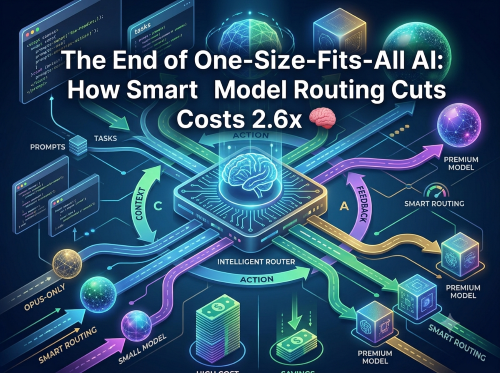
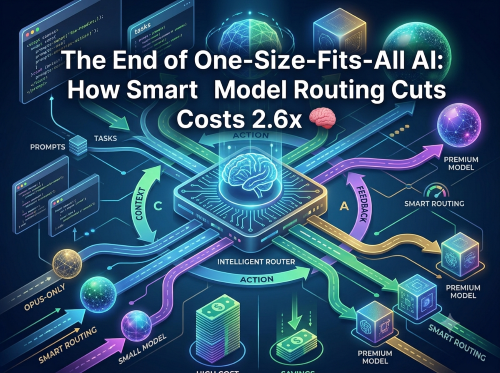
This dynamic adaptation is powered by a Context-Action-Feedback (C-A-F) loop:

  • Context: When a prompt arrives, the router analyses its metadata alongside historical memory to see how various models performed on similar tasks in the past.
  • Action: Using this retrieved context, the router selects the optimal model from the available pool and executes the task.
  • Feedback: The framework verifies the real-world outcome — observing whether code ran successfully, a database query compiled, or an error occurred — and logs this signal back into its memory bank.

Consider a practical example in a data engineering pipeline. A complex SQL query is initially sent to a cheaper open-source model, which hallucinates a column name and fails to compile. The C-A-F loop logs this precise compiler error. The next time a query with similar syntactic edge cases arrives, the router checks its context, recognises the past failure pattern, and automatically routes the prompt to a more capable reasoning engine.


Inside the ACRouter Architecture

The researchers behind this approach created a concrete implementation known as ACRouter, built on three primary modules supported by a tool layer:

  • The Memory Module: Built on a vector store, this component retrieves historical execution records during the context phase and updates the database with new performance feedback.
  • The Orchestrator: Responsible for the action phase, this module processes the user prompt together with relevant past context to select the best target model. Remarkably, the orchestrator itself does not require a massive footprint — the team trained a sub-billion parameter adaptor based on Qwen 3.5 (0.8B parameters) that can easily be self-hosted on modest hardware.
  • The Verifier & Tool Layer: The verifier assesses the model's output using real execution tools, such as Python code interpreters, database engines, or sandbox environments. This provides an objective, verifiable signal on whether the task succeeded or failed.


Performance in the Field: Reaching the Pareto Frontier

To test the framework against real-world enterprise demands, researchers benchmarked ACRouter across roughly 10,000 tasks using an evaluation environment called CodeRouterBench. The tests evaluated performance across eight major frontier models across both single-turn coding tasks and multi-step agentic programming environments.

The benchmark highlighted a vital reality: no single model dominates every task category. While high-cost models like Claude Opus achieve strong overall averages, specialised tasks like test generation or algorithm design are often handled better — and at a fraction of the cost — by smaller, dedicated models.

In production scenarios, static routers repeatedly sent niche syntax queries to ill-equipped models because they could not see the execution errors occurring downstream. ACRouter, by contrast, adapted immediately upon receiving negative execution feedback.

Across the benchmark runs:

  • On identical in-distribution task sets, ACRouter cost $13.21 to process the full workload, compared to $34.02 for a default setup using Claude Opus — representing a 2.6x reduction in operating costs.
  • ACRouter achieved the lowest cumulative regret (a key metric tracking sub-optimal routing decisions over time), placing it directly on the Pareto frontier where performance is maximised relative to cost.


Ideal Use Cases and Practical Limitations

While self-learning model routing delivers significant efficiency gains, it is essential to recognise where this architecture fits best:

  • Where it excels: Verifiable tasks with clear, objective binary success signals — such as software engineering, data engineering, database querying, and structured information extraction.
  • Where it is overkill: Simple, low-volume applications or trivial queries where any base model performs adequately and the additional orchestration layer adds unnecessary engineering overhead.
  • Where it struggles: Subjective domains, such as creative writing, brand copywriting, or open-ended strategic brainstorming, where outputs cannot be automatically evaluated by an execution engine.


Getting Started

The code for Agent-as-a-Router has been made open-source on GitHub, with the orchestrator model weights available on Hugging Face under the Apache 2.0 licence. The framework integrates seamlessly with existing agentic developer tools including Claude Code, Codex, and OpenCode.

To explore the research, benchmarks, and architecture details in full, read the original article at VentureBeat:

👉 ACRouter picks the smartest AI model per task, beating Opus-only setups by 2.6x on cost


Disclaimer: This article is provided for informational purposes only, mistakes may be made, and it's not offered or intended to be used as legal, tax, investment, financial, or any other advice.




ecosystem for entrepreneurs


Simon Keighley Thanks, Kevin - I completely agree; as AI ecosystems become more diverse, intelligent orchestration and adaptive routing will increasingly be the key differentiators for building scalable, cost-effective enterprise AI systems.
July 31, 2026 at 10:13am
Kevin Jacobson Excellent perspective. The future of AI isn't about finding one model that does everything—it's about intelligently matching the right model to the right task. Smart routing improves efficiency, reduces costs, and makes advanced AI more practical at scale without sacrificing quality. It's a great reminder that thoughtful orchestration is becoming just as important as the models themselves. Thanks for sharing these valuable insights.
July 31, 2026 at 10:05am
Simon Keighley Really appreciate the thoughtful perspective, Olov - the parallel between adaptive AI routing and optimising marketing funnels is spot on: both require continuous feedback loops, experimentation, and intelligent allocation of resources rather than relying on static assumptions. Thanks for reading.
July 28, 2026 at 4:03pm
Olov Forsgren This is a brilliant breakdown, Simon. You’ve hit on a fundamental truth of system design: static rules always break down in dynamic environments. The Context-Action-Feedback (C-A-F) loop you described is essentially the engineering equivalent of how we optimize marketing funnels—you can't just set a static path and hope for the best; you have to observe real-world friction and adapt. I particularly appreciate your point about the 'Pareto frontier.' In a world where everyone is default-routing everything to the most expensive model out of convenience, architectures like ACRouter prove that true efficiency comes from orchestration, not brute force. Thanks for sharing this deep dive—definitely food for thought as we look at optimizing our own tech stacks!
July 28, 2026 at 3:41pm