x




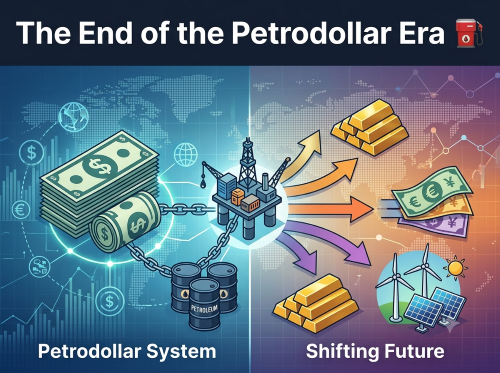
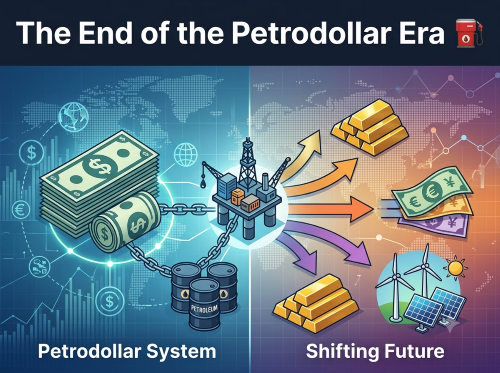
For more than half a century, a quiet financial pact between the United States and Saudi Arabia served as the unshakeable foundation of the global monetary order. It dictated how energy was traded, how central banks managed their reserves, and how Washington financed its spending. Today, that foundation is undergoing a fundamental structural shift.
To understand where global finance is headed—and why central banks are reallocating billions into physical gold—it is essential to examine how the petrodollar architecture was built, why it is fracturing, and what is rising to take its place.
The petrodollar system refers to the informal agreement whereby global crude oil sales are priced and settled exclusively in US dollars. Because oil remains the indispensable engine of global commerce, this single convention created an artificial, permanent demand for the dollar across every energy-importing nation on earth.
The term petrodollar specifically describes the US dollars earned by oil-exporting nations through petroleum exports. Rather than sitting idle, these massive cash surpluses were directed back into Western financial markets—most notably US Treasury bonds. This continuous cycle, known as petrodollar recycling, provided the structural plumbing that sustained the dollar’s status as the world’s undisputed reserve currency for five decades.
The seeds of the petrodollar system were sown during the collapse of an earlier monetary regime. In 1944, the Bretton Woods agreement established the US dollar as the world’s anchor currency, pegged to gold at $35 per ounce. However, by the late 1960s, expanding US fiscal deficits from domestic spending and the Vietnam War severely strained American gold reserves. Foreign central banks began converting their dollar holdings into physical gold, prompting President Richard Nixon to suspend dollar-gold convertibility in August 1971.
With the gold anchor removed, the unbacked fiat dollar faced an existential credibility crisis. The solution emerged from the energy turmoil of the early 1970s.
Following the 1973 Yom Kippur War, Arab members of OPEC imposed an oil embargo on Western nations, causing crude prices to quadruple almost overnight. Energy-exporting nations, particularly Saudi Arabia, accumulated vast dollar surpluses far beyond what their domestic economies could absorb.
Recognising an opportunity to secure dollar demand, US policymakers intervened. In June 1974, Washington and Riyadh formalised a broad framework for economic and military cooperation. Shortly thereafter, in July 1974, US Treasury Secretary William Simon travelled to Jeddah with a clear directive: secure an agreement that would tie Saudi Arabia’s wealth directly to American capital markets.
The resulting bargain was straightforward:
As other OPEC nations followed suit, global oil trade was fully dollarised, creating an enduring framework that anchored international demand for the US currency.
Once operational, petrodollar recycling created a self-reinforcing financial loop that generated immense structural advantages for the American economy:
Economists frequently refer to this phenomenon as the "exorbitant privilege." It enabled the United States to consume vastly more than it produced, backed by the global necessity of holding dollars for energy access.
After five decades, the structural dynamics holding the petrodollar loop together are eroding under the weight of several converging forces:
1. Declining Dollar Reserve Shares
According to International Monetary Fund (IMF) COFER data, the US dollar's share of global central bank foreign exchange reserves has fallen from roughly 72% in 2001 to approximately 57% in 2025—marking its lowest level in three decades.
2. Diminishing Exporter Surpluses
Due to rising domestic expenditure and ambitious economic transformation programmes, major energy producers are recycling smaller surpluses into foreign debt. For instance, Saudi Arabia ran a budget deficit of approximately $33 billion in 2025. When an exporter experiences fiscal deficits, it draws down existing reserves rather than accumulating new US Treasuries.
3. Bilateral Trade and Non-Dollar Settlement
The rise of major non-Western economies has catalysed a transition towards local currency settlement. China, the world's largest oil importer, has increasingly settled energy purchases in yuan. Bilateral oil trade data reveals that Saudi Arabia's yuan-denominated settlements with China have expanded rapidly, while countries like India have shifted significant volumes of Russian crude purchases into UAE dirhams and yuan.
4. The Weaponisation of Financial Infrastructure
The decision by Western nations to freeze $300 billion in Russian central bank assets in 2022 transformed sovereign reserve management. It demonstrated to neutral nations that dollar-denominated assets carried geopolitical risk. Consequently, central banks worldwide have accelerated efforts to diversify into sovereign assets free from political counterparty exposure.
5. The Broader Energy Transition
As renewable technology, electrification, and alternative energy sources expand, the relative weight of petroleum in global GDP is shifting. A world that becomes less dependent on crude oil over time is naturally a world with reduced structural demand for oil-backed currency reserves.
As Council on Foreign Relations economist Brad Setser observed, the classic era of petrodollar dominance has reached its conclusion.
A common misconception is that the petrodollar will be replaced overnight by a single rival fiat currency, such as a BRICS token or the Chinese yuan. However, no single national currency currently possesses the capital market depth, liquidity, and open capital controls required to fully assume the role of sole global reserve currency.
Instead, the global monetary system is fragmenting into a multi-currency framework, with physical gold serving as the primary neutral anchor.
Data from the World Gold Council (WGC) highlights this profound institutional shift:
Unlike fiat debt instruments, physical gold carries no counterparty risk, cannot be frozen by foreign decrees, and represents an unencumbered monetary asset. As sovereign managers seek neutrality, gold is absorbing the capital exiting dollar-denominated reserves.
While central banks operate on decade-long horizons, the underlying economic realities affect individual purchasing power directly.
The petrodollar system allowed the US to borrow cheaply and maintain vast debt burdens. As structural foreign demand for US Treasury bonds wanes, maintaining the current national debt structure requires higher interest yields or increased central bank monetary expansion. Both paths place downward pressure on the real purchasing power of unbacked paper currencies.
Gold's recent performance reflects these structural dynamics. After reaching an all-time high of $5,589.38 per ounce in January 2026, gold continues to trade at historical highs, hovering around $4,076.21 per ounce by mid-2026. This upward repricing does not simply reflect market speculation; it represents the long-term institutional revaluation of hard assets in an evolving international monetary system.
The dismantling of the petrodollar framework is not a sudden collapse, but a deliberate, structural rebalancing. As sovereign reserve managers systematically transition from politically exposed assets toward neutral monetary anchors, understanding these mechanics becomes vital for preserving wealth in the decade ahead.
For more information and detailed analytical insights regarding this monetary transition, read the original report at GoldSilver:
👉 The Petrodollar System Explained: What It Is, How It Worked, and What’s Replacing It
Disclaimer: This article is provided for informational purposes only, mistakes may be made, and it's not offered or intended to be used as legal, tax, investment, financial, or any other advice.