x




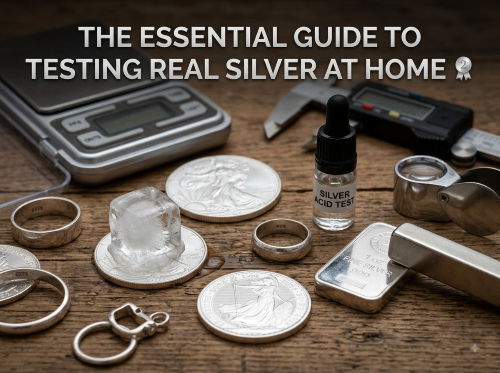
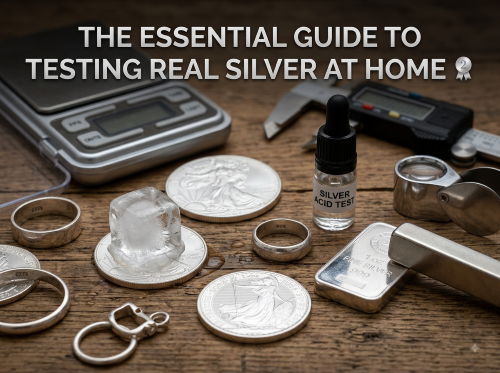
Silver remains one of the most accessible and versatile precious metals on the market, but its popularity also makes it a prime target for counterfeiters. From silver-plated brass chains stamped with misleading marks to copper-core bullion coins and fake sterling jewellery, sophisticated imitations are widespread across online marketplaces, estate sales, and secondhand shops.
Whether you are verifying inherited heirlooms, checking a newly acquired bullion coin, or assessing vintage jewellery, knowing how to test silver effectively gives you peace of mind. Authenticating silver ranges from quick, instant physical checks to rigorous non-destructive laboratory methods.
Before investing in specialised chemicals or testing devices, three rapid checks can weed out low-grade fakes in less than a minute.
If an item passes initial visual inspection, testing its distinct physical characteristics—such as electrical conductivity, thermal properties, acoustic resonance, and density—provides far deeper insight without damaging the metal.
The Magnetic Drag Test (Eddy Currents)
Whilst silver does not stick to magnets, it possesses another unique magnetic behaviour: silver is the most electrically conductive metal in existence. When a powerful neodymium (rare-earth) magnet moves across a genuine silver surface, it induces electrical eddy currents, creating a opposing magnetic force that acts as a physical brake.
To perform this test, incline a silver bar or flat plate at a slight angle and slide a strong neodymium magnet down its surface. On genuine silver, the magnet will slide down remarkably slowly as if moving through syrup. On plated items or base metals, the magnet will either stick fast or slide off rapidly without any dragging effect.
The Ice Thermal Conductivity Test
Silver exhibits the highest thermal conductivity of any common metal, meaning it transfers heat across its mass almost instantly.
Place a standard ice cube directly onto a room-temperature silver item. Real silver will rapidly draw heat from the ambient environment straight into the ice, causing it to melt rapidly as if placed on a hot surface. To confirm the result, place a second ice cube on a stainless steel spoon or piece of base metal; the ice on the real silver will melt exponentially faster.
The Acoustic Ping Test
Due to its molecular lattice structure and density, fine silver produces a clear, high-pitched, sustained ringing tone when gently struck. Base metals produce a short, dull thud.
Balance a coin loosely on the tip of your finger and tap it gently with another coin or a small metal object. Listen closely for a resonant, clear ping that lingers for a second or two. Dedicated smartphone applications are also available to analyse the frequency soundwave of specific bullion coins against official mint standards.
The Specific Gravity (Density) Test
Specific gravity measures a metal's density relative to water. Fine silver has a specific gravity of roughly 10.49, whereas sterling silver sits around 10.36. Base metal fakes differ significantly: stainless steel ranges from 7.75 to 8.05, pewter sits near 7.30, and nickel silver averages 8.70.
To measure specific gravity at home:
A calculated ratio close to 10.49 confirms fine silver. While subtle air bubbles or minor scale inaccuracies can slightly alter the result, a reading drastically lower than 10.30 indicates a base metal core.
Chemical testing evaluates how silver reacts with common reagents. Note: Chemical testing can cause surface discolouration or permanent marks, so it should be avoided on collectable coins, proof items, or fine investment bullion bars where surface condition dictates resale value.
Nitric Acid Testing
Acid testing kits contain varying strengths of nitric acid calibrated to detect specific purities (.800, .925, and .999).
To test, lightly scratch an inconspicuous area of the metal on a slate stone to bypass any outer plating. Apply a single drop of testing acid to the streak. Real sterling silver causes the acid to turn a cream or bright red colour depending on the solution strength. If the liquid fizzes green or blue, copper or brass beneath a silver plating is being dissolved.
Household Bleach Test
Household bleach contains sodium hypochlorite, which reacts aggressively with genuine silver to form silver chloride—a dark, grey-black tarnish.
Apply a tiny drop of household bleach to an unseen area using a cotton swab. Genuine silver will turn dark almost immediately. A complete lack of reaction suggests the item is either stainless steel, nickel, or heavily coated in protective plastic varnish. The dark mark can usually be polished out with a silver-cleaning cloth afterward, but use this test sparingly.
Household Vinegar Test
For a gentler household check, white vinegar (acetic acid) can be applied to an inconspicuous spot. Real silver shows virtually no reaction when exposed to mild acetic acid, whereas unplated copper, zinc, or brass alloys may discolour, oxidise, or fizz slightly after a few minutes.
Bullion coins such as the American Silver Eagle, UK Silver Britannia, and Canadian Silver Maple Leaf are minted to precise, published dimensions and tolerances, making them straightforward to verify without chemical exposure.
When dealing with high-value collections, estate jewellery, or large silver bars, professional non-destructive instruments offer the highest degree of accuracy.
Does real silver tarnish over time?
Yes, genuine silver reacts with trace sulphur compounds in the air, forming a grey, brown, or black layer of silver sulphide. Tarnishing is a natural chemical process and does not mean your silver is fake. In fact, an item that remains completely bright and shiny after decades without polishing may be stainless steel or coated in clear lacquer.
Will a magnet stick to real silver?
No. Real silver is non-magnetic and will not stick to a magnet. However, a magnet will smoothly drag down an inclined silver surface due to induced eddy currents.
Why does ice melt so fast on genuine silver?
Silver possesses the highest thermal conductivity of any metal. It draws surrounding ambient room heat into itself and transfers it directly into the ice, melting it rapidly upon contact.
How can I tell sterling silver from silver-plated items?
Silver-plated items feature a paper-thin layer of fine silver over a base metal core like brass, copper, or nickel. Over time, high-wear areas like clasps, hinges, and edges reveal the base metal underneath. Plated items also fail specific gravity density tests and will react green or blue during acid testing once the surface layer is breached.
Testing methods are valuable tools for verifying secondhand purchases, heirlooms, or private market trades. However, the simplest way to ensure authenticity is purchasing precious metals directly from reputable bullion dealers who verify their inventory using professional-grade electronic testing equipment before sale.
Disclaimer: This article is provided for informational purposes only, mistakes may be made, and it's not offered or intended to be used as legal, tax, investment, financial, or any other advice.