x




The dream of having a true digital assistant—one that actually understands what you are looking at, remembers your preferences, and can control your phone just like a human would—has always felt just out of reach. While tech giants have flooded the market with AI chatbots, these systems usually feel like isolated web apps rather than an integrated part of your device.
That is all about to change. The AI team from Chinese smartphone innovator Oppo, specifically the Multi-X Team at the OPPO AI Center, has introduced a groundbreaking open-source Android AI agent framework called X-OmniClaw.
Instead of routing your personal life through a distant cloud server, X-OmniClaw runs directly on your physical Android device. By utilising the hardware your phone already has—the camera, the microphone, and the screen—this framework creates a hands-free, context-aware assistant capable of executing real tasks across real apps without compromising your privacy.
Here is a deep dive into how Oppo is revolutionising mobile automation and why X-OmniClaw represents a massive leap forward for agentic AI.
Most of the mobile AI systems we see today do not actually live on your phone. Instead, they operate on cloud servers that host virtualized, simulated copies of Android. When you ask them to do something, the AI taps and scrolls through apps remotely.
This cloud-first method comes with glaring limitations. Because the AI is trapped in a virtual environment, it lacks access to your physical camera feed, your actual on-device photo gallery, or your local files. It operates less like a personal assistant and more like a stranger controlling a cloned copy of your device from afar.
X-OmniClaw takes the exact opposite approach by introducing an edge-native architecture. It executes directly on your physical device, eliminating the gap between virtual simulations and real-world contexts.
To explain this concept, Oppo’s technical report uses a clever car analogy:
By keeping the core logic on the device, X-OmniClaw ensures lightning-fast local responses, better data privacy, and a seamless connection to the physical world.
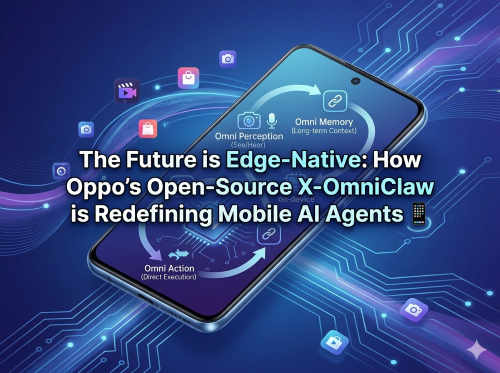
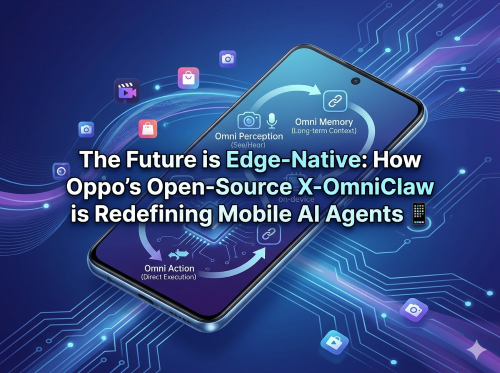
X-OmniClaw operates as a continuous, intelligent loop built upon three foundational pillars: Omni Perception, Omni Memory, and Omni Action.
1. Omni Perception (Seeing and Hearing)
Omni Perception acts as the sensory input pipeline. It unifies camera feeds, real-time screen content, and voice commands into a single stream. Before the agent acts, a local vision-language model interprets what is happening.
For example, if you point your phone camera at a physical object on a store shelf and ask, "How much does this cost online?", X-OmniClaw instantly recognizes the object visually, opens a shopping app, and handles the search natively—no manual typing or uploading required.
2. Omni Memory (Continuous Context)
What prevents most AI assistants from being genuinely useful is their "one-shot" nature; they forget everything the moment a conversation ends. X-OmniClaw solves this with Omni Memory. It maintains persistent context across different tasks, app switches, and user sessions.
Even more impressive, it builds a long-term semantic memory from your local photo gallery. It scans raw images and transforms them into structured, searchable data about objects, locations, and events. This ongoing continuity allows X-OmniClaw to act as a permanent companion rather than an episodic chatbot.
3. Omni Action (Seamless Execution)
Executing commands on a messy mobile interface is incredibly difficult for AI. Screen layouts change, and intrusive ads can confuse standard automation tools. Omni Action addresses this by combining XML interface data with an on-device visual model and Optical Character Recognition (OCR). This dual-layer approach allows the agent to precisely identify what to tap, scroll, or click, even on complex layouts.
Furthermore, Omni Action includes an innovative behaviour cloning feature. If you have a multi-step task that requires navigating deep into an app's sub-menus, you only have to record yourself doing it once. X-OmniClaw learns the path and generates an Android deeplink shortcut. The next time you request that task, the agent replays the route instantly, bypassing the tedious navigation entirely.
Oppo has demonstrated several highly practical use cases that showcase how X-OmniClaw streamlines everyday mobile workflows:
Autonomous AI agents are the defining technology trend of the era. The current wave of innovation was kickstarted by OpenClaw—the open-source desktop agent framework that racked up over 373,000 GitHub stars and caught the attention of OpenAI by proving what persistent, locally-run AI could achieve on PCs. Similarly, frameworks like Nous Research’s Hermes Agent pushed boundaries with self-improving learning loops.
However, these systems were primarily engineered for heavy desktop hardware. X-OmniClaw successfully scales this advanced architecture down to the device that stays in your pocket. Built upon the open-source HermesApp codebase and explicitly inspired by OpenClaw’s structured skill model, Oppo has masterfully adapted these concepts for the multimodal, always-on environment of a smartphone.
In a tech landscape where the most powerful AI capabilities are locked behind corporate paywalls and proprietary cloud ecosystems, Oppo’s decision to make X-OmniClaw open-source is a breath of fresh air.
The code is currently available on GitHub, and Oppo has committed to releasing all project assets and continuously updating the framework as the technology matures. This opens the door for a global community of developers to build upon, customise, and optimise edge-native AI automation for millions of Android users worldwide.
We are finally moving away from static voice commands and entering an era of proactive, deeply integrated mobile intelligence. With frameworks like X-OmniClaw leading the charge, the future of mobile AI isn't in the cloud—it's right in the palm of your hand.
To learn more about the technical specifications, development milestones, and how this open-source framework is shaping the future of Android automation, read the full coverage on Decrypt:
👉 This Open-Source Phone AI Agent Sees, Hears and Acts—All Without Touching the Cloud
Disclaimer: This article is provided for informational purposes only, mistakes may be made, and it's not offered or intended to be used as legal, tax, investment, financial, or any other advice.