x



Gold has defied typical expectations in 2026 by falling sharply despite rising geopolitical tensions, dropping around 15% in March. Analysts at HSBC explain that a stronger US dollar and higher interest rates have reduced demand, particularly from non-US buyers, and increased the cost of holding a non-yielding asset. They argue that gold is now behaving more like a risk asset, as ownership has shifted towards retail and leveraged investors who are more likely to sell during periods of market stress, contributing to increased volatility.
Despite this, HSBC maintains a positive long-term outlook for gold, driven largely by the ongoing trend of global de-dollarisation, with central banks increasing gold purchases to reduce reliance on the US dollar. The traditional inverse relationship between gold and real interest rates has weakened since 2022, influenced by factors such as retail participation, geopolitical risks and central bank demand. Volatility is expected to remain a defining feature of the market in 2026, but recent price behaviour does not necessarily undermine the broader bullish trend. Source
Gold has climbed back above 4,500 dollars an ounce, but extreme volatility is discouraging retail investors from participating, which could lead to further price declines in the near term. Carley Garner highlights that sharp and rapid price swings, combined with high trading costs and margin requirements, have made the market highly risky and difficult to navigate, with many traders stepping aside. Even those attempting to profit from the downturn have struggled due to sudden reversals, while expensive options and leveraged products amplify both gains and losses. Although physical bullion and ETF investors may be more resilient, signs of panic selling and declining liquidity are adding to instability.
Garner remains cautious on gold’s short-term outlook, suggesting prices could fall further despite their historically high levels, and that any rebound may present a selling opportunity rather than a sustained recovery. She also points to crude oil as the dominant force influencing not only gold but the wider commodity markets, increasing correlations across assets including currencies and agricultural products. With volatility spreading across sectors, traders are adopting defensive strategies or avoiding the market entirely, as the current environment makes consistent profits difficult to achieve. Source

Image Source: Kitco News
Gold and silver prices have strengthened near midday as investors increased safe-haven buying amid ongoing tensions in the Middle East. June gold rose by $36.30 to $4,652.00, while May silver gained $1.244 to $71.04. Falling global government bond yields and higher crude oil prices have also supported the precious metals markets. Comments from Fed Chair Powell on interest rates and inflation had little impact on the market, while geopolitical risks continue to dominate investor sentiment, particularly amid escalating U.S.-Iran tensions and troop movements in the Persian Gulf.
Global sovereign bond markets have rallied as concerns mount over potential disruptions to world economic growth from the conflict, with U.S., U.K., and Japanese bonds all advancing. Nymex WTI crude oil trades near $102.25 a barrel, the U.S. dollar is stronger, and the 10-year U.S. Treasury yield stands at 4.33 percent. Technically, gold futures face resistance at $4,611.40 and $4,634.00 with support at $4,500.00 and $4,444.70, while silver futures have resistance at $72.50 and $74.80 and support at $67.70 and $65.00. Source
Gold rebounded last week after holding key support at its 200-day moving average, ending a three-week losing streak despite rising oil prices. Commerzbank has upgraded its forecasts, predicting gold will reach $5,000 an ounce by the end of this year and $5,200 by the end of 2027. The bank expects the war in Iran to conclude before summer, prompting markets to reprice anticipated U.S. rate cuts. Elevated interest rates and higher energy prices have constrained gold recently, but falling real interest rates over the longer term are expected to reduce the opportunity cost of holding the metal, supporting further gains.
Silver is also expected to benefit, with Commerzbank forecasting prices of $90 by year-end and $95 by 2027, supported by tight market fundamentals. Although recent gold price movements have faced headwinds from rising bond yields and a stronger U.S. dollar, its role as a safe-haven and important monetary asset remains intact. The nature of the current crisis, focused on inflation rather than economic risk, has limited immediate safe-haven flows, but the long-term outlook for precious metals remains bullish. Source
Gold futures rose to $4,540 per ounce on Monday, gaining $50 and marking a five-day advance of roughly $125, the strongest since slipping below its 100-day simple moving average on March 26th. Both the U.S. Dollar Index and crude oil futures climbed significantly, with oil rising 18.28% to $102.88 per barrel, creating inflationary pressure that has supported gold despite the typically negative impact of a stronger dollar. The surge reflects a mix of safe-haven demand and hedging against inflation, though technical resistance remains a key factor.
The 100-day SMA at $4,624 represents a critical barrier that gold must surpass to shift from a recovery phase to a resumption of the uptrend. While gold remains 19.31% below its record high of $5,626, reclaiming this moving average could attract momentum-driven buyers and open the path toward higher resistance levels. Current market conditions leave gold in a technically constrained but fundamentally supported position, with future movement hinging on whether it can break above the $4,624 threshold or faces a retest of recent lows. Source
Gold prices remain under pressure as central banks shift from buyers to sellers, removing a key driver of demand. The Turkish central bank reduced its reserves by around 53 tonnes, illustrating how gold is used as a liquid asset during financial stress. Despite short-term price swings triggered by geopolitical events, including U.S. threats against Iran, Heraeus analysts note that the near-term trend for gold looks bearish as prices consolidate following January’s record highs. Spot gold last traded at $4,568.57 per ounce, up 1.66% on the session, but underlying market dynamics suggest caution.
Silver production from major producers is performing strongly, with KGHM Group and Coeur Mining reporting higher output compared with last year. KGHM’s refined silver production in the first two months of 2026 reached 252.3 tonnes, while Coeur expects 18,680 to 21,930 thousand ounces of silver this year, up from 17.9 million ounces in 2025. Silver prices have responded to these fundamentals, trading above $71 per ounce, though analysts warn that a break of support around $64 could push prices toward $55. Source
Silver led weekly gains among precious metals, while gold’s quarterly average prices remain historically high, supporting strong revenue growth for miners. Zijin Gold International reported a net profit of $1.6 billion for FY25, up 233% year on year, driven by higher gold prices and effective cost management. Uzbekistan’s gold reserves also increased, reaching 13.1 million troy ounces by March 1, highlighting strong national accumulation.
Platinum underperformed, with ETF holdings declining and production guidance from Zhaojin lowered for 2026 due to operational disruptions. Central bank sales, including Turkey’s 60-ton reduction, have also weighed on gold. Opportunities include the recent correction being viewed as a strategic entry by DoubleLine CEO Jeffrey Gundlach, with technical indicators showing oversold conditions. Singapore is expanding its gold-trading infrastructure, potentially attracting global central bank activity. Threats include tighter regulations by Chinese banks on retail gold accumulation products, Russia and Turkey selling central bank gold reserves, and the vulnerability of platinum group metals to recession-driven declines in consumer demand. Source
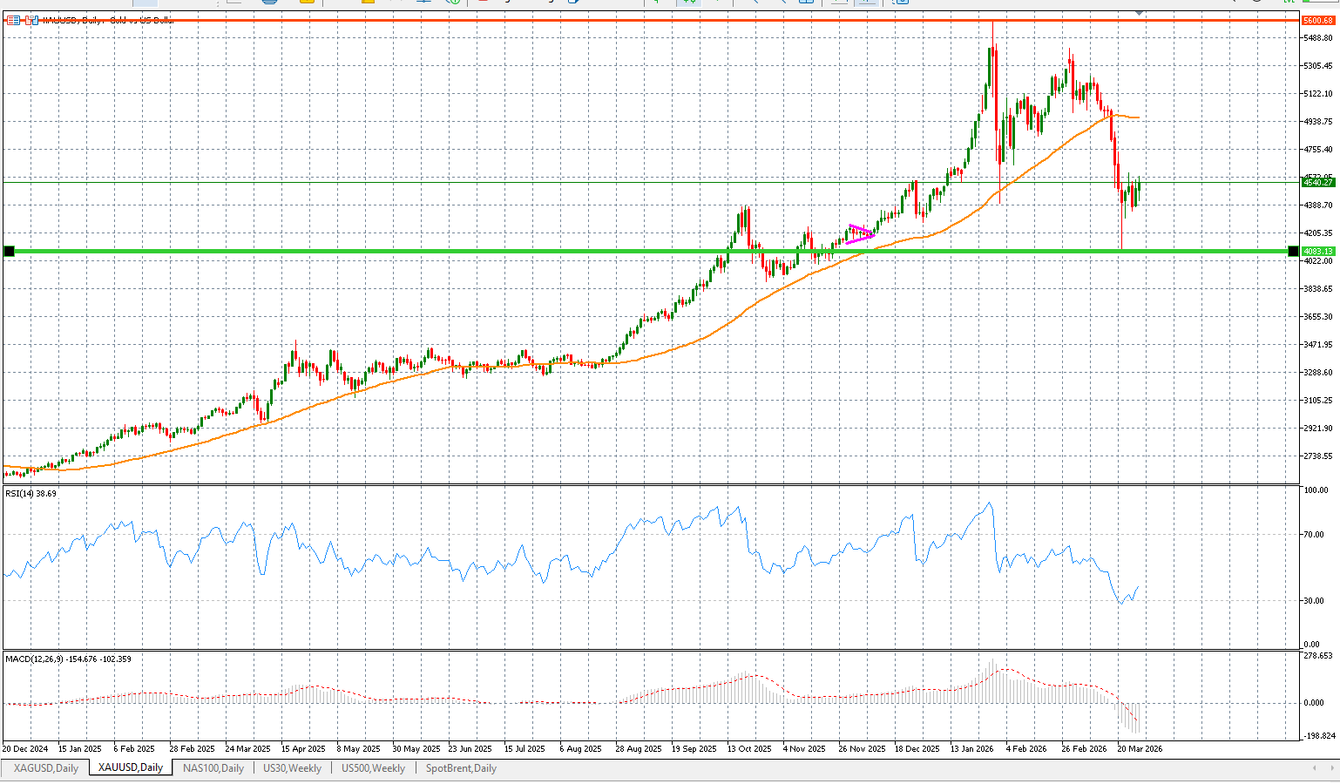
Image Source: Kitco News
Gold is stabilising in the mid-$4,500 to $4,600 range after a sharp correction from January’s record highs near $5,600, reflecting a market recalibrating amid competing inflation risks, interest-rate expectations, and geopolitical tensions. The metal’s response has shifted from a straightforward safe-haven surge to a more nuanced dynamic, where rising oil prices and inflation expectations have intermittently pressured bullion even as geopolitical uncertainty persists. The market is now balancing inflation and growth risks, with elevated energy costs signalling inflation while concerns over slowing economic activity temper broader gains.
The stabilisation suggests aggressive liquidation has eased and gold is increasingly behaving as a macro-sensitive instrument rather than a purely defensive asset. Policy uncertainty, particularly around interest rates, continues to underpin support, while geopolitical developments maintain risk premiums. Cross-market signals indicate that pressures from rising yields and energy prices are moderating, and the recent correction appears more like a strategic reset than a structural breakdown. As long as inflation remains elevated and policy clarity is limited, gold is expected to stay supported as a long-term anchor amid global market complexities. Source
Gold is ending a three-week losing streak, trading around $4,525 per ounce after holding long-term support near $4,100. The rebound comes despite rising oil prices above $98 a barrel and a stronger U.S. dollar, with analysts suggesting the metal may have found a durable bottom and that safe-haven dynamics could be reasserting. However, risks remain, including potential central bank sales of gold reserves, such as Turkey’s recent monetisation of nearly 60 tonnes, which could weigh on prices and offset short-term gains.
Market participants note that a prolonged Middle East conflict driving higher energy costs could stoke stagflation fears, creating an environment supportive of gold as a hedge against inflation. Analysts caution that a sustainable rally would require gold to retest and hold key support zones around $4,200–$4,300 before momentum toward $4,800 can develop. Attention is also focused on upcoming U.S. economic data and Fed commentary, which could influence gold’s trajectory amid continuing uncertainty over growth, inflation, and geopolitical risks. Source
Gold faces short-term challenges from rising Treasury yields, which may deter marginal buyers, but the medium-term outlook remains strong as underlying economic factors continue to support its appeal for both individuals and institutions. Ryan McIntyre of Sprott Inc. believes the next major wave of gold investment will come from broader institutional participation, which has so far been limited due to a lack of internal expertise in commodities and the strong performance of equities, which has reduced the urgency for diversification. While central banks have already accumulated gold, wider institutional adoption is expected once familiar asset classes like equities falter, with Bitcoin having drawn some institutional attention away from gold in recent years.
Silver, by contrast, faces a more uncertain path due to its dependence on industrial demand, which could be affected by geopolitical tensions such as the Iran conflict. Although silver is in a supply deficit and retains some appeal as a diversifier, rising yields and weakening industrial demand are likely to weigh on prices in the near term. Investment interest in silver is expected to follow gold’s trend, with any renewed momentum contingent on a rise in gold first. Source
Turkey’s central bank has reduced its official gold reserves by nearly 59 tonnes over the past two weeks, partly selling gold outright and partly using it in swap agreements to secure foreign currency or liras. This move comes amid heightened global economic uncertainty linked to the U.S.-Israel conflict with Iran, which has increased demand for emergency liquidity. Turkey, previously one of the most aggressive central bank buyers of gold, has monetized its reserves before, notably in 2023 during a period of high inflation and a record current account deficit, before rebuilding its holdings once conditions stabilised.
The recent sales highlight a broader trend in which central banks may prioritise liquidity and domestic needs over gold accumulation. Analysts note that other central banks, such as Poland’s, could follow a similar path, monetising reserves to fund urgent requirements like military spending. In this environment, central banks are expected to hold off on new gold purchases, focusing instead on assets that address immediate economic pressures and scarcity. Source
Federal Reserve Bank of New York President John Williams stated that the current monetary policy stance is well suited to manage a range of challenges, including higher near-term inflation driven by unusual circumstances such as the war in the Middle East. He noted that the conflict could trigger a supply shock, raising inflation through higher commodity and intermediate costs while simultaneously slowing economic activity. Although energy price increases are expected to push inflation up in the coming months, Williams anticipates some reversal later in the year if oil prices decline after the conflict ends. He did not indicate any immediate need for changes to policy.
The ongoing conflict has created a delicate balancing act for the Fed, with higher energy costs threatening both inflation and economic growth. While financial markets are considering the possibility of rate cuts later this year, the Fed is maintaining caution amid upside inflation risks and potential labour market downside. Williams projects economic growth at around 2.5% this year, inflation peaking at 2.75% before returning to the 2% target next year, and a gradual easing of unemployment, offering a more optimistic outlook than many of his colleagues. Source
In this week’s Live from the Vault, Andrew Maguire explains the multi-layered pressures on gold, where price is being actively influenced rather than reflecting natural flows, and the recent correction masks strong underlying physical demand.
Andrew highlights key drivers including PPT intervention in derivatives, COMEX speculators, sovereign and oil-linked selling, and central bank accumulation, marking the transition from paper-driven selling to physical market dominance.
Disclaimer: These articles are provided for informational purposes only. They are not offered or intended to be used as legal, tax, investment, financial, or any other advice.