x




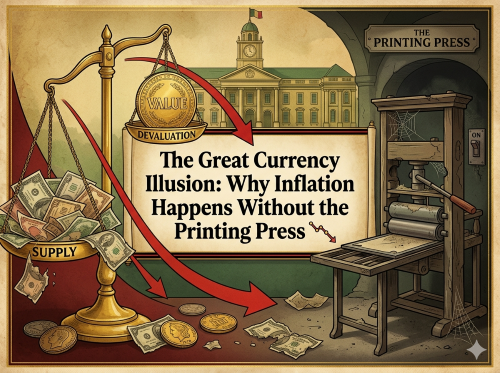
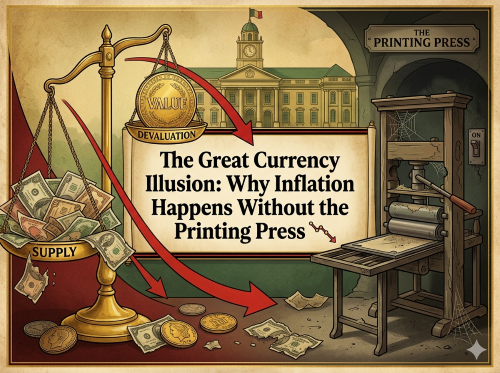
Many people believe that inflation is simply the result of central banks running printing presses at full speed. This is what economists traditionally refer to as 'money printing'. According to this standard view, if the government increases the supply of money, prices rise; if they keep the supply steady, prices should remain stable.
However, history tells a very different story. Inflation can—and frequently does—occur without any significant money creation at all. To understand why your money is losing purchasing power today, it is essential to look past the 'money supply' and focus on a far more critical factor: the underlying value of the currency itself.
Monetary inflation is best understood not as an increase in the number of banknotes in circulation, but as a decline in the value of a currency. While a falling currency value can be accompanied by an expansion of the money supply, the two do not always go hand in hand.
Consider the example of Bitcoin. Its total supply is algorithmically fixed and grows at a highly predictable, stable rate. Yet, its value has been famously volatile, experiencing dramatic surges and crashes. This real-world experiment disproves the traditional economic theory that a stable supply automatically guarantees a stable value.
Historically, governments did link money creation directly to state finances. Centuries ago, a ruler might collect a thousand silver coins in taxes, melt them down, and remint them into two thousand coins containing half the silver content. This classic debasement evolved into the literal printing of paper money. Today, however, inflation amongst major global economies is rarely driven by such crude, direct financing. Instead, it is born out of macroeconomic management, central bank missteps, and the inherent instability of floating fiat currencies.
To see how supply and value can operate entirely independently, we only need to look at nineteenth-century American history. Between 1775 and 1900, the United States dollar supply grew by an astonishing 160 times. Yet, because the dollar was strictly tied to a fixed weight of gold, its actual value remained unchanged. The price of commodities was virtually identical at the turn of the twentieth century to what it had been during the American Revolution. Massive money growth resulted in zero monetary inflation because the value of the currency was anchored.
The reverse scenario—where the money supply remains flat but value collapses—has happened repeatedly over the last century:
In 2020, global central banks genuinely did go 'bonkers', flooding the world economy with newly created digital money, which predictably triggered a sharp wave of inflation.
More recently, however, we have entered a different phase. The Federal Reserve and other global central banks have adopted a much more 'hawkish' stance, abandoning the zero-interest-rate policies of the previous decade. In fact, the Federal Reserve's base money supply has actually shrunk compared to its 2021 peak.
Yet, despite this lack of money printing, major fiat currencies have continued to lose significant ground against gold, the ultimate historical benchmark of stable monetary value.
Why is this happening? Floating fiat currencies naturally fluctuate, and when they decline, central banks rarely have the appetite to engineer a recovery in value. Raising rates might slow a currency's fall, but central banks almost never restore it to its old purchasing power because doing so is politically painful and recessionary.
Furthermore, the global market is forward-looking. Investors can see that governments worldwide are unwilling or unable to tackle their mounting debt and deficit crises. This growing lack of confidence chips away at the perceived value of fiat currencies, causing an accidental, chaotic devaluation.
The destructive chaos of floating currencies suggests that central banks cannot manage money effectively by simply tweaking interest rates or monitoring supply metrics. Throughout history, the only system that has provided true, long-term price stability is one where the value of a currency is firmly anchored to a reliable benchmark—namely, gold.
Regrettably, governments rarely choose to fix a broken monetary system when they can instead use inflation to quietly erode the real value of their colossal debts. Until a stable benchmark is restored, understanding that inflation is about a loss of currency value—not just printing presses—is the first step to protecting your financial future.
For a deeper dive into this historical perspective on currency and monetary policy, you can read the original analysis on BullionVault:
Source: 👉 Inflation Without Money Printing
Disclaimer: This article is provided for informational purposes only, mistakes may be made, and it's not offered or intended to be used as legal, tax, investment, financial, or any other advice.