x




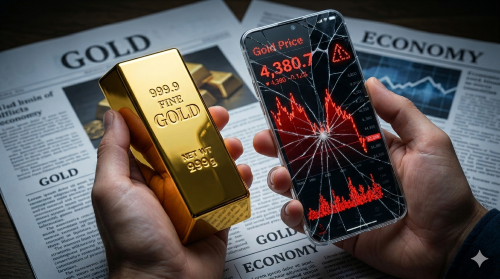
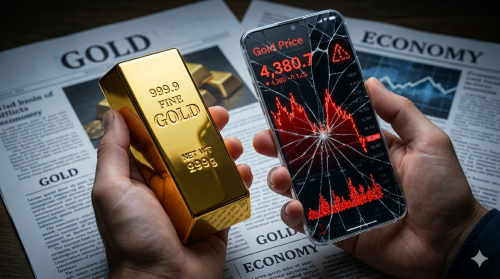
If you only glance at the financial news headlines, you would think the gold bull market has run out of steam. Spot prices have recently slid to a two-month low, hovering around the $4,380 to $4,400 mark. Financial commentators are pointing to a familiar mix of factors: escalating tensions in the Middle East, surging oil prices, a dominant US dollar, and renewed fears that the Federal Reserve might raise interest rates rather than cut them.
On paper, the bears seem to be winning. But beneath the surface of the digital tickers, a completely different reality is unfolding.
The physical gold market and the paper derivatives market are moving in opposite directions. While Western day-traders dump "paper gold" contracts, Eastern institutions and sovereign buyers are aggressively accumulating the physical metal at a historic pace. For savvy investors, this massive disconnect isn’t a sign of weakness—it is a generational buying opportunity. Let’s dive into what is actually happening behind the scenes.
Logically, geopolitical turmoil should drive investors straight into safe-haven assets like gold. Yet, since the US-Iran conflict flared up, spot gold prices have actually dropped by roughly 15%. This counterintuitive move is known as gold’s "double bind."
When conflict triggers strikes near critical trade zones—such as the recent military actions near Iran's Bandar Abbas airport—crude oil prices spike. Because the global economy runs on oil, this immediately stokes fears of energy-driven inflation.
For the Federal Reserve, higher inflation means interest rates must stay elevated, or even increase. Because gold is a non-yielding asset (it doesn’t pay monthly dividends or interest coupons), the prospect of higher interest rates raises the opportunity cost of holding it.
At the same time, global market panic forces large institutional funds to sell off liquid assets—including their paper gold positions—to raise cash and cover losses elsewhere. This forced selling, combined with a surging US dollar, creates an artificial downward pressure on the spot price.
This phenomenon isn't new. Analysts point out that gold often drops during the initial shock of a global crisis.
A prime example occurred in March 2020 during the onset of the COVID-19 pandemic. As global stock markets crashed, gold initially plummeted by roughly 12% as investors scrambled for liquidity. However, because the underlying structural demand for the precious metal never changed, gold recovered all its losses within just six weeks and went on to hit new highs.
The current selloff is following the exact same script. The short-term price drops are driven by temporary paper positioning, while the long-term, structural demand from central banks and global investors remains entirely intact.
While Western institutions trade paper slips, Asia is swallowing up the actual physical supply. Nowhere is this more obvious than in China.
In April 2026, China’s net gold imports via Hong Kong nearly tripled month-on-month, exploding to 43.5 tonnes. To put that in perspective, March had actually seen a net export of 4.9 tonnes. Total monthly imports reached 58.6 tonnes—a massive 178% increase in just thirty days.
What makes this surge remarkable is that it is happening despite high prices and relatively soft consumer jewellery demand. Chinese commercial banks fully utilised expanded import quotas because their clients are buying gold strictly for wealth preservation and investment.
According to the World Gold Council, China's net imports for the first quarter of 2026 reached an astonishing 316 tonnes. That represents a 182% increase over the previous quarter and a spectacular 333% rise year-on-year. When the world’s largest gold consumer triples its intake, it is an unmistakable signal of long-term conviction.
As Eastern demand surges, the physical backing of Western futures exchanges is quietly evaporating.
In late May 2026, registered gold inventories at the COMEX exchange fell by roughly 6.5% in just 30 days. That means approximately 1.1 million ounces of gold were physically withdrawn from CME Group-approved vaults. This is metal that was actively sitting there to back up futures contracts, and it has now been removed from the system.
This isn’t a sudden, panicky run on the banks. Instead, it is a slow, steady, and deliberate drain. Large buyers are taking delivery of their metal and moving it into private, unallocated storage with absolutely no intention of leaving it in the paper trading ecosystem.
With thousands of paper contracts still outstanding and fewer physical ounces available in the vaults, the ratio of paper claims to deliverable physical supply is tightening to historic levels.
This migration of gold is part of a much larger macroeconomic trend: global wealth is moving East.
According to the Boston Consulting Group (BCG) 2026 Global Wealth Report, Hong Kong has officially overtaken Switzerland as the world's largest cross-border wealth hub. Cross-border assets in Hong Kong jumped 10.7% to reach $2.95 trillion, narrowly nudging past Switzerland’s $2.94 trillion.
While Switzerland is still absorbing defensive safe-haven capital fleeing the Middle East conflict, Hong Kong and Singapore are growing at an estimated 9% annually. By 2030, Asia's wealth hubs are projected to outpace Switzerland by nearly $600 billion.
The exact same capital pools driving this historic shift in global wealth are the ones buying up physical bullion. The rise of Eastern financial power and the surge in physical gold demand are the exact same story.
The financial world currently has two gold markets. There is the paper market—where computer algorithms and leveraged traders price gold based on daily oil fluctuations, Fed rate rumours, and dollar strength. Then there is the physical market—where sovereign nations, central banks, and ultra-wealthy individuals are quietly accumulating every physical ounce they can get their hands on.
History shows that the paper price and the physical reality always reconcile eventually, and the physical market always wins. Investors who can look past the short-term noise of the price tickers and hold tangible, physical metal will be the ones vindicated when these two worlds inevitably collide.
To read the original industry update and explore more market analysis, visit the full report on GoldSilver.com:
👉 Gold Radar: 5 Stories the Price Chart Isn’t Telling You
Disclaimer: This article is provided for informational purposes only, mistakes may be made, and it's not offered or intended to be used as legal, tax, investment, financial, or any other advice.