x



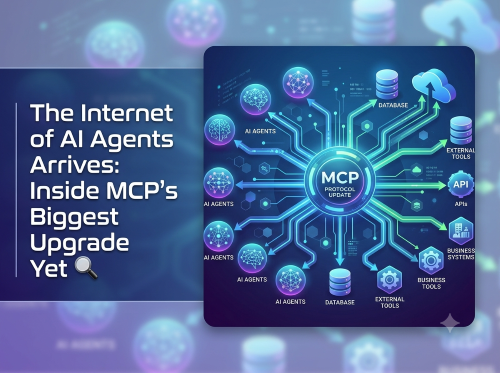
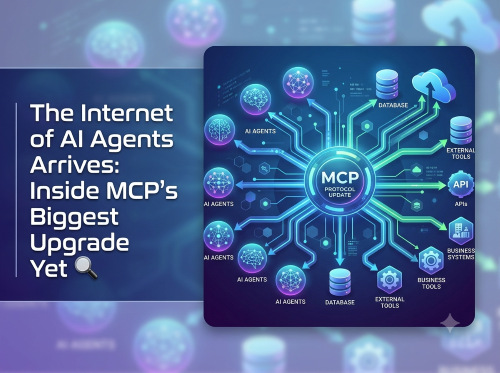
The Model Context Protocol (MCP)—the open standard serving as the vital connective tissue between artificial intelligence agents and real-world software—has just undergone its most consequential evolution to date. Under the stewardship of the Agentic AI Foundation (AAIF), a directed fund under the Linux Foundation, MCP has completed a sweeping architectural overhaul.
This update transitions the protocol to a fully stateless design, hardens its authentication infrastructure, establishes a formal enterprise deprecation policy, and introduces powerful new extensions. Together, these changes mark a definitive turning point: AI agents are officially moving out of sandbox pilots and into massive enterprise production environments.
To understand why this architectural revision is being hailed across the tech sector, one must look at the operational hurdles that previously constrained autonomous agents.
Under MCP’s original design, an AI client maintaining a dialogic workflow had to preserve a persistent, stateful connection with a specific server instance. In modern cloud-native environments—where compute nodes spin up, scale down, and restart continuously behind load balancers—this requirement was a major point of friction. If a underlying server node failed or cycled off, the entire active session broke, causing agentic workflows to fail mid-task.
By transitioning MCP to a completely stateless architecture, the protocol now mimics the foundational design choice that enabled the modern World Wide Web. MCP clients can now communicate with standard load balancers and connect seamlessly to any available server node in a Kubernetes cluster or serverless deployment. Organisations no longer need complex "sticky routing" or shared state clusters simply to keep an agent operational.
Eliminating state at the protocol layer inevitably involves engineering trade-offs:
Because the vast majority of software engineers interface with MCP via official Software Development Kits (SDKs) in languages like TypeScript, Python, C#, Rust, and Java, migrating existing applications to the new architecture is designed to be virtually seamless.
Scaling autonomous systems across Fortune 500 infrastructure requires rigorous security guarantees and predictable life-cycle management. This release delivers both.
Mandatory 12-Month Deprecation Horizon
To prevent surprise breaking changes, the AAIF has introduced a strict 12-month deprecation policy. Before any protocol feature can be formally removed, developers are guaranteed a full year's notice. Formulated through direct consultation with cloud leaders including Google, Microsoft, and Amazon, this governance rule provides enterprise engineering departments with the stability required to commit long-term resources.
Hardened OAuth 2.0 and Identity Protection
On the security front, the updated standard enforces mandatory validation of the issuer (iss) parameter during authentication. This preventive enhancement closes off potential OAuth mix-up attacks, ensuring AI clients cannot be tricked into sending credentials or sensitive prompt contexts to illegitimate identity providers.
Furthermore, through a collaboration with identity provider Okta, the release incorporates an Enterprise Managed Authorization extension. This allows central security teams to mandate corporate credential sign-ons across hundreds of internal MCP servers, preventing unverified third-party tools from tapping into company data silos.
As AI applications mature, simple conversational text outputs are no longer sufficient. This release elevates two major capabilities into official protocol extensions, expanding how humans and agents interact:
1. MCP Apps (Server-Rendered Interfaces)
Instead of returning long paragraphs of text, MCP servers can now deliver rich, interactive, server-rendered user interfaces directly inside the client application. Users can interact with dynamic dashboards, forms, and visual components generated on the fly, dramatically accelerating the deployment of complex operational tools.
2. MCP Tasks (Long-Running Operations)
Real-world enterprise tasks—such as batch processing video assets, analysing vast financial ledgers, or querying massive databases—rarely conclude instantly. Instead of keeping fragile connection streams open indefinitely while a job executes, MCP Tasks introduces durable task handles. A client can initiate a job, disconnect, restart, or pivot to other work, and subsequently poll or receive notification once the long-running process completes.
3. Multi-Round-Trip Requests
Servers and clients can now negotiate parameters dynamically within a single logical operation. If an agent needs additional confirmation or missing parameters before completing an action, it can execute a multi-turn conversation over the existing stream to finalise the request.
Originally created by Anthropic in late 2024, MCP was formally donated to the Agentic AI Foundation under the Linux Foundation in late 2025. Since then, stewardship has broadened into a multi-vendor effort.
While Anthropic engineers continue to serve as key maintainers, the core working groups now feature active leadership from Microsoft, OpenAI, Google, Amazon, and Block. Membership in the AAIF has surged past 240 organisations, spanning tech vendors, retail giants, financial institutions, telecommunications providers, and consumer protection bodies.
Crucially, MCP remains completely model-agnostic. Whether an enterprise deploys open-weight models like Gemma or Kimi, or frontier proprietary models, MCP provides a unified, open language for tool integration and system access. By establishing a neutral venue where competing technology firms align on open protocols, the industry is building the foundational infrastructure for a global "Internet of Agents."
With SDK downloads hitting roughly 250 million per week, the Model Context Protocol has moved far beyond its origins as an experimental open-source project. By delivering stateless scalability, enterprise-grade identity controls, long-running task support, and vendor-neutral governance, this landmark update gives developers the robust plumbing needed to power the next generation of autonomous AI systems.
For further technical details and deep-dive insights regarding this announcement, you can read the original coverage on VentureBeat:
👉 MCP just got its biggest update ever — here’s what changes for AI agents
Disclaimer: This article is provided for informational purposes only, mistakes may be made, and it's not offered or intended to be used as legal, tax, investment, financial, or any other advice.