x




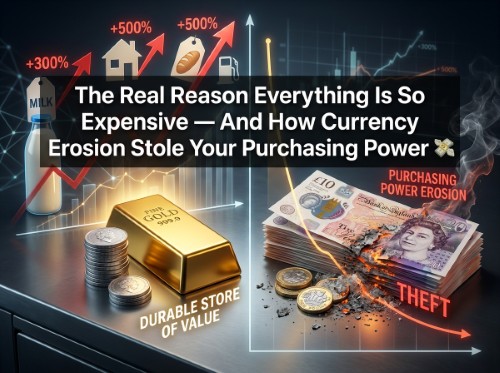
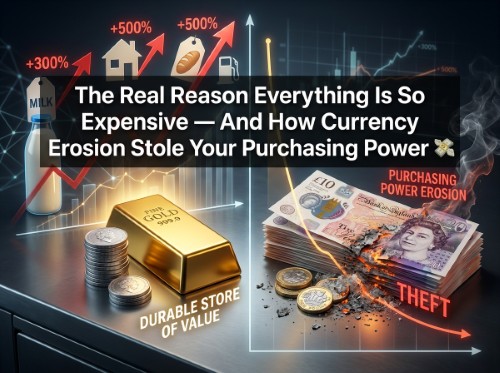
You work hard, productivity hits record highs, and the broader economy keeps growing. Yet, at the end of every month, your earnings seem to stretch a little less than they used to.
Whether it is buying a home, paying the energy bill, or filling a trolley at the supermarket, there is an inescapable feeling that the game has been rigged. You are not imagining it, and you are certainly not alone. The economic data confirms what millions of households feel every day. However, standard mainstream coverage often misses the core truth by treating housing unaffordability, stagnant wages, skyrocketing debt, and inflation as isolated issues.
They are not separate problems. They are multiple symptoms of a single underlying cause: the steady, relentless erosion of purchasing power through monetary expansion.
For previous generations, buying a home was a standard milestone of adulthood. Today, it feels like an insurmountable hurdle for millions of working families.
In 1985, the median home in the United States cost roughly $82,000, while the median household income was about $23,000. That represented a price-to-income ratio of around 3.5. In straightforward terms, it took roughly three and a half years of gross income to buy the average property.
Fast forward to the present day: the median home price has climbed above $400,000, while median household incomes sit around $80,000 to $82,000. That ratio has stretched to 5. It now requires five full years of gross income—before taxes, utility bills, or groceries—just to cover the cost of a average home.
This dramatic 40-year deterioration in affordability did not happen by accident. Home prices expanded by roughly five times over four decades, while incomes grew less than four times over the same period. Crucially, housing was increasingly fuelled by decades of cheap credit and historically low interest rates. When central banks inflate the money supply, that excess capital naturally flows into financial assets and real estate first, driving prices out of reach before wages ever have a chance to catch up.
One of the most persistent myths in modern economics is that people are struggling because they simply aren't working hard enough. The data tells the exact opposite story.
Since 1979, worker productivity has grown by more than 90%. Workers are producing nearly double the economic output per hour compared to 45 years ago. Yet over that exact same timeline, typical worker pay grew by just 33%.
If wages had kept pace with productivity, the average worker would be earning considerably more per hour today. So where did that lost value go? While top earners and asset owners captured a vast share of those gains, the real purchasing power of the average wage was quietly eaten away.
Your pay cheque may show a higher nominal figure than it did ten years ago, but the crucial metric is real purchasing power—what that money actually buys. When the money supply expands faster than the production of real goods and services, every individual unit of currency represents a smaller slice of the economic pie. Your wages go up on paper, but your bills go up even faster.
To bridge the growing gap between stagnant real incomes and soaring living costs, households have turned to the only tool available: debt.
US household debt reached a staggering record of $18.8 trillion, with mortgage balances making up $13.2 trillion of that total. Decades of escalating property prices forced buyers to take on larger, longer-term loans just to secure shelter.
At the same time, governments have followed an even more extreme borrowing trajectory. US public debt recently surged past $39.4 trillion, representing more than 100% of the entire country's annual gross domestic product (GDP). The government now owes more than the entire economy produces in a year—a sharp contrast to 1990, when debt was well under half of GDP.
This national debt is not an abstract figure confined to spreadsheets. Annual interest payments on government debt now exceed $1 trillion, surpassing the entire national defence budget. When governments run permanent deficits of this scale, they must either borrow heavily or rely on central bank creation to expand the currency supply. Either path dilutes the value of existing money and accelerates the cost-of-living squeeze on everyday citizens.
It is easy to view high house prices, lagging pay, record debt, and price inflation as completely distinct events driven by corporate greed, supply chain shocks, or political disagreements.
In reality, they are all branches of the same tree.
When governments run persistent budget deficits and central banks expand the money supply to absorb that debt, the fundamental unit of exchange loses value. Increasing the supply of any item without increasing the underlying demand or supply of real goods naturally makes each unit worth less. Apply that fundamental law to money, and prices rise across the board.
Asset markets like housing absorb expansionary money first, sending property values soaring. Wages adjust far more slowly, lagging behind real costs. Households take on credit cards and massive mortgages to maintain their lifestyle. Governments borrow continuously to fund deficits, requiring even further monetary expansion. It is a self-reinforcing cycle driven by the mechanics of fiat currency.
When the purchasing power of paper currency steadily declines, assets with a strictly limited supply tend to behave very differently.
Gold and silver cannot be printed at the click of a button or created via central bank balance sheet expansion. There is a finite amount of physical metal in the earth, requiring real energy, time, and labour to extract.
In 1990, gold traded at roughly $387 per ounce. Today, it trades at over $4,000 per ounce. Silver has experienced a similar trajectory, trading near $58 per ounce. These price surges are not random speculative bubbles; they are a direct mirror reflecting the debasement of paper currency over the exact same multi-decade period.
As housing affordability deteriorates and national debts reach unprecedented levels, tangible assets with fixed supplies increasingly highlight the difference between real wealth preservation and paper currency.
Understanding how monetary expansion impacts your daily life is the vital first step toward protecting your financial future in an era of relentless currency dilution.
GoldSilver - The Economy Is Broken. Here's Who Got Rich Anyway.
Everything you feel is broken about the economy is real. The housing math, the stagnant wages, the debt, the purchasing power that keeps slipping away. The data backs you up on every count. But that is only half the story.
Meet Megan King Diaz, the new host of The Gold Silver Show. A former Wall Street analyst and investment advisor who managed money for high net worth clients, and the founder of Economic Muse, Megan left the world of being expected to have all the answers to start asking the same questions you're asking. In her first episode, she walks through what the data actually shows: the broken parts of the system, and the quiet pattern that rewarded the people who understood what was happening.
For a deeper dive into these economic mechanisms and expert commentary on navigating today's markets, you can read the full original article and watch the accompanying breakdown at GoldSilver.com:
👉 Why Is Everything So Expensive? The Real Reason Explained
Disclaimer: This article is provided for informational purposes only, mistakes may be made, and it's not offered or intended to be used as legal, tax, investment, financial, or any other advice.