x




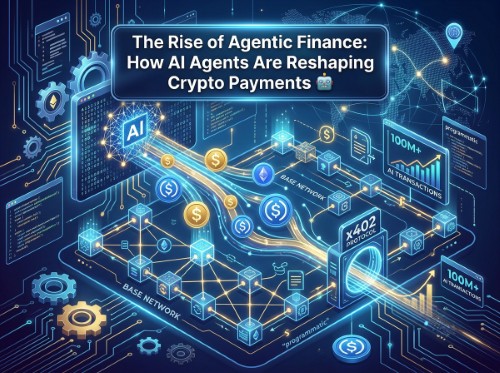
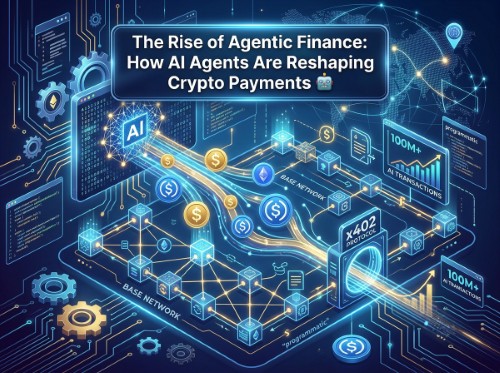
As artificial intelligence continues to redefine global technology, a fundamental shift is occurring at the intersection of AI and blockchain technology. Rather than competing for capital and attention, these two revolutionary fields are converging into a new economic model known as Agentic Finance (AiFi).
Coinbase Chief Executive Brian Armstrong recently addressed the debate surrounding whether cryptocurrency platforms should pivot towards artificial intelligence. Instead of viewing AI as a threat to blockchain relevance, Armstrong highlighted how autonomous software agents will inherently drive massive demand for decentralised financial services.
Here is a detailed look into how Agentic Finance works, why legacy banking systems fall short for autonomous software, and how Coinbase’s technology stack is quietly processing hundreds of millions of automated transactions.
Agentic Finance refers to an economic environment where autonomous software entities—commonly known as AI agents—actively participate in the digital economy. These agents do not merely suggest actions to human operators; they independently perform complex tasks, purchase digital assets, pay for micro-services, and interact with financial protocols without human intervention.
To operate effectively, autonomous agents require financial infrastructure that can execute transactions instantaneously, around the clock, and with negligible overheads. Traditional financial institutions are fundamentally ill-equipped to support this level of automation. Opening a conventional bank account requires identity verification, physical documentation, and human approval. Furthermore, credit card rails and traditional wire transfers impose high fees and slow settlement cycles that make automated micro-payments unfeasible.
In contrast, blockchain networks provide programmable money. Through smart contracts and cryptographic wallets, an AI agent can hold funds, send payments, and execute transactions programmatically in milliseconds.
To power autonomous machine-to-machine payments, Coinbase has assembled a dedicated three-part technical stack:
1. Base: High-Throughput Layer 2
Launched in 2023, Base is an Ethereum Layer-2 scaling network designed to deliver fast settlement speeds and low transaction fees. While originally created as general-purpose blockchain infrastructure, Base has rapidly emerged as a primary settlement layer for automated software agents due to its minimal cost per transaction.
2. USDC: Reliable Digital Currency
Volatility presents a significant challenge for automated systems attempting to price services dynamically. USDC—the dollar-pegged stablecoin co-developed by Circle and Coinbase—provides the price stability required for software programs to calculate costs accurately, settle invoices, and manage treasury balances without exposure to market fluctuations.
3. x402: The Automated Payment Protocol
Introduced in 2025, x402 is an open payment protocol built around the long-overlooked HTTP "402 Payment Required" status code. The protocol enables web applications, APIs, and AI agents to request and settle stablecoin payments automatically. By removing manual checkout interfaces and login requirements, x402 allows software to programmatically pay for data feeds, server compute, and specialised API access on demand.
The adoption of Agentic Finance is no longer purely theoretical. On-chain data demonstrates that automated machine-to-machine activity is expanding rapidly:
This rapid growth underscores how quickly developer ecosystems are integrating x402 and Base into automated AI pipelines.
The core argument articulated by Brian Armstrong is straightforward: AI agents cannot rely on legacy financial rails.
If an AI agent needs to query a database 1,000 times per minute, paying a fraction of a penny per call, traditional credit cards or banking clearing systems cannot process those micro-transactions economically. Crypto rails offer several crucial advantages for machine-driven operations:
As artificial intelligence systems grow more capable, their need for autonomous economic agency will only increase. Rather than replacing the need for Web3 technology, the expansion of AI serves as a major catalyst for blockchain adoption.
The seamless integration of high-speed Layer-2 networks like Base, stable digital assets like USDC, and automated protocols like x402 demonstrates that the infrastructure for a fully machine-driven economy is already live and scaling fast.
To read the full news coverage and explore additional details regarding Chainalysis tracking and Coinbase earnings metrics, visit the original article on Cointelegraph:
👉 Coinbase CEO touts agentic finance as Base tops 100M AI payments
Disclaimer: This article is provided for informational purposes only, mistakes may be made, and it's not offered or intended to be used as legal, tax, investment, financial, or any other advice.