x




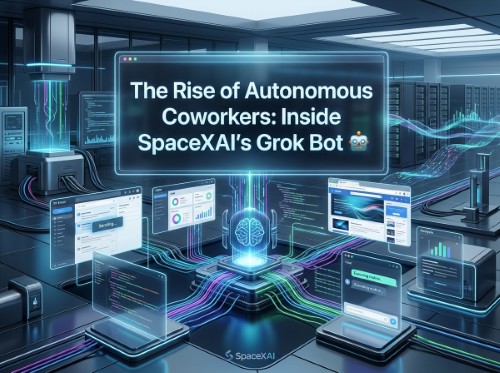
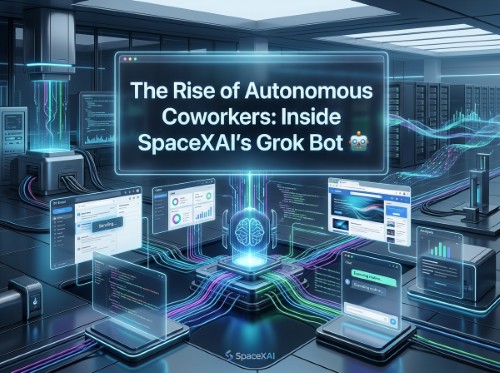
The enterprise artificial intelligence landscape is undergoing a fundamental structural shift. We are rapidly moving past the era of passive, prompt-driven chatbots that require constant human supervision and manual task execution. With the launch of Grok Bot in early beta, SpaceXAI—the division formed around xAI, SpaceX, and Cursor—has introduced a new paradigm: persistent digital coworkers designed to log into applications, execute complex workflows, and operate autonomously on dedicated cloud infrastructure.
Starting at $120 per seat per month, Grok Bot transforms how organisations approach daily operations, software interactions, and cross-team collaboration.
Rather than relying strictly on custom API connectors or Model Context Protocol (MCP) integrations, Grok Bot operates through its own persistent cloud computer environment. Each Bot is equipped with a virtual browser, filesystem, and desktop interface, allowing it to sign into websites and legacy software using standard human user credentials.
This design choice resolves one of the biggest friction points in modern enterprise software: fragmented SaaS ecosystems without clean API access. A Grok Bot can perform tasks inside any destination tool—from updating CRM records overnight to sifting through Zendesk queues—and continue working seamlessly even after you close your laptop.
The setup process is remarkably simple. Users can train a Bot through a "teach a task" feature. By demonstrating a workflow once while the Bot observes, the system saves the action sequence as a repeatable routine, adapts to user preferences over time, and integrates corrective feedback as edge cases arise.
One of Grok Bot’s most powerful capabilities is its multi-agent orchestration framework. Rather than deploying isolated bots for single tasks, users can assemble specialised digital teams.
A typical configuration might include distinct Bots assigned to specific roles:
Because multiple Bots can share context, chat threads, and filesystem environments on the backend, they pass work back and forth independently. The human professional steps into the loop primarily to provide judgment calls or high-level strategic sign-offs.
SpaceXAI has made Grok Bot available across macOS, Windows, Linux, and iOS:
At this price point, Grok Bot moves away from low-cost utility subscriptions and positions itself as operational infrastructure. For decision-makers, the economic calculation rests on whether persistent digital labour can eliminate enough repetitive manual work and traditional automation maintenance to yield a net positive return on investment.
As AI agents gain full autonomy over production environments, execution reliability becomes paramount. A faulty chatbot answer is easily discarded, but an autonomous worker modifying live CRM databases or communicating with external clients presents real operational risks.
SpaceXAI addresses this by encouraging clear escalation rules and permission boundaries. Consequential actions—such as sending financial payments, making public posts, or altering critical production settings—require explicit human confirmation before completion.
Additionally, Grok Bot utilises an automated backend routing model to distribute tasks across underlying LLMs. While this simplifies the experience for non-technical workers, enterprise deployment teams will likely seek greater visibility into model selection, latency, and token consumption management as usage scales.
Grok Bot represents a pivotal shift from conversational assistants to persistent digital colleagues. The future of enterprise productivity won't just depend on asking AI the right questions, but on how effectively we can manage teams of autonomous agents performing continuous, real-world work.
Disclaimer: This article is provided for informational purposes only, mistakes may be made, and it's not offered or intended to be used as legal, tax, investment, financial, or any other advice.