x




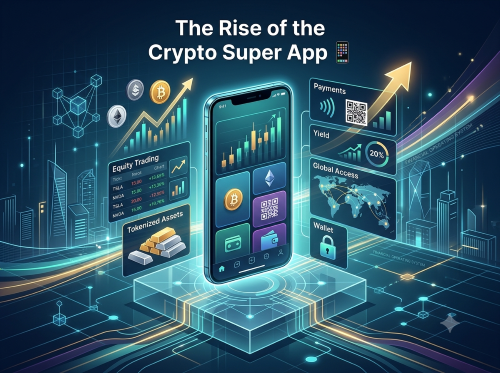
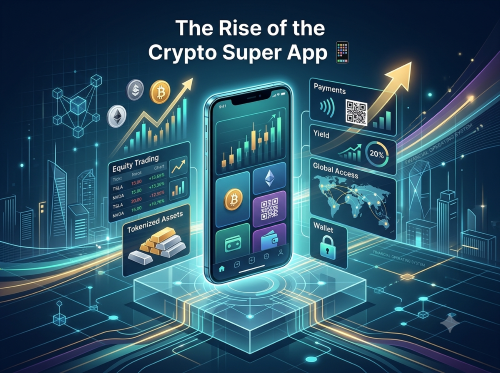
In the early days of cryptocurrency, centralised exchanges competed primarily on raw technical specifications. Success was defined by order execution speed, order book depth, market liquidity, and lower trading fees. However, as infrastructure across leading platforms has matured and standardised, these core execution metrics have transformed from competitive differentiators into basic entry requirements.
To build sustainable moats and drive long-term growth, major crypto venues are pivoting toward a much broader ambition: transforming from simple trading venues into comprehensive financial operating systems.
Instead of operating solely as platforms for buying and selling digital tokens, platforms are now consolidating trading, yield generation, payment rails, self-custody wallets, traditional equities, and real-world assets (RWAs) into a single, unified interface.
The concept of a "super app" is not entirely new, but its application to digital assets represents a profound shift in global finance.
In Asian markets, platforms like WeChat evolved from messaging services into daily life operating systems serving over 1.4 billion users, while Alipay transitioned from a payment processor into a gateway connecting over a billion consumers to thousands of financial services. In Western fintech, companies like Revolut followed a similar trajectory, expanding from foreign-exchange cards into multi-asset platforms spanning stock trading, crypto, savings, and lending.
The strategic logic behind a super app is straightforward: capturing the entire life-cycle of a user’s capital. Rather than running isolated product lines, a platform brings every financial tool into one interface. Every new service added gives users fewer reasons to leave, dramatically raising switching costs, lowering customer acquisition costs (CAC), and increasing lifetime customer value (LTV).
Centralised crypto venues possess four structural advantages that make them exceptionally well-equipped to win the financial super-app race:
The clearest demonstration of this super-app evolution in action is Binance. Holding over $153 billion in disclosed user reserves and processing roughly a third of global centralized spot volume alongside 42.5% of global futures volume, Binance has expanded aggressively beyond digital assets.
In early 2026, the platform introduced gold and silver perpetual contracts settled in stablecoins. Months later, it expanded into direct U.S. equities trading across more than 7,000 U.S. stocks and exchange-traded funds (ETFs) with zero commissions and fractional ownership.
This was further augmented by bStocks—1:1 tokenised versions of major public equities like Tesla, NVIDIA, and Microsoft issued on the BNB Chain. These tokenised assets trade 24/7 and seamlessly plug into decentralised finance (DeFi) protocols.
The market response highlighted strong demand:
In less than a year, the boundary between crypto exchanges, stockbrokerages, and commodities markets has blurred. Investors can now manage Bitcoin, hedge with gold, and trade fractional stock shares—all from a single login, account balance, and mobile app.
This structural transformation delivers profound benefits to both sides of the market.
For Financial Platforms
Expanding into a financial operating system de-risks exchange business models from crypto market cyclicality. Revenue streams diversify away from purely transaction-fee reliance into payment processing fees, yield spreads, conversion margins, and asset management fees on tokenised products. A broader suite of features strengthens user retention and lowers the overall cost of acquiring users across adjacent product lines.
For Everyday Users
Users benefit from unprecedented operational simplicity:
Historically, the primary obstacle to building a multi-asset financial operating system was regulatory ambiguity across major jurisdictions. However, regulatory frameworks are rapidly evolving to accommodate cross-asset innovation.
Legislative milestones such as the U.S. GENIUS Act provided federal clarity for stablecoins, while regulatory bodies globally are drafting updated rules for integrated multi-asset custody and trading platforms.
As regulatory hurdles continue to clear, the debate moves away from whether crypto super apps are permissible toward which platforms will execute the vision most effectively. The future of finance belongs to integrated networks where crypto, traditional equities, and real-world assets coexist seamlessly within a single operating system.
For further research and deeper statistical insights on this topic, read the full report at The Block Research:
👉 How Crypto Venues Are Building Financial Operating Systems: Binance as a Super App
Disclaimer: This article is provided for informational purposes only, mistakes may be made, and it's not offered or intended to be used as legal, tax, investment, financial, or any other advice.