x




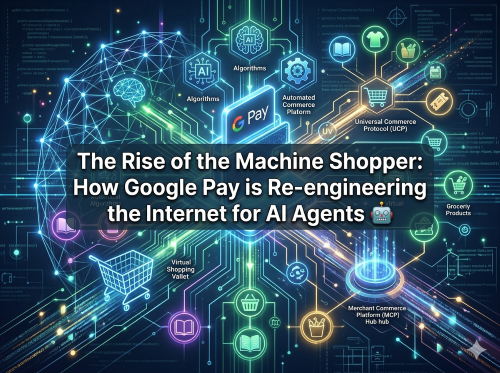
Imagine a world where you never have to navigate a cluttered checkout page, compare shipping rates, or manually enter your credit card details ever again. Instead, you simply tell your personal AI assistant, "Book me a return flight to Edinburgh for next weekend and order my usual weekly groceries," and it happens instantly in the background.
This is the promise of autonomous AI agents. However, while artificial intelligence has made massive leaps in understanding human language, it hits a digital brick wall when it tries to buy things for us. Today’s e-commerce websites are built exclusively for human eyes, relying on visual cues, pop-ups, and multi-step forms. To an AI agent, a standard checkout page is an unpredictable obstacle course.
Recognising this friction, Google is quietly pulling off a massive infrastructure overhaul. By shifting away from user-interface-dependent checkouts, Google Pay is positioning itself as the foundational backend for machine-to-machine commerce. Through the introduction of the Universal Commerce Protocol (UCP) and a brand-new server architecture, the tech giant is preparing for a future economy driven by autonomous digital buyers.
To understand how profound this shift is, we have to look at the new underlying technology Google is deploying. This isn't just a minor software update; it is an entirely new framework designed to bypass human checkout pages altogether.
1. The Universal Commerce Protocol (UCP)
Right now, if an AI developer wants their agent to buy something from three different online retailers, they have to write custom code to interact with each individual shop. The Universal Commerce Protocol solves this by creating a standardised global language for commerce. Whether an AI agent is talking to a global airline or a local boutique, UCP allows it to seamlessly initiate a transaction, verify real-time stock levels, and arrange delivery details through a single, unified specification.
2. The Merchant Commerce Platform (MCP) Server
Acting as the brains of this new operation is the Merchant Commerce Platform server. This server-side system acts as a bridge, handling complex merchant integrations and abstracting away the messy backend of online retail for the AI. Crucially for Google, this centralises immense amounts of transaction data, giving the company an unprecedented look at how autonomous agents behave and spend money.
3. Dynamic Callbacks for Android Native
During a typical checkout, things change. A user might alter their delivery address at the last second, causing shipping costs and taxes to fluctuate. To prevent AI agents from getting confused and restarting the entire purchase from scratch, Google has introduced dynamic callbacks into its Android Pay API. This allows the system to recalculate order variations on the fly, making the machine-driven transaction resilient and fluid.
4. Expanded WebView Support
Autonomous agents won’t just live inside standalone apps; they will operate across the web, particularly within social media platforms where conversational commerce is booming. By expanding payment support inside WebViews—the technology that allows apps to display web content—Google ensures that agents can natively execute secure payments anywhere on the web without forcing the user to open an external browser.
This structural shift introduces a radical challenge for businesses and marketing leaders. For decades, Search Engine Optimisation (SEO) and web design have been focused on human psychology: catchy headlines, beautiful imagery, and persuasive copywriting.
In an era dominated by AI agents, traditional SEO changes completely. Machines do not care about a beautiful layout or an emotional brand story. They care about structured data.
If an AI agent cannot instantly parse your product pricing, exact dimensions, real-time availability, and shipping parameters through clean, machine-readable data, your business effectively becomes invisible. In the machine economy, the companies that win won't just be those with the best marketing campaigns, but those whose digital inventory is most accessible to algorithms.
While the convenience of a universal standard is undeniable, it presents a significant strategic crossroads for Chief Information Officers (CIOs) and enterprise leaders.
By routing AI-driven commerce through its new MCP servers, Google positions itself as the ultimate clearinghouse for autonomous transactions. This grants the company a privileged, high-level view of global machine-purchasing trends. For businesses, relying heavily on a proprietary protocol introduces the long-term risk of platform lock-in. Enterprises must carefully weigh the immediate ease of adopting Google's ecosystem against the strategic cost of handing over valuable behavioural data.
Perhaps the biggest hurdle in letting AI buy things on our behalf is security. If a digital agent suffers a software glitch or falls victim to a malicious exploit, it could theoretically execute unauthorised, high-volume transactions in milliseconds, draining a user's bank account before they even notice.
To solve this, Google is implementing a "human-in-the-loop" security architecture powered by cross-device biometric authentication.
Under this model, the AI agent does all the heavy lifting—finding the product, negotiating the price, and filling out the backend data—but it cannot finalise the payment alone. Instead, it programmatically sends a prompt to the user’s smartphone. With a quick fingerprint scan or facial recognition check on their phone, the human approves the purchase that the agent arranged on their laptop or smart home device.
This elegant solution creates an essential digital kill-switch, providing a clear audit trail and ensuring that humans retain ultimate financial control without ruining the frictionless nature of automated shopping.
The transformation of Google Pay is a definitive signal that the internet is outgrowing its human-only origins. We are moving rapidly toward a dual-layered digital world: one built for human experiences, and a deeper, API-driven layer optimised entirely for artificial intelligence.
Enterprises that view their digital presence solely as a collection of visual websites will find themselves left behind. To thrive in this next phase of global commerce, businesses must start auditing their technical architecture today, ensuring their data structures are ready to welcome the world's newest and fastest consumers: AI agents.
For more detailed information and further insights into this developing story, read the original coverage on Artificial Intelligence News:
👉 Google Pay preps for AI agents with Universal Commerce Protocol
Disclaimer: This article is provided for informational purposes only, mistakes may be made, and it's not offered or intended to be used as legal, tax, investment, financial, or any other advice.