x




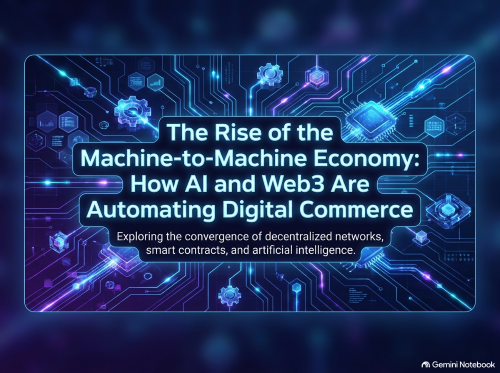
Something fundamental is shifting across the digital landscape. For decades, the internet was built around human interactions: humans clicking links, typing search queries, entering credit card details, and manually approving transactions. But as large language models (LLMs) and autonomous AI software agents evolve from simple conversational interfaces into proactive economic actors, that human-centric design is hitting a hard wall.
Today, AI agents are performing complex multi-step workflows—sourcing data feeds, spinning up cloud compute, hiring specialised sub-agents, and managing digital assets. To do this effectively, software requires a financial infrastructure that moves at its own pace: instant, frictionless, and completely automated. This necessity has sparked the convergence of Artificial Intelligence and Web3, creating a dedicated machine-to-machine economy powered by decentralized technology.
Traditional banking infrastructure and card networks were designed around human identity verification, business hours, and manual authorisation steps. An AI agent cannot produce a driver’s license for KYC compliance, nor can it afford to wait two business days for an ACH batch transfer to settle when it needs to purchase server capacity in milliseconds.
When autonomous agents require compute resources, real-time data access, or micro-transactions, legacy payment rails introduce unacceptable friction. This is where digital-native rails step in. Dollar-pegged stablecoins and HTTP-native payment protocols allow autonomous agents to pay for precisely what they use on a pay-per-call basis. According to Stablecoin Insider’s analysis on agentic payments and stablecoin rails, stablecoins provide the software-native liquidity and borderless finality required for machines to transact freely without needing manual human approval for every API request.
To act as self-sustaining economic entities, AI agents need more than just money—they need identity, governance, and cryptographic autonomy. Blockchains provide the exact primitives required to make software truly self-sovereign.
Through sovereign wallet architectures, an AI agent can securely hold funds, execute transactions, and maintain an immutable audit trail on-chain. Human principals can set granular spending controls, budget caps, and cryptographic delegation policies, ensuring that an agent operates strictly within its designated boundaries. As highlighted in CV VC’s insights on the on-chain AI agent economy, sovereign wallets and secure execution environments turn AI agents into an independent digital workforce capable of generating revenue, purchasing services, and managing capital autonomously.
Furthermore, programmable smart contracts act as the binding legal agreement between machines. When an agent requests a service from another autonomous node, smart contracts lock funds in escrow and release payment deterministically the moment performance is verified. As detailed in Chainlink’s research on the agentic economy, combining high-reasoning AI models with tamper-proof smart contract execution eliminates counterparty risk and enables hyper-efficient AI-to-AI commerce across global networks.
The synergy between AI and Web3 extends far beyond payments. Decentralised infrastructure networks are increasingly integrating self-operating AI nodes directly into their operational layers to manage tasks that are too fast or complex for human operations teams.
Rather than relying on static rules or periodic manual interventions, these intelligent nodes analyse real-time network traffic, dynamic gas fees, and liquidity conditions. They automatically optimise data routing across multi-chain paths, execute portfolio rebalancing, and perform predictive security screening to flag exploit vectors before malicious transactions are confirmed on-chain.
Infrastructure providers are already seeing rapid adoption of these specialised agentic frameworks. As outlined in QuickNode’s breakdown of top AI agents in Web3, intelligent agents are taking on diverse roles—from automated yield bots and governance proxies in DAOs to real-time risk monitors. Having low-latency RPC connections and reliable data streams ensures these software agents can monitor state changes and react at machine speed.
We are moving rapidly toward a future where autonomous agents may eventually outnumber human transactors on digital networks. As open standards for agent identity, permissioned delegation, and micro-settlement continue to mature, the friction between computational tasks and financial settlement will disappear completely.
The fusion of AI’s analytical reasoning with Web3’s trustless settlement layer represents more than just incremental automation—it is a fundamental paradigm shift. By giving machines their own financial layer, we are unlocking an internet economy that is faster, continuously operational, and infinitely more scalable than anything built for humans alone.
Disclaimer: This article is provided for informational purposes only, mistakes may be made, and it's not offered or intended to be used as legal, tax, investment, financial, or any other advice.