x




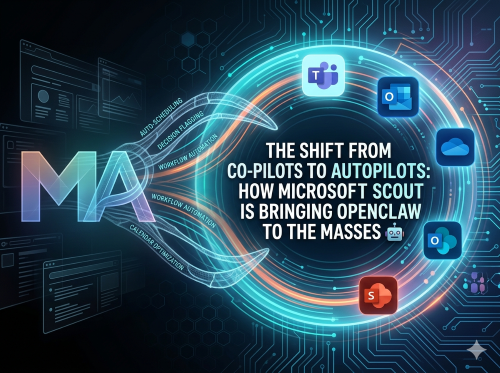
The tech world moves at a dizzying pace. If you talk to software developers or AI enthusiasts, they will tell you that autonomous AI agents are old news and that everyone is already using OpenClaw. In a way, they are completely right. However, there is a massive difference between a tool being popular on GitHub and a tool being accessible to the average office worker.
That is exactly the gap Microsoft is bridging. At its Build 2026 conference at the Fort Mason Center in San Francisco, Microsoft announced the launch of Scout. Scout is the tech giant's very first "Autopilot" agent, and it is built directly on top of OpenClaw.
While tech-savvy early adopters have been experimenting with agentic AI for months, Microsoft possesses something those developers do not: a massive, built-in audience of 1.4 billion Windows users ready to adopt this technology.
Meet Microsoft Scout.
— Microsoft 365 (@Microsoft365) June 2, 2026
An always-on agent that keeps work moving, taking action without needing to be prompted each time.
As Microsoft’s first Autopilot agent, Microsoft Scout works across Teams, Outlook, OneDrive, and more—taking action within the controls your organization… pic.twitter.com/YqeDABRHAy
For the past few years, the tech industry has been obsessed with "Copilots"—AI assistants, sidebars, and chatbots that wait for you to type a prompt before they help you. Microsoft was actually an early pioneer of this trend. Way back in February 2023, the company introduced the Copilot sidebar for the Edge browser. It was a context-aware assistant that knew what you were reading, though, truth be told, most people closed it immediately because the timing was early and the use case was not quite obvious yet.
By Build 2025, things evolved. GitHub Copilot transformed into a fully autonomous coding agent, and later that year, agentic browsing was brought into the everyday web experience.
But Scout represents a brand-new category that Microsoft calls "Autopilots." These are not chatbots you have to supervise or constantly prompt. Instead, these are AI systems that simply run in the background.
Instead of waiting for an instruction, Scout connects directly to your everyday workplace tools—including Teams messages, Outlook emails, OneDrive files, and SharePoint sites. It then quietly handles the complex, manual coordination work that professionals frequently forget to do. Scout can autonomously:
Schedule meetings across multiple complicated time zones.
Flag projects or decisions that have stalled in email threads.
Block out focus time on your calendar well before a major deadline sneaks up on you.
While independent developers might roll their eyes at Microsoft acting like it invented this technology, the genius of Scout lies in its distribution strategy.
Scout is powered by OpenClaw, an open-source personal agent framework that took the AI world by storm when it launched in January 2026. Created by Austrian developer Peter Steinberger (who was subsequently hired by OpenAI), OpenClaw accumulated an astonishing 180,000 GitHub stars in just three months.
Rather than trying to build a competing, closed-source framework from scratch, Microsoft chose to build Scout on top of OpenClaw’s incredibly solid repository. It is a win-win scenario. OpenClaw gets mainstream, enterprise-level distribution. Meanwhile, Microsoft gets a shortcut to a multi-billion-pound idea, gains instant credibility with the open-source community, and avoids having to explain complicated developer jargon to corporate clients.
Crucially for businesses, Microsoft is wrapping Scout in enterprise-grade security and contributing policy controls back to the open-source OpenClaw project. This means Scout can live inside Microsoft 365, landing on the desks of everyday workers who have never opened a terminal window in their lives and just want their afternoon meeting preparation handled automatically.
Scout did not debut in isolation. Microsoft CEO Satya Nadella made it clear during his keynote to 2,500 developers that AI agents are "the new operating system for work."
To support this vision, Microsoft also announced that the Windows operating system itself is being repositioned as a runtime environment for AI agents, complete with new execution containers and local model support.
Furthermore, Microsoft announced that its Work IQ APIs will become generally available on June 16. This organisational intelligence layer builds a real-time model of how a company operates by analysing collaboration patterns across emails, calendars, and files. For perspective on how massive this is, Fortune 500 organisations average over 600 terabytes of this kind of data. In early testing, these new APIs processed data twice as fast as traditional Microsoft 365 APIs while cutting token usage by 80%, representing a massive efficiency gain for developers.
If you are eager to try it, Scout is currently available in a private preview for a select group of corporate customers and members of Microsoft's Frontier programme. Because it is designed for secure corporate environments, getting access requires an Intune policy configuration, an opt-in attestation, and an active GitHub Copilot licence to complete the installation.
Ultimately, Scout proves that the future of AI is not about finding the perfect prompt; it is about creating software smart enough to do the work before you even think to ask.
To read the original report and get more information on this announcement, please visit the full article on Decrypt:
👉 Microsoft Turns OpenClaw Into an Enterprise AI Agent With Scout
Disclaimer: This article is provided for informational purposes only, mistakes may be made, and it's not offered or intended to be used as legal, tax, investment, financial, or any other advice.