x




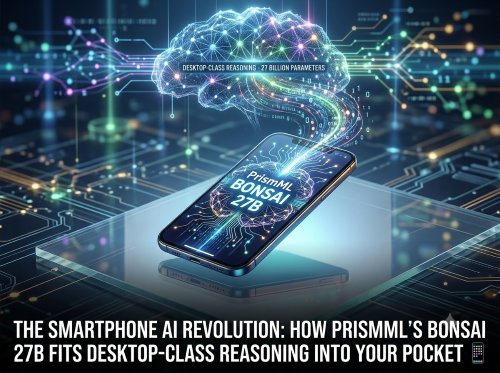
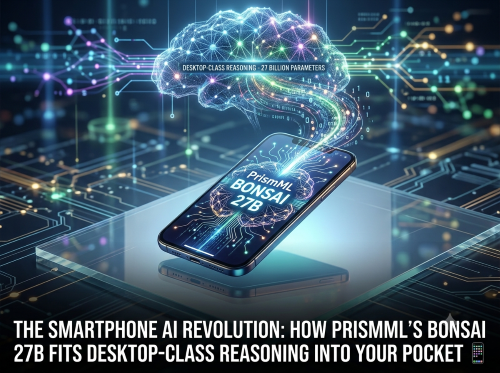
For years, running powerful artificial intelligence directly on your mobile device felt like a far-off tech fantasy. If you wanted deep reasoning, multi-step agentic behaviour, or complex code generation, you had no choice but to route your queries through massive cloud datacentres. Beyond the privacy concerns and internet dependencies, the sheer hardware requirements of high-capacity models made local execution on small chips completely non-viable.
That paradigm has just experienced a seismic shift. PrismML has unveiled Bonsai 27B, a 27-billion-parameter AI model squashed down to an astonishing 3.9 GB. For the first time in AI history, a medium-sized reasoning model can fit comfortably within the memory limits of a standard smartphone, executing completely offline without sacrificing its core intelligence.
To understand why Bonsai 27B is such a milestone, it helps to look at the math behind conventional AI models. Parameters are essentially the internal dials and settings that determine how an AI processes information. As a rule of thumb, the higher the parameter count, the smarter and more capable the model becomes.
However, high parameter counts come with hefty memory demands:
As a result, Bonsai 27B can run locally on an iPhone 17 Pro Max at a snappy rate of 11 tokens per second. On desktop-class mobile hardware like Apple’s M5 Pro chip, the ternary version reaches roughly 26 tokens per second.
How did PrismML accomplish a 14-fold reduction in size without causing the model's intelligence to collapse? The secret lies in technology developed alongside intellectual property from Caltech.
Standard AI models represent each internal weight using 16 bits of floating-point precision, meaning every setting can choose from over 65,000 potential values. Bonsai completely abandons this resource-heavy approach in favour of extreme low-bit compression:
Most traditional "low-bit" quantised models maintain certain sensitive components—such as attention layers or language model heads—at full precision to prevent quality degradation. Bonsai takes a far bolder approach: everything is compressed end-to-end.
Additionally, PrismML incorporated a hybrid attention architecture. Roughly 75% of Bonsai's layers use linear attention rather than full quadratic attention. This structural design choice makes running a massive 262,000-token context window practical on mobile hardware, avoiding the steep computational bottlenecks that usually plague smartphone processors.
The biggest concern with extreme compression is accuracy loss. Remarkably, Bonsai 27B retains almost all of its full-precision foundation's intelligence.
Across 15 standardised benchmarks evaluating knowledge, mathematics, coding, and tool manipulation in thinking mode, Ternary Bonsai 27B scored an average of 80.49—retaining 94.6% of the full-precision model's capabilities.
Key highlights include:
Beyond synthetic benchmarks, real-world testing proves that Bonsai 27B delivers where it counts.
Local Coding and Vibe Coding
In practical tests, Bonsai 27B successfully generated a functional first-person typing-horror browser game (Zombie Type) within two quick prompt iterations. The model established clean collision detection, sound scoring logic, and reliable code structure on its very first pass, using the second pass to refine aesthetics and gameplay mechanics. Because the model runs locally and free of charge, rapid iterative prompting incurs zero API cost or network latency.
Coherent Long-Form Writing
When tasked with creative writing, Bonsai demonstrates strong structural awareness. While zero-shot prompts yield straightforward narratives, the model excels at maintaining consistent internal logic, pacing, and narrative character arcs—performing on par with established cloud micro-models like Claude Haiku.
PrismML’s accomplishment has not gone unnoticed by Big Tech. Reports indicate that Apple is in early discussions with PrismML to evaluate this proprietary compression technology for future native on-device integration.
Furthermore, PrismML is actively expanding its line-up, with plans to apply this extreme compression architecture to Google's Gemma models and larger frontier systems in the near future.
Best of all for developers and AI enthusiasts, 1-bit Bonsai 27B is available today for free download under the permissive Apache 2.0 open-source licence.
To read the original report and explore deeper technical testing details, visit the original coverage on Decrypt:
👉 Meet Bonsai: The First 27B AI Model That Fits on Your Phone
Disclaimer: This article is provided for informational purposes only, mistakes may be made, and it's not offered or intended to be used as legal, tax, investment, financial, or any other advice.