x




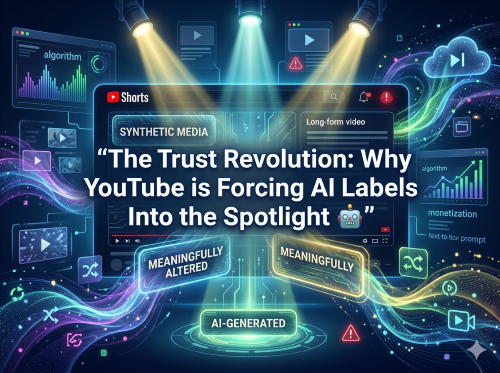
The digital landscape is shifting beneath our feet. As generative artificial intelligence becomes deeply woven into the fabric of online video production, the line between reality and digital illusion has blurred. In a massive push for transparency, YouTube has announced a significant update to its platform architecture, moving AI disclosure labels into highly prominent view.
This policy update isn't happening in a vacuum. It arrives alongside Google's aggressive rollout of next-generation AI video editing and remixing tools. As a result, the world's largest video platform is attempting a delicate balancing act: empowering creators with revolutionary AI technology while strictly protecting viewers from being misled.
Historically, finding out if a YouTube video relied on digital manipulation required looking at the video description. That is about to change. YouTube is implementing a single, unified label format designed to capture the viewer's attention immediately.
For standard, long-form videos, the disclosure tag will now sit directly beneath the video player, making it impossible to ignore. For YouTube Shorts, the tags will be displayed as direct overlays on top of the scrolling video feed itself. The goal is clear: to give audiences the necessary context regarding synthetic media at a single glance.
These labels are mandatory for any "meaningfully altered" or photorealistic content that looks entirely real but was actually generated or modified by AI systems. Whether it is a deepfake of a famous public figure or a hyper-realistic landscape created with code, viewers will know exactly what they are watching.
In a major technical escalation, YouTube is no longer relying solely on the honesty of content creators. The platform has confirmed it will deploy internal automated detection systems to actively scan uploaded videos.
If a creator fails to manually flag their video, but YouTube's underlying algorithms detect significant photorealistic AI manipulation, the platform will automatically apply the disclosure tag.
This introduces a proactive layer of security against hidden digital manipulation. However, recognising that algorithms can make mistakes, YouTube is allowing creators to dispute incorrect automated tags via YouTube Studio. It is important to note that if a video is created using built-in YouTube AI features or contains embedded digital metadata proving AI generation, the label is permanent and cannot be appealed.
The reason YouTube is moving so quickly on disclosures becomes obvious when looking at Google's broader software roadmap. At the recent Google I/O event, the tech giant unveiled Gemini Omni, a highly advanced multimodal AI engine.
Gemini Omni integrates Google's finest creative engines, including Veo, Nano Banana, and Genie. This system can take text prompts, basic images, or existing audio and instantly output complex, edited footage. For YouTube Shorts, this opens up a new era of remixing. Users can now restyle entire videos with a single tap, digitally insert themselves into viral clips, and completely transform the work of other creators.
Because Google is making it incredibly easy for the average person to simulate reality with AI, it has an obligation to build the guardrails to identify it. The prominent labels act as those guardrails.
We’re making AI disclosures simpler for creators and clearer for viewers. Here's what's coming:
— Updates From YouTube (@UpdatesFromYT) May 27, 2026
🏷️ Labels for realistic AI-generated content will appear on the video player for both long-form videos and on Shorts.
🔍 We’re introducing automatic AI detection to help creators… pic.twitter.com/2F3pXIvESI
For creators worried about their analytics, YouTube has offered reassurance. The company explicitly stated that these transparency labels will have absolutely no impact on how videos are recommended by the algorithm, nor will they affect a channel's ability to monetise content.
The core objective is to strike a healthy balance between technological innovation and public trust. By standardising these disclosures, YouTube aims to destigmatise the ethical use of AI tools while shutting down deceptive practices.
Ultimately, as video creation enters an era where anyone can "simulate the world" with a text prompt, platform-wide transparency is no longer optional. It is essential for survival.
For more insights and technical details on this rollout, you can read the full original coverage on Decrypt:
👉 YouTube Makes AI Content Labels More Prominent as Google Pushes Video Remix Tools
Disclaimer: This article is provided for informational purposes only, mistakes may be made, and it's not offered or intended to be used as legal, tax, investment, financial, or any other advice.