x




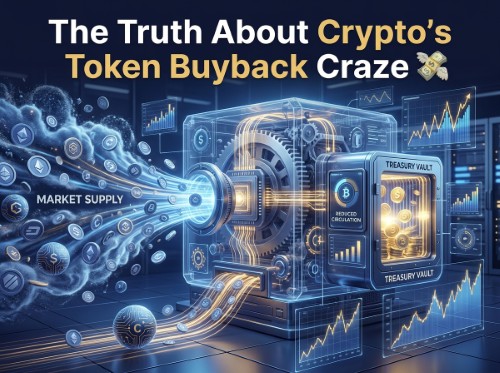
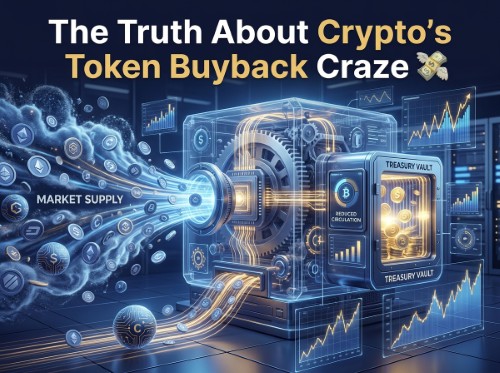
The cryptocurrency market is witnessing a fundamental shift in how decentralized protocols handle revenue. Taking a cue from traditional corporate finance, major blockchain projects are committing hundreds of millions of dollars toward buying back their native tokens from the open market.
What was once a minor experiment has evolved into one of the industry's defining tokenomics trends. However, as protocol revenues are diverted into open-market bids and token burns, a critical question emerges for investors and developers alike: do token buybacks build sustainable long-term value, or are they simply a sophisticated form of financial engineering designed to mask underlying weaknesses?
Token buybacks involve a protocol utilising its accumulated revenue or surplus cash flow to purchase its own native tokens directly from secondary markets. Once acquired, these tokens are either permanently removed from circulation ("burned") or stored within the project’s treasury for strategic deployment.
The scale of this activity has exploded. Across the decentralized finance (DeFi) and wider Web3 ecosystem, protocols have deployed roughly $640 million into token buyback schemes over recent months — marking a 17% increase year-on-year and representing an extraordinary leap from the modest sums recorded just two years ago.
This capital expenditure is heavily concentrated among a few standout players:
For years, crypto projects struggled to establish a direct, quantifiable relationship between a protocol’s on-chain adoption and the spot price of its utility token. Early tokenomic designs relied heavily on speculative narratives, governance rights, or yield farming emissions — mechanisms that frequently diluted holders or failed to capture real economic activity.
Revenue-funded buybacks address this historical gap in several distinct ways:
1. Direct Value Accrual and Perpetual Buying Demand
By using actual protocol fees to buy tokens on the open market, projects create a constant, automated bid order. When these tokens are subsequently burned, the total supply contracts. Under basic economic principles, reducing circulating supply while maintaining or growing demand applies natural upward pressure on token value.
2. Simplified Value Proposition for Investors
Explaining complex multi-sig governance rights, dynamic parameter setting, or intricate fee-sharing structures can alienate retail participants. By contrast, a project stating that it actively uses platform earnings to buy and burn its own token provides a clear, understandable investment rationale that mirrors classic equity share buybacks.
3. Tax Efficiency
In many legal jurisdictions, distributing raw protocol revenues directly to token holders acts as a taxable income event or dividend. Buybacks allow value to accrue directly into the token's market price, offering a far more tax-efficient mechanism for long-term token holders to benefit from revenue growth without immediately triggering taxable distributions.
Not all buybacks are executed with the same end goal in mind. The industry has effectively bifurcated into two primary methodologies:
The Deflationary Burn Model
Pioneered by platforms like Hyperliquid and Pump.fun, this approach treats buybacks as a permanent supply reduction mechanism. By destroying purchased tokens, the protocol permanently concentrates ownership percentages among existing holders. The aim is straightforward: maximise scarcity and directly reward token holders proportionate to platform volume.
The Pseudo-Equity Treasury Model
Conversely, protocols like Spark view buyback tokens not as capital to be destroyed, but as strategic treasury assets. By acquiring SPK from the open market and holding it in reserve, Spark creates what leadership describes as a "pseudo-equity" model.
Instead of treating protocol revenues as a simple cash dividend payout, the treasury retains flexibility. It can redeploy acquired tokens to fund ecosystem growth, reward long-term participants, or support future strategic initiatives — ensuring token holders participate in long-term economic expansion while preserving capital adaptability.
While buybacks sound appealing on paper, they carry substantial trade-offs that every crypto participant should evaluate carefully.
The fundamental issue boils down to capital allocation and opportunity cost. Every sovereign pound or dollar a protocol spends purchasing its own token is capital unavailable for:
If a burgeoning crypto startup can reinvest its protocol surplus at a high return on investment (ROI) — such as launching a new product line or capturing market share — doing so creates far greater compounding value than simply buying back tokens at current market rates.
Furthermore, buybacks are not a guaranteed formula for price appreciation. High-profile assets implementing aggressive burn mechanisms have still experienced severe drawdowns during market corrections, proving that buyback pressure alone cannot withstand broader macroeconomic downswings or decaying user activity.
As industry analysts point out: a buyback mechanism cannot turn an unsustainable protocol into a sustainable business model. If a platform lacks product-market fit or organic user demand, buying back tokens is merely a temporary price support strategy rather than a long-term solution.
As crypto protocols adopt corporate financial tactics, financial regulators worldwide are paying closer attention.
In traditional finance, stock buybacks represent corporate earnings returned to equity owners who possess legal rights to residual assets and corporate governance. In crypto, token holders rarely possess legal claims on protocol assets or binding contractual protections.
This creates a delicate regulatory challenge:
By dressing tokens up in the financial mechanics of corporate stocks, projects risk inviting strict securities enforcement — particularly if governance models fail to demonstrate genuine operational decentralisation.
Token buybacks represent a maturing crypto market attempting to anchor token valuations to real economic performance rather than pure speculation. When implemented by mature, highly profitable protocols with robust capital reserves, buybacks can serve as an effective tool for long-term value distribution.
However, investors must look beyond the immediate hype of buyback announcements. The ultimate test of any token’s health lies in a simple question: If the buybacks stopped tomorrow, would organic demand and protocol utility still justify holding the token?
If the answer is no, then buybacks are merely masking structural deficiencies. Real, lasting crypto value is built on network adoption, user retention, and continuous product innovation — not just programmatic financial engineering.
Disclaimer: This article is provided for informational purposes only, mistakes may be made, and it's not offered or intended to be used as legal, tax, investment, financial, or any other advice.