x




.png)
China’s central bank continued expanding its gold reserves in February, marking the 16th consecutive month of purchases despite bullion prices remaining close to January’s record highs. The People’s Bank of China added 30,000 ounces during the month, bringing its total holdings to 74.2 million ounces by the end of February, valued at about $387.6 billion according to the State Administration of Foreign Exchange. Since November 2024 the bank has increased its reserves by roughly 1.4 million ounces. China’s foreign exchange reserves also rose for a seventh straight month, reaching $3.4 trillion at the end of February, an increase of $8.7 billion compared with January, largely driven by exchange rate conversion effects and asset price gains linked to a stronger US dollar index.
China has also significantly increased its imports of Russian gold, including a record $961 million purchase in November 2025 following $930 million in October. These two months accounted for nearly all of the bilateral gold trade between the countries during the year, with total Chinese imports of Russian gold reaching $1.9 billion from January to November, almost nine times higher than the same period a year earlier. The growing purchases reflect Beijing’s strategy of reducing reliance on the US dollar, although analysts believe the official figures may understate the true scale. Estimates suggest China may have added far more gold than reported, potentially over 1,080 tonnes since mid-2022 based on international bullion flows and export data from the United Kingdom. Source
Gold continues to attract strong investor demand despite recent price volatility and periods where it has struggled to maintain a safe-haven bid. Global physically backed gold ETFs recorded inflows of $5.3 billion in February, marking the ninth consecutive month of net inflows and the strongest start to a year on record. Total holdings rose by 26 tonnes to 4,171 tonnes, while higher prices pushed assets under management to a record $701 billion, according to the World Gold Council. North America accounted for the majority of February’s inflows with $4.7 billion, extending a nine-month streak of demand, while Asian funds added $2.3 billion driven largely by Japanese investors reacting to political uncertainty, a weakening yen and strong local gold price performance.
European funds were the only region to see outflows, losing $1.8 billion early in the month following a late-January selloff, although flows later turned positive. World Gold Council strategist Joe Cavatoni said geopolitical tensions continue to support investor interest, but long-term price strength is ultimately tied to fundamental factors rather than short-term shocks. He noted that rising volatility, currently around 25 to 30 percent compared with the traditional expectation of about 15 percent, reflects growing participation and faster capital movement across markets. While structural disruptions such as tariffs or transport bottlenecks could create unpredictable instability, persistent ETF inflows and continued central bank demand suggest gold remains an important diversifier for investors navigating geopolitical and economic uncertainty. Source
Gold lost momentum last week after ending a five-week rally, falling 3 percent as the US dollar strengthened sharply and energy prices surged. According to Bob Savage, head market strategist at BNY, investors moved away from bonds amid concerns that an energy shock could reduce the likelihood of interest rate cuts in the United States and United Kingdom while increasing the risk of rate hikes in the European Union. During the same period the dollar rose 1.7 percent, its strongest weekly gain in four years, while oil climbed more than 20 percent and natural gas surged over 50 percent, raising broader fears of stagflation in global markets.
BNY’s risk sentiment index reflects the shift in investor mood, falling from a peak in the 99th percentile two weeks before the conflict to a more neutral level around the 64th percentile. Savage said investors still view gold as an alternative to fiat currencies but noted that both momentum and demand have weakened. He added that markets may eventually move to restore the historical correlation between oil and gold prices, which could require either a sharp rise in oil or a decline in gold. Despite the current volatility, many investors appear to be treating geopolitical conflict as temporary noise while focusing more closely on underlying economic trends and inflation pressures linked to rising energy costs. Source
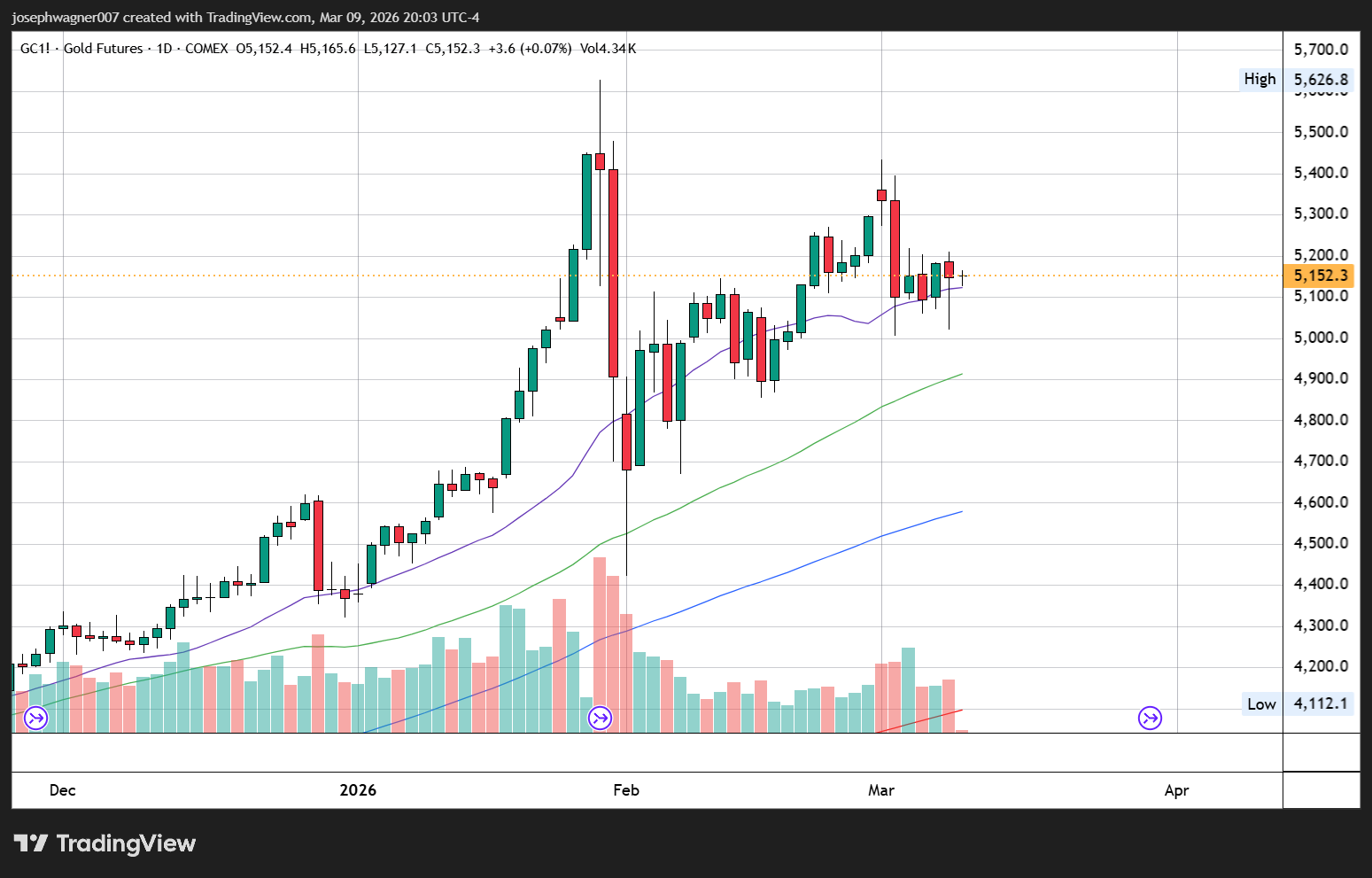
Image Source: Kitco News
Gold prices declined as extreme volatility in oil markets and shifting expectations for US monetary policy weighed on investor sentiment. Oil surged as high as $119 per barrel before reversing sharply to around $94.70, while gold futures fell by $32.60 to $5,148.70, recovering somewhat from an intraday low of $5,021.20. Market turbulence has been driven largely by the escalating conflict between the United States, Israel and Iran, which began on 28 February following joint airstrikes that killed Iran’s supreme leader Ali Khamenei and several senior officials. Mojtaba Khamenei, the former leader’s son, has since been appointed as the new supreme leader, a controversial choice that has raised expectations the conflict could persist rather than end quickly.
Immediately after the strikes, the US dollar strengthened as investors moved into the currency as a safe-haven asset, putting pressure on gold prices. However, concerns about a prolonged Middle East conflict and potential energy supply disruptions have pushed oil higher and revived fears of inflation, which are now influencing expectations for Federal Reserve policy. Traders have begun pushing back forecasts for the first interest rate cut from May to September, as higher energy costs could keep inflation elevated. While higher interest rates typically weigh on gold, the metal has remained relatively resilient as investors increasingly view it as a hedge against rising inflation and the risk of stagflation. Source
Gold prices fell sharply on Monday as investors grew increasingly concerned that the conflict involving Iran could trigger a global stagflationary environment marked by rising inflation and higher interest rates. A stronger US dollar, which climbed to a three-and-a-half month high, also weighed on the metal. April gold futures dropped $65.50 to $5,092.00 by midday, while silver managed to recover from earlier losses to trade slightly higher at $84.50. Oil prices surged during the session, briefly approaching $120 per barrel before stabilising near $98, reinforcing fears that energy supply disruptions could drive inflation and slow economic growth.
Investor optimism for a quick resolution in the Middle East has faded, with markets increasingly pricing in the possibility of a prolonged supply shock. Analysts warn that sustained higher energy prices could push global inflation higher while reducing economic growth, a combination that would create stagflationary pressure. Meanwhile, China’s central bank continued its steady accumulation of gold, increasing reserves by 30,000 ounces in February and extending a buying streak to 16 months. Although global central bank purchases slowed at the start of the year due to market volatility, overall buying still outweighs sales, with geopolitical tensions continuing to support long-term demand for gold. Source
Gold has struggled to sustain recent gains despite escalating conflict in the Middle East, with prices unable to hold above $5,100 an ounce even as financial markets remain volatile. The metal recently reached a high of $5,419 but has since fallen, with spot gold trading around $5,078.40 and under pressure from selling. According to Natixis precious metals analyst Bernard Dahdah, uncertainty surrounding the war and the potential closure of the Strait of Hormuz has strengthened the US dollar as the primary safe haven for investors. Some investors may also be selling gold to cover losses or margin calls in declining equity markets, with the S&P 500 falling more than 3% to around 6,645 since missile strikes by the US and Israel on Iran.
Despite the recent pullback, gold continues to hold above key support near $5,000 and could move higher if rising energy prices push global inflation upward. Dahdah expects this dynamic to eventually lift gold towards the $5,500 to $5,800 per ounce range as the economic effects of the conflict filter through markets. However, he also cautioned that geopolitical safe-haven demand is typically temporary and may fade once the conflict ends. If the war concludes and market conditions stabilise, prices could fall back to roughly $4,600 an ounce, suggesting that current levels include about $450 per ounce linked to the geopolitical risk from the Iran conflict. Source
Gold and silver have surrendered the early gains they made following the outbreak of conflict involving Iran, as investors reassess the outlook and lock in profits after a sharp rally to record highs. Analysts at Heraeus said the initial safe-haven demand for gold has faded, with selling pressure emerging as markets judge the conflict may be relatively short-lived. The reaction in financial markets has been milder than expected, similar to the early phase of the Russia–Ukraine war in 2022 when gold rallied briefly before giving up those gains. Treasury yields have risen by only around 20 basis points, while the US dollar index has strengthened from 97.6 to around 99, suggesting investors do not currently expect a prolonged crisis.
Even so, the conflict is affecting the global precious metals market through disruptions to physical trade. Dubai, a major hub for gold refining and exports, particularly to India, has seen shipments curtailed because gold is often transported on commercial passenger flights, many of which have been cancelled due to the conflict. Spot gold has slipped to around $5,079.63 per ounce. In silver markets, the price also initially rose but later declined as investors reduced exposure, while lower production forecasts from Mexican miner Fresnillo added to supply concerns. The company expects output between 42.0 million and 46.5 million ounces this year, down from 48.7 million ounces in 2025, and silver prices may face further near-term pressure with support levels seen around $78 and $64 per ounce. Source
Nicole Adshead-Bell of Cupel Advisory said strong gold markets can blur the line between company-specific performance and broader sector momentum, making it difficult to judge which firms are genuinely outperforming. Speaking at PDAC 2026 in Toronto, she explained that beta represents the overall thematic forces lifting the sector, while alpha reflects results driven by management execution and strategy. During buoyant periods, rising prices tend to lift most companies, masking operational weaknesses that may only become visible when market conditions tighten.
She noted that many gold producers currently hold substantial cash reserves, with at least ten companies reporting more than $1 billion on their balance sheets even after boosting shareholder returns and funding exploration and development. This places a spotlight on capital discipline, including whether buybacks, investment decisions and treasury strategies match management’s stated valuations. Adshead-Bell also pointed to investor concerns over strategic clarity, citing Barrick’s consideration of a potential IPO for a subsidiary holding its North American gold assets and ongoing tensions within the Nevada Gold Mines joint venture with Newmont. She added that financing structures such as royalty and streaming deals are gaining attention as investors assess capital efficiency, while junior miners face scrutiny over the effectiveness of marketing spend and investor communication as the sector tests whether companies can deliver genuine alpha rather than relying on favourable market conditions. Source
Video - Gold’s Cash Pile Problem, Barrick’s Crossroads and a Cycle Warning | Nicole Adshead-Bell
Gold ended a volatile week after failing to sustain what many investors expected to be a typical safe-haven rally following missile strikes by the United States and Israel on Iran. Prices initially surged to around $5,400 an ounce when markets opened, but the move quickly reversed as traders took profits, triggering heavy selling pressure. Once the initial geopolitical shock faded, investors shifted their attention back to broader economic factors such as energy prices, currency movements and expectations for monetary policy.
The metal also faced headwinds from a stronger US dollar and the prospect that the Federal Reserve may have limited room to cut interest rates if rising oil prices fuel inflation. Higher energy costs could push up global production and transport expenses, forcing central banks to keep policy tighter for longer, which tends to support Treasury yields and increase the opportunity cost of holding non-yielding assets like gold. Despite these pressures, gold remains supported at historically high levels, underpinned by longer-term factors including rising government debt, geopolitical fragmentation and continued central bank purchases as countries diversify reserves away from the dollar in an increasingly multipolar financial system. Source
Gold was the best-performing precious metal of the week despite a modest 1.34% decline, supported by strong demand and record holdings in countries like Turkey, where gold stock has reached over $750 billion. K92 Mining reported strong earnings and production, with a new processing plant exceeding feasibility expectations and 2026 guidance pointing to further growth. Rising energy prices from the Middle East conflict and higher Treasury yields have strengthened the dollar, limiting expectations for near-term Federal Reserve rate cuts and reducing some of the metal’s traditional tailwinds.
However, gold faces significant headwinds from a stronger US dollar, elevated yields, and cautious investor sentiment, which have driven short-term volatility and weighed on performance. Central bank actions, such as Poland’s proposed revaluation of reserves for defence funding, add further uncertainty. At the same time, silver offers opportunities, entering its eighth deficit year with historically low inventories and strong investment demand, while strategic acquisitions and asset sales by miners like Discovery Silver and SSR Mining are unlocking capital and reshaping portfolios. Persistent macroeconomic pressures, risk-off flows, and gold’s status as a non-yielding asset leave it exposed to continued short-term declines even as structural demand factors support the broader market. Source
Gold has struggled to sustain a safe-haven rally despite heightened geopolitical tensions following U.S. and Israel missile strikes on Iran, with spot prices falling to around $5,142.60 an ounce and ending the week down 2.5%. Analysts note that the metal is caught between opposing forces: weak U.S. employment data could support aggressive Fed easing, while rising oil prices and inflation concerns may keep monetary policy neutral for longer. The precious metal’s short-term behaviour has been closely tied to momentum and oil prices, reflecting continued speculation rather than traditional haven demand, with support around $5,000 providing a key floor for prices in the near term.
Rising crude prices, which have reached approximately $90 a barrel, have strengthened the U.S. dollar and contributed to volatility in financial markets, limiting gold’s upside despite persistent Middle East tensions. Investors remain focused on upcoming U.S. macroeconomic data, including CPI, PCE, GDP revisions and jobless claims, which will influence the Federal Reserve’s policy trajectory and, by extension, gold’s direction. Analysts suggest that unless the conflict escalates or persists beyond a month, gold may remain range-bound, with buying opportunities emerging on dips, while technical levels at $5,200, $5,050, $5,000 and $4,900 are expected to guide near-term trading. Source
In this week’s Live from the Vault, Andrew Maguire and Bill Holter explain why silver has become the critical pressure point in the global derivatives system, as surging physical delivery demands collide with rapidly tightening exchange inventories.
With futures contracts representing far more silver than exchanges can deliver and physical markets in Asia trading at persistent premiums, the experts highlight how mounting stress in Western futures markets could spark a historic breakdown.
Disclaimer: These articles are provided for informational purposes only. They are not offered or intended to be used as legal, tax, investment, financial, or any other advice.
Featured Image - Source: Unsplash