x




Fintech firm Antalpha is preparing to realise a major gain from its large investment in Tether Gold after a surge in gold prices. The company purchased $241 million worth of the gold-backed token in September, equivalent to 1.8 tonnes of physical gold, at an average price of $3,693 per ounce. Following the sharp rise in gold prices through late 2025 and early 2026, the position has generated more than $100 million in unrealised profit. Blockchain data indicates the firm has begun moving around $15 million of its holdings to a crypto custody platform, suggesting it may be preparing to sell part of the position and lock in profits.
Interest in Tether’s gold-backed token has grown as the company continues to expand its physical gold reserves and strengthen its role in the bullion market. Analysts estimate Tether now holds between 125 and 150 tonnes of gold, making it one of the largest non-sovereign holders globally and placing its gold holdings alongside major exchange traded funds in terms of scale. The company has also rapidly increased its purchases to support both its gold token and its dollar stablecoin reserves, with gold accounting for around 7% of total holdings and plans underway to raise that share to between 10% and 15% of the portfolio as demand for digital gold continues to expand. Source
Rising risks in the rapidly expanding private credit market could help sustain higher gold prices as investors seek protection from potential financial instability. Laks Ganapathi, chief executive of Unicus Research, said vulnerabilities in these largely unregulated lending markets may spill into the broader economy, creating conditions for a slow and extended downturn. She noted that private credit has grown dramatically from around $40 billion in 2000 to nearly $2 trillion today, much of it operating outside the regulatory oversight and stress testing applied to traditional banks. With persistent inflation and rising global debt weakening confidence in credit markets, investors are increasingly turning to gold, commodities and other hard assets for stability.
Ganapathi warned that many private credit loans are unrated and valued using internal models rather than open market pricing, making it difficult for investors to assess the true level of risk. The sector has also expanded into consumer finance areas such as commercial real estate, auto lending and buy now pay later products, increasing the potential for stress to spread through interconnected borrowers and financial institutions. She expects the next downturn to develop gradually rather than collapse suddenly, potentially stretching from 2025 to 2027 amid weak growth and resurgent inflation. In that environment, she argues that preserving capital will become more important than chasing yield, with gold likely to remain attractive as a store of value while governments continue running deficits and expanding debt. Source
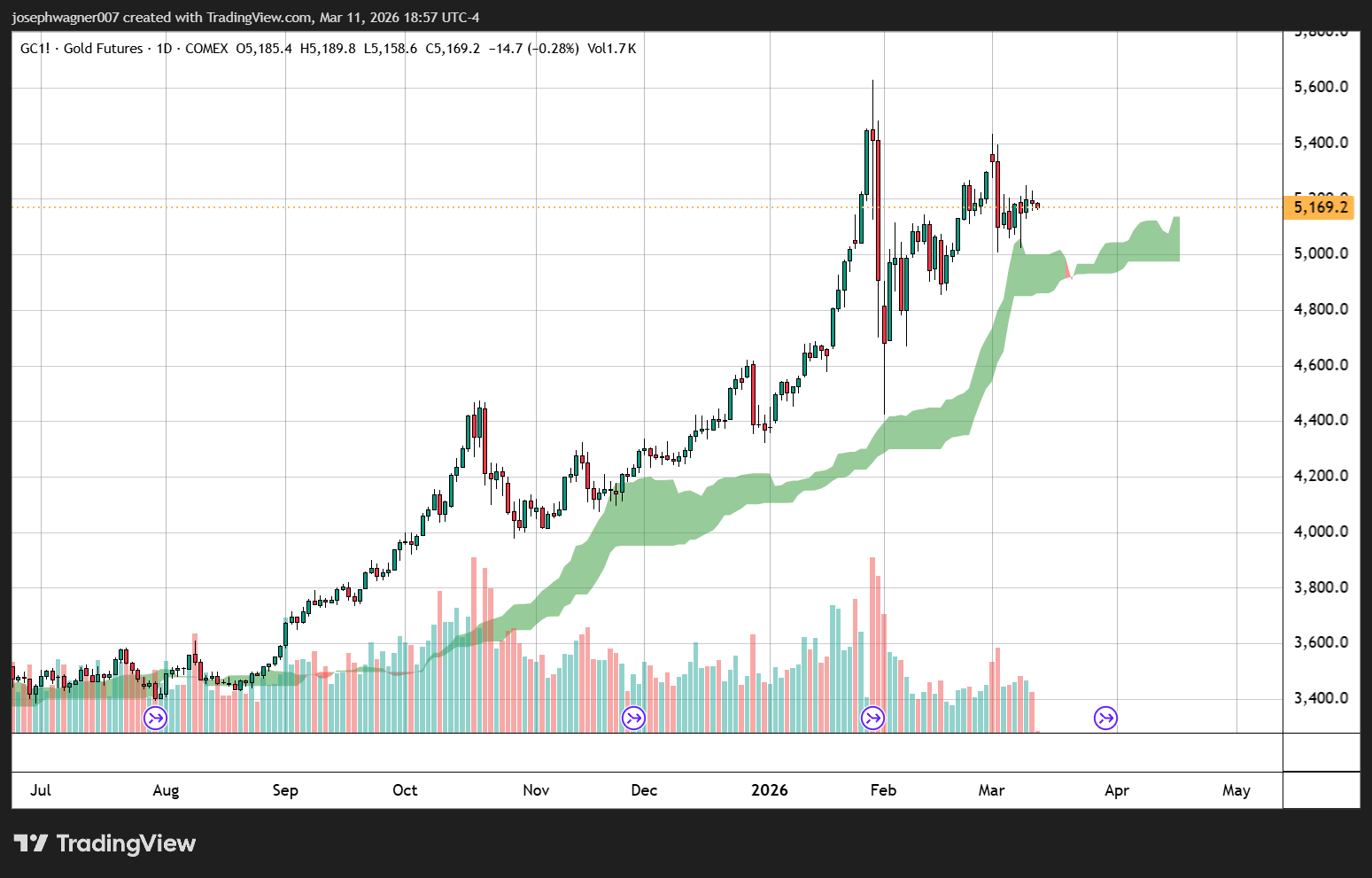
Image Source: Kitco News
Gold prices fell sharply as commodity markets reacted to escalating tensions in the Middle East and extreme volatility in oil prices. Gold futures dropped by $32.60 to $5,148.70 per ounce, though they recovered from an intraday low as buyers returned during the session. Oil markets were even more volatile, with West Texas Intermediate crude jumping to nearly $119 per barrel before retreating to $94.70. The turmoil follows a conflict that began on February 28 when the United States and Israel carried out coordinated airstrikes that killed Iran’s Supreme Leader Ali Khamenei and several senior officials. The situation intensified after Iran’s clerical leadership appointed Mojtaba Khamenei as the new supreme leader, a move rejected by both Washington and Jerusalem and widely viewed as signalling the possibility of a prolonged conflict.
Despite the geopolitical crisis, gold has behaved unexpectedly, falling about $200 since the first strikes as investors initially rushed into the U.S. dollar, which typically strengthens during global uncertainty and puts pressure on dollar-priced commodities. Attention has since shifted to the potential inflation impact of rising energy prices and what it could mean for Federal Reserve policy. Although February’s Consumer Price Index report showed moderate inflation, with prices rising 0.3% month-on-month and 2.4% annually, markets largely dismissed the data because it predates the current conflict. Disruptions to oil shipments through the Strait of Hormuz, a key route for roughly a fifth of global seaborne oil supply, could drive energy prices higher and complicate the Fed’s interest rate outlook, leaving gold caught between safe-haven demand and pressure from a strong dollar. Source
Gold reaching $10,000 an ounce within the next five to seven years is no longer an unrealistic scenario as structural pressures reshape the global financial system, according to Capitalight Research’s Chantelle Schieven. She said the metal’s recent performance suggests that if current trends continue, prices could approach that level by 2029. Gold’s strength is being driven not only by traditional macroeconomic factors but also by deeper geopolitical and financial changes, including rising global debt and growing uncertainty. Price volatility has increased significantly, with frequent daily swings exceeding $50 and sometimes $100, yet long-term investors have continued to benefit from the broader upward trend.
Schieven argues that the bull market is rooted in structural shifts that accelerated after sanctions against Russia prompted many countries to reconsider holding assets tied to the U.S. dollar or Western financial systems. At the same time, soaring levels of government and personal debt are limiting how aggressively central banks can raise interest rates without damaging economic stability. Ongoing geopolitical tensions, including conflicts in the Middle East and broader global fragmentation, are further reinforcing demand for gold as a store of value. While predicting the exact timeline is difficult, she believes these long-term forces will keep gold’s trajectory upward, with silver potentially attracting more retail investors as the rising cost of gold makes it less accessible. Source
The closure of the Strait of Hormuz for 11 days is raising concerns not only about Middle East tensions but also about the stability of the US Treasury market. Instead of falling as many expected during geopolitical turmoil, the yield on the 10-year US Treasury has risen to around 4.2%. Analyst Luke Groman argues that the real vulnerability for the United States lies in its heavy debt levels and global dependence on the US dollar. With about $27 trillion in dollar-denominated assets held by foreign investors, countries facing surging energy costs may be forced to sell US Treasuries in order to buy oil and other essential commodities, pushing yields higher and exposing structural weaknesses in the financial system. The pressure is intensified by the United States’ fiscal situation, with a projected federal deficit of $1.9 trillion in 2026 and a debt-to-GDP ratio now above 120%.
The Strait of Hormuz normally carries roughly a quarter of global seaborne oil trade, making its disruption particularly damaging for energy-dependent economies in Asia. While most markets treat the route as effectively blocked, some oil is still moving, with China reportedly receiving a large share of the remaining shipments and maintaining substantial stockpiles of Iranian crude stored offshore near China and Malaysia. These developments highlight shifting geopolitical dynamics and questions about supply security in a world already strained by high debt and inflation. In this environment, tangible assets are gaining appeal, with gold increasingly seen as a reliable store of value as trust in sovereign debt weakens. Groman argues that investors should hold a meaningful allocation of physical gold and suggests the metal could climb above $6,000 by mid-year if the disruption in the Strait of Hormuz continues. Source
Video - Luke Gromen: Gold To $6,000 By Midyear As US Faces 1956 Suez Moment
Gold and silver prices fell by midday Wednesday as short-term futures traders took profits and the US dollar index strengthened, which added pressure to the metals. April gold futures dropped $57.20 to $5,183.40, while May silver fell $4.172 to $85.445. A US consumer price index report released during the session had little impact on markets, coming broadly in line with expectations. February inflation rose 0.3% month-on-month and 2.4% year-on-year, while the core measure excluding food and energy increased 0.2% on the month and 2.5% annually.
Other outside markets showed mixed influences, with crude oil trading higher at around $86.50 per barrel and the yield on the 10-year US Treasury note near 4.2%. Technically, gold bulls are aiming for a close above resistance at $5,434.10, while bears are targeting a move below the key $5,000 support level. Silver traders are watching resistance at $95.86 and support near the February low of $71.815, with nearer-term levels around $90.385 on the upside and $84.00 on the downside shaping current market sentiment. Source
Gold mining companies are generating record margins and strong free cash flow as gold prices remain above $5,000 per ounce, placing the sector in a favourable position for the year ahead. Imaru Casanova of VanEck said that with average all-in sustaining costs below $2,000 per ounce, miners can remain highly profitable even if gold prices stop rising. She noted that many investors are beginning to accept current record prices as a new normal rather than a temporary spike, which could encourage markets to adopt higher long-term price assumptions when valuing mining companies.
Casanova said this shift in perception could support strong performance in mining equities, especially as companies continue to operate with disciplined capital strategies rather than aggressive expansion. While production costs are expected to rise by roughly 10–12% in 2026, gold prices have already climbed more than 20% this year, leaving the sector with expanded margins and significant resilience. Discussions with dozens of mining firms at a major industry conference indicated strong balance sheets, cautious reserve assumptions and a focus on returns, selective growth and operational efficiency, reinforcing the view that gold mining equities are well positioned to outperform the metal if prices remain near current levels or move higher. Source
Gold prices are struggling to hold near $5,200 per ounce as investors react to persistent inflation data that may keep the Federal Reserve’s monetary policy unchanged for longer than previously expected. The Consumer Price Index rose 0.3% in February after a 0.2% increase in January, matching economists’ forecasts. Annual inflation remained at 2.4%, still above the Federal Reserve’s 2% target, while core inflation, which excludes food and energy, increased 0.2% on the month and held at 2.5% year-on-year for the third straight month.
The latest inflation figures triggered modest selling in the gold market, with spot prices slipping to around $5,178 per ounce. Analysts note that the data largely reflects conditions before the escalation of military operations involving the United States, Israel and Iran, which could create new inflationary pressures through energy and supply chain disruptions. Shelter costs continued to be the largest contributor to inflation in February, rising 0.2%, while food prices increased 0.4% and energy prices climbed 0.6%, adding to concerns that price pressures may strengthen in the months ahead. Source
Strong conditions in the gold sector can blur the difference between company-specific performance and broader market momentum, according to Nicole Adshead-Bell of Cupel Advisory. She said rising prices often lead investors to mistake alpha, which reflects a company’s unique performance, for beta, the wider forces lifting the entire sector. In buoyant markets the overall upswing can hide operational weaknesses, meaning problems may only become visible once market conditions tighten.
Adshead-Bell noted that many gold producers are currently holding large cash reserves, with at least ten companies reporting more than $1 billion on their balance sheets even after increasing spending and shareholder returns. She said the sector now faces a test of capital discipline, including how companies manage treasury decisions and buybacks in relation to their valuations. Investors are also closely watching strategic direction, particularly after Barrick disclosed it was considering an IPO of a subsidiary containing its North American gold assets amid tensions within the Nevada Gold Mines joint venture with Newmont. Broader financing trends, including streaming deals such as Lundin Gold’s silver stream-for-equity agreement, and concerns about how junior miners communicate with investors, highlight the growing focus on whether management teams can prove genuine outperformance through disciplined capital allocation rather than relying on favourable market conditions. Source
Gold’s long rally has been driven more by structural uncertainty than by inflation, according to StoneX analyst Rhona O’Connell. She said investors increasingly view gold as a hedge against broader instability rather than rising prices, noting that instruments such as inflation-protected bonds can serve as more direct inflation hedges. Geopolitical tensions, including conflict in the Middle East and ongoing tariff disputes, have helped support the metal, but much of this risk appears to have already been priced into the market. The outbreak of war involving Iran briefly pushed prices higher, though the move was relatively modest and short-lived because investors had already anticipated heightened geopolitical risk.
O’Connell said demand has been strengthened by investors buying dips over the past year and a half, although the market may now be approaching saturation as participants who waited for deeper pullbacks ultimately entered at higher levels. She emphasised the difference between price and value, arguing that gold retains its underlying value even as its market price fluctuates. Looking ahead, she believes one of the most significant risks for gold could come from questions surrounding the independence of the US Federal Reserve, particularly if legal developments affecting the balance of power between the executive branch and the central bank create doubts about monetary policy stability. Although recent geopolitical tensions and economic uncertainty continue to support precious metals, she suggested that both gold and silver appear technically overbought and may need a pause before the next phase of their upward trend. Source
Gold prices are holding around $5,100 an ounce amid volatile trading, but Byron King of Paradigm Press Group sees continued upside as global economic uncertainty and unsustainable debt levels support the precious metals sector. He highlighted that renewed interest in tangible assets and structural shifts in the global economy are driving capital back into mining, with sentiment among companies and investors strengthening. King argued that even those who missed gold’s rise from roughly $2,000 to $5,000 an ounce should focus on potential gains ahead, as the rally may still be in its early stages.
King emphasised that the fundamental driver behind the gold rally is concern over fiat currency stability and growing government debt, particularly in the U.S., where monetisation and inflation may be preferred over repayment. Physical gold provides wealth preservation, while mining equities offer broader upside potential, especially as global demand for strategic minerals rises and governments increase spending on critical resource projects. He suggested that large producers with disciplined management could increasingly resemble income-producing assets, and that companies controlling real assets would hold enormous value if financial systems face disruption. Source
Gold surged past $5,200 an ounce as markets reacted to escalating geopolitical tensions in the Middle East and growing instability in credit markets. Despite massive disruptions to oil supply and sharp intraday price swings, crude prices fell sharply, highlighting a disconnect between market moves and underlying fundamentals. Father Emmanuel Lemelson of Lemelson Capital Management emphasised the extreme volatility and warned that the current conditions may be a precursor to broader market stress, as Iran shows no signs of compromise and U.S. policy responses add to uncertainty.
Lemelson also highlighted cracks in private credit and real estate markets, noting recent gating of BlackRock’s HLEND fund and losses at major hedge funds as early warning signs of systemic strain. With global debt at $350 trillion and housing market liquidity constrained, investors are increasingly turning to hard assets, although caution is needed as demonstrated by silver’s recent crash. He argued that active, disciplined investing is now essential, advocating for careful analysis of tangible assets and undervalued companies rather than following unregulated advice. His approach focusses on American companies with strong balance sheets and attractive yields, illustrating that preserving capital and generating returns can come from less obvious, value-driven opportunities. Source
Video - ‘The Guy with the Biggest Military’ | Fr. Emmanuel Lemelson on the Fatal Flaw in Gold
Precious metals have experienced unprecedented gains in recent months, with gold rising 75% over the past year and silver surging 148% in 2025, reflecting strong investor, industrial, and central bank demand. Kristy Akullian of BlackRock highlighted that volatility has increased sharply, reinforcing the risks alongside the rally. Key drivers include rising government debt making gold an attractive store of value, safe-haven demand amid geopolitical uncertainty, and strong industrial consumption of silver, particularly for electronics, solar panels, and data centres. Central bank purchases, which have steadily increased to diversify away from the U.S. dollar, have further reshaped global demand and are expected to remain supportive in 2026.
Akullian emphasised that both metals play complementary roles in portfolios, with gold acting as a strategic diversifier during market stress and silver offering higher volatility with upside potential from industrial demand and technological growth. She noted room for further expansion in private wealth allocations and emerging sectors such as stablecoins, which are increasingly backed by gold. While price forecasts are challenging due to the absence of cashflows, the finite supply and sustained demand from new sources suggest a constructive outlook for both metals. As such, gold and silver can provide investors with both resilience and exposure to structural growth trends. Source
Disclaimer: These articles are provided for informational purposes only. They are not offered or intended to be used as legal, tax, investment, financial, or any other advice.
Featured Image - Source: Unsplash