x




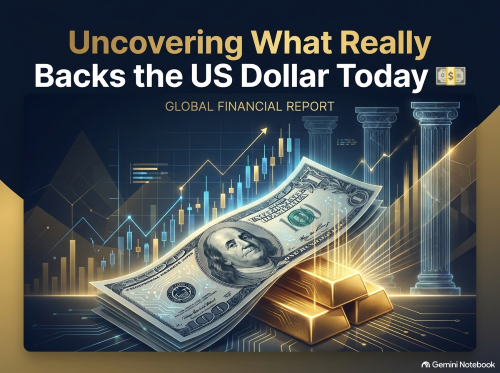
Have you ever looked at a US dollar note and wondered what actually gives it value? Ask a dozen people, and you might hear a dozen different explanations—ranging from heavy vaults packed with gold bars to pure public trust. The truth is both simpler and far more fascinating than traditional monetary myths suggest.
While paper currency once represented a direct claim on precious metals, the modern dollar functions on an entirely different foundation. Understanding how this system works requires looking at history, legal authority, economic output, and global trade dynamics.
For much of American history, precious metals provided the bedrock for currency. Between 1944 and 1971, under the Bretton Woods monetary framework, the dollar was formally pegged to gold at $35 per ounce. Although domestic citizens lost the legal right to redeem their paper notes for physical gold in 1933, foreign governments could still exchange official dollar reserves for Treasury gold.
That arrangement came to a dramatic halt on 15 August 1971, when President Richard Nixon suspended gold convertibility—an event remembered as the 'Nixon Shock'. From that moment on, the dollar became a pure fiat currency, deriving its authority not from a physical commodity, but from government decree and market adoption.
Intriguingly, the old monetary order did not vanish completely. The US Treasury still holds 8,133.5 tonnes of gold (roughly 261.5 million troy ounces). However, under federal statute, this gold remains on official books at a frozen 1973 statutory price of $42.2222 per ounce, valuing it at approximately $11 billion. On the open market, that exact physical metal is worth well over $1 trillion. This balance-sheet anomaly highlights the sharp dividing line between statutory accounting and modern economic reality. For a comprehensive look at this historical evolution, you can read this detailed analysis on what backs the US dollar today.
If gold no longer stands directly behind paper bills, what actually supports the currency? Today, the Greenback is sustained by three main pillars:
1. Sovereign Legal Authority
Printed on every Federal Reserve note is the explicit statement: "This note is legal tender for all debts, public and private." Codified under 31 U.S. Code Section 5103, this legal status compels courts, businesses, and institutions within US jurisdiction to recognise dollars as valid settlement for financial obligations and tax payments.
2. Taxation Power and Economic Capacity
Economists often refer to the 'full faith and credit' of the US government. In practical terms, this represents a claim on future national economic output. The US government possesses the constitutional authority to levy taxes across a population of more than 340 million people, supported by an economy producing over $31 trillion in annual output. Additionally, Federal Reserve notes in circulation are backed on the Fed's balance sheet by US Treasury securities—meaning public debt and government creditworthiness underpin physical currency. If you are curious about how public revenues and debt structure modern finance, consider exploring what backs the United States dollar in depth.
3. International Demand and Capital Markets
A currency relies on widespread utility to maintain purchasing power. The US dollar benefits from exceptionally deep, transparent, and liquid capital markets. It remains the primary currency used to invoice global trade, price key commodities like crude oil under petrodollar trade arrangements, and issue international debt.
The dollar's role as the primary global reserve currency grants the United States significant financial advantages, often termed an 'exorbitant privilege'. Among these benefits are:
Currently, the dollar features in 88 per cent of foreign exchange transactions, accounts for 54 per cent of global trade invoicing, and makes up 56.70 per cent of allocated global foreign exchange reserves. To better understand how these financial mechanisms function internationally, check out these insights on what's behind the U.S. dollar's dominance.
Despite its established position, the dollar's global reserve share has experienced a gradual, long-term decline from roughly 71 per cent in the late 1990s. Central banks across the globe have progressively diversified reserve portfolios by accumulating gold, non-traditional liquid currencies (such as the Australian dollar, Canadian dollar, and Singapore dollar), and alternative assets.
Furthermore, evolving international trade partnerships—including initiatives by BRICS member nations to settle transactions in local currencies—and the exploration of Central Bank Digital Currencies (CBDCs) reflect a changing global landscape. Nevertheless, given the unparalleled depth of US financial markets and the absence of a single immediate replacement, the dollar continues to serve as the chief anchor of world commerce.
Ultimately, what backs the US dollar today is not a stack of bullion in a bank vault, but an interconnected network of legal authority, tax-collecting power, immense economic productivity, and global commercial necessity. Yet comparing this modern fiat framework to the historical gold standard reveals a fundamental trade-off between short-term policy flexibility and long-term monetary discipline.
Under a gold-backed system, money creation was bound to a physical, finite commodity. This 1:1 anchor placed strict natural limits on sovereign spending, preventing governments from creating money out of thin air to cover chronic fiscal deficits. Because the currency represented a fixed quantity of gold, citizens enjoyed strong protection against inflation, and purchasing power remained largely stable over long horizons.
In contrast, today's pure fiat currency removes those natural constraints. Because Federal Reserve notes are backed primarily by government securities and tax capacity, policymakers gain immense flexibility to react to crises, stimulate borrowing, and manage national liquidity. However, this absence of metallic backing also removes fiscal discipline, creating a structural incentive for perpetual borrowing. The consequences of this shift are evident in mounting national debt and the steady loss of domestic purchasing power—underscored by the fact that the US dollar has lost roughly 98 per cent of its purchasing power since the Federal Reserve was created in 1913.
As global public debt compounds to unprecedented levels, the stability of a fiat currency relies heavily on perpetual economic growth and institutional credibility. Without the hard constraint of a gold anchor, managing relentless debt accumulation while maintaining long-term monetary trust remains the primary vulnerability of the modern financial system.
Disclaimer: This article is provided for informational purposes only, mistakes may be made, and it's not offered or intended to be used as legal, tax, investment, financial, or any other advice.