x




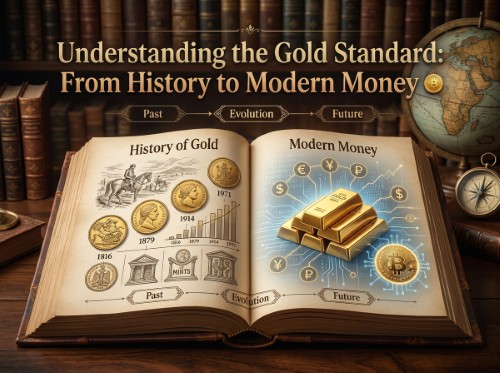
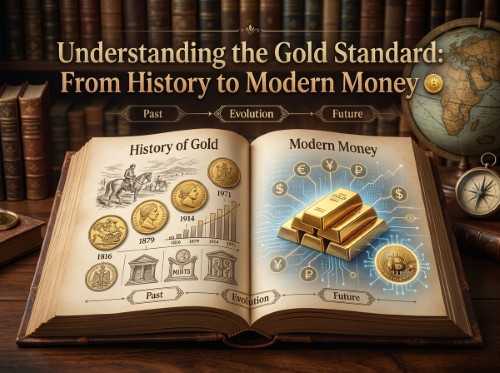
The term gold standard is frequently invoked in modern financial debates regarding central bank interest rates, BRICS de-dollarisation initiatives, and inflation hedges. Yet, despite its prevalence in economic discourse, its practical mechanisms and historic evolution are often misunderstood. Rather than serving as a singular, immutable rulebook, the gold standard was a dynamic monetary framework that evolved across more than a century as governments attempted to balance monetary discipline with economic flexibility.
To understand how global finance arrived at today's pure fiat environment—and why central banks are once again accumulating gold at record paces—it is essential to examine how gold-backed monetary systems functioned, why they broke down, and what role physical bullion plays in the modern world.
A gold standard is a monetary regime in which a country's national currency is directly pegged to a fixed weight of physical gold. Under this agreement, the issuing government or central bank pledges to convert paper currency into physical metal upon demand at an official fixed rate.
Because money creation is tied to a tangible, finite commodity, central banks cannot arbitrarily expand the money supply. New paper currency can only enter circulation if backed by corresponding gold reserves.
Throughout history, governments sought ways to preserve this discipline while reducing the friction and expense of storing and transporting physical metal. As a result, the gold standard manifested in four distinct structures:
While gold served as money for millennia, the formal international gold standard era spanned roughly from the late 19th century until 1971.
The Classical Gold Standard (1879–1914)
By the late 1870s, major industrial powers aligned their currencies with gold. Britain had operated on a gold basis since 1816, Germany joined in 1871, and the United States formally adopted the system in 1879 following civil war disruptions. This created a unified international monetary architecture where exchange rates were fixed relative to gold weights, facilitating frictionless global trade.
Life under the classical era brought remarkable long-term price stability; consumer prices in the UK in 1913 were roughly identical to those in 1875. However, this long-run stability was paired with sharp short-term volatility, as money supply could not quickly expand during economic shocks. The classical system came to an abrupt end in 1914 when nations suspended gold convertibility to finance military expenditure during the First World War.
The Interwar Distortions (1918–1939)
Post-war attempts to rebuild the gold standard were plagued by economic mismanagement. Britain re-entered the standard in 1925 at its pre-war exchange rate—a decision spearheaded by then-Chancellor Winston Churchill that drastically overvalued sterling. UK exports suffered, unemployment mounted, and capital flight forced Britain off gold in 1931 amidst the Great Depression.
In the United States, President Franklin D. Roosevelt signed Executive Order 6102 in 1933, requiring private citizens to surrender gold coins and bullion to the Federal Reserve. The subsequent Gold Reserve Act of 1934 revalued gold from $20.67 to $35.00 per ounce, devaluing the dollar and transferring monetary metal ownership to the US Treasury.
The Bretton Woods System (1944–1971)
Delegates from 44 Allied nations gathered in New Hampshire in 1944 to construct a stable post-war monetary framework. Under Bretton Woods, the US dollar was fixed directly to gold at $35 per ounce, while all other member currencies were pegged to the dollar. This turned the US dollar into the world's premier reserve currency, anchored indirectly to physical bullion.
The gold standard ultimately collapsed because government fiscal commitments outpaced available gold reserves. Throughout the 1950s and 1960s, persistent US trade deficits, funding for domestic social programmes, and military spending on the Vietnam War flooded international markets with paper dollars.
Foreign central banks holding these dollars retained the right under Bretton Woods to redeem their paper notes for physical gold at $35 per ounce. US Treasury gold stocks dwindled rapidly from nearly $24.8 billion in 1949 to roughly $10 billion by 1971. A coordinated effort known as the London Gold Pool failed to suppress market demand, and redemption pressure reached unsustainable levels.
On 15th August 1971, President Richard Nixon announced the "temporary" suspension of the dollar's convertibility into gold—an event known historically as the Nixon Shock. The gold window was never reopened. By 1973, fixed exchange rates were replaced entirely by floating, unbacked fiat currencies worldwide.
The fundamental difference between a gold standard and a fiat system lies in the balance between monetary flexibility and spending discipline:
A formal return to a classical gold standard—where everyday citizens can convert cash into fixed weights of metal—is highly improbable in modern economies. Governments remain unwilling to surrender the policy flexibility required to manage economic downturns. However, gold is quietly assuming an expanded structural role in global monetary reserves through alternative channels.
Record Central Bank Reserve Purchases
Following the freezing of approximately $300 billion in Russian foreign exchange assets by Western governments in 2022, central banks globally recognised the geopolitical risks inherent in holding pure paper reserves. Annual official gold purchases exceeded 1,000 tonnes consecutively in recent years, marking the most aggressive reserve accumulation since the fall of Bretton Woods. Because physical gold stored in domestic vaults carries no counterparty risk and cannot be sanctioned by decree, its appeal as an unencumbered reserve asset has skyrocketed.
BRICS and Commodity-Linked Trade Tokens
The expanded BRICS alliance—comprising major global economies including China, India, Brazil, Russia, and the UAE—continues to develop alternative cross-border trade mechanisms. While a single gold-backed circulating currency remains a complex long-term goal, multi-currency trade settlement networks and digital tokens (such as the "Unit" framework backed partially by physical gold and currency baskets) represent attempts to diminish reliance on the US dollar in international trade.
Rather than replacing national fiat currencies, gold is emerging as an indispensable neutral anchor within a multipolar global reserve system.
Disclaimer: This article is provided for informational purposes only, mistakes may be made, and it's not offered or intended to be used as legal, tax, investment, financial, or any other advice.