x




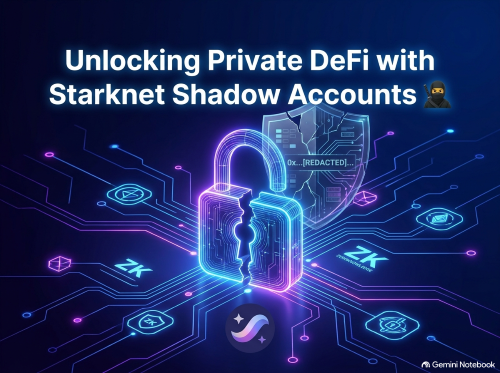
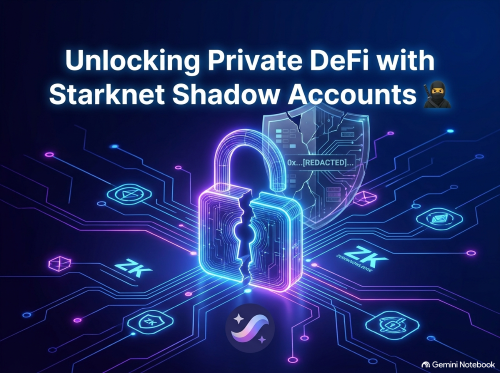
Public blockchains have always suffered from a fundamental tension. On one hand, complete transparency allows anyone to verify transactions, audit smart contracts, and confirm account balances without trusting a central authority. On the other hand, that exact same transparency means your entire financial life is on display for anyone with an internet connection and an address scanner.
If you use a single primary crypto wallet to swap tokens on a decentralized exchange, borrow against collateral, stake assets, and collect digital art, a curious observer can easily stitch those actions together. They can figure out your total net worth, monitor your trading strategy, and track when you move funds. For a long time, the crypto industry struggled to offer a clean middle ground between full public exposure and complete, dark-pool anonymity.
Starknet, the Layer-2 scaling network built by StarkWare, recently introduced a novel solution to this problem called Shadow Accounts. Designed as a new privacy primitive built on the STRK20 framework, Shadow Accounts offer users a way to separate their master wallet identity from their daily activity across individual applications.
Before the official rollout, anticipation had been building across social media. Crypto analysts, including @Crypto Banter on X, highlighted early teasers showing locked primary addresses alongside redacted secondary accounts. Shortly afterwards, Cryptonews covered the Shadow Accounts launch, breaking down how this technology alters how we think about privacy in decentralized finance.
To understand why Shadow Accounts represent a major shift in user experience, it helps to look at how traditional Web3 wallets operate. Normally, your public wallet address serves as your universal identifier. Whether you log into a lending protocol, a yield aggregator, or a decentralised exchange, you use the exact same string of characters. Over time, that single address becomes a detailed ledger of your personal financial behaviour.
Shadow Accounts change this dynamic by creating persistent, application-specific pseudonymous addresses. Instead of broadcasting your main wallet address to every protocol you interact with, a Shadow Account acts as a dedicated identity for a specific application.
Imagine walking into a bank where, instead of using your primary passport every time you open a account or sign up for a service, you are issued a secure, application-specific pseudonym. The bank knows how the funding flows internally, but external observers seeing your account activity cannot connect that specific activity back to your main vault.
When integrated into a application, the user experience is straightforward. You connect your standard wallet, flip a toggle switch from Public to Private, and deposit funds into a vault or protocol position. From that point on, your Shadow Account maintains that ongoing position under its own distinct address. When you are ready to exit, you simply withdraw the assets back into your shielded balance.
Behind the scenes, Shadow Accounts rely on Starknet's STRK20 privacy framework. Introduced earlier in 2026, STRK20 was initially designed to support shielded token transfers and private balances on the Starknet network. Shadow Accounts extend that underlying mechanism from holding and sending tokens to actively deploying them within smart contracts.
The funding flow relies on zero-knowledge proofs and helper contracts. When you activate private mode inside a supported application, your funds move from your main wallet into the STRK20 privacy pool. From there, a disposable, application-specific Shadow Account is initialised and funded from the shielded balance.
For developers, adopting this functionality does not require rebuilding existing smart contracts from scratch. As detailed in StarkWare's launch thread on X, developers can integrate private modes into their applications using the Starknet Wallet API via a simple function call. The underlying wallet software handles the complex cryptographic lifting, including private state management, proof generation, and transaction submission. This allows protocols to offer private features without fragmenting liquidity or forcing users into separate, isolated privacy pools.
It is vital to understand the explicit boundary of what Shadow Accounts do and do not hide. This feature represents a change to on-chain identity rather than a system for invisible execution.
Shadow Accounts successfully obscure the link between your primary wallet and your application-specific address. An outside observer tracking your main wallet will not see where your funds went after they entered the shielded pool, nor will they be able to link your main address to the specific Shadow Account interacting with a given protocol.
However, the Shadow Account itself remains fully transparent on the blockchain. Its transactions, token balances, and open positions are publicly visible on block explorers. Anyone analyzing the blockchain can still inspect what that specific Shadow Account is doing—they simply will not know who owns it or what other addresses belong to the same person.
This distinction creates a practical middle ground. It prevents aggressive wallet-profiling and portfolio tracking while preserving the public verifiability that makes decentralized finance trustworthy.
It is also worth noting what Shadow Accounts do not cover. They are designed to protect identity linkages across applications, not to fix hardware vulnerabilities, compromised private keys, or unsafe signing habits. If a device is compromised, private keys remain at risk regardless of whether Shadow Accounts are in use.
The practical value of any privacy tool depends heavily on real-world adoption, and Starknet protocols have already begun rolling out support.
Ekubo Protocol, one of the leading decentralised exchanges on Starknet, introduced private liquidity provision powered by Shadow Accounts. Traders can now provide liquidity, earn trading fees, and manage complex automated market maker positions without exposing their primary wallet addresses to public tracking. Because the trading positions exist on the main DEX contracts, liquidity remains unified rather than split into separate private pools.
Similarly, Opus Money implemented Shadow Accounts to enable private borrowing. Users can shield their collateral, manage debt positions, and mint stablecoins while keeping their main wallets disconnected from their borrowing activity.
Beyond liquidity provision and lending, the underlying architecture supports a wide variety of financial activities. Staking protocols, perpetual trading platforms, prediction markets, limit order books, and NFT marketplaces can all implement Shadow Accounts to give users a default private mode.
The launch of Shadow Accounts is part of a broader trend across the blockchain sector toward nuanced, user-centric privacy tools. Rather than pushing users toward all-or-nothing privacy solutions that frequently draw regulatory scrutiny, modular primitives like STRK20 focus on protecting individual privacy rights at the user interface and identity level.
While market price action for underlying tokens like STRK can fluctuate in the short term due to macro conditions, the technical foundation being laid on Starknet points to a future where privacy is no longer a niche feature reserved for specialised privacy coins. By separating identity from activity, Web3 applications can finally offer the same basic level of privacy that consumers expect in traditional finance, without sacrificing the open auditability that makes decentralized networks so powerful.
Disclaimer: This article is provided for informational purposes only, mistakes may be made, and it's not offered or intended to be used as legal, tax, investment, financial, or any other advice.