x




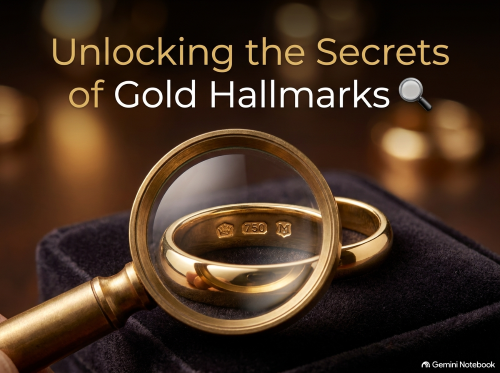
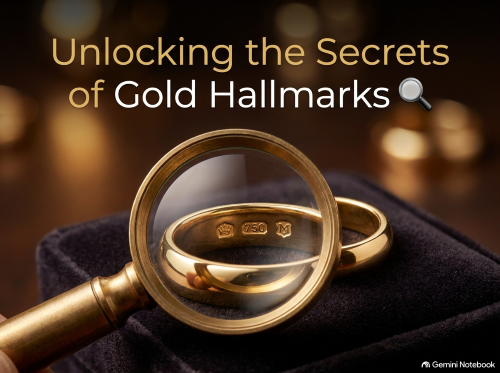
Have you ever turned a gold ring around in your fingers, peered inside the band, and wondered what those tiny, faded stamps actually mean? You are certainly not alone. For centuries, anyone buying or trading gold has faced the exact same dilemma: precious yellow metal is easy to dilute, hard to verify with the naked eye, and deceptively simple to fake.
That is precisely where gold hallmarks come into play. A genuine gold hallmark is much more than a decorative brand or a maker's claim. It is an official, legal certification applied by an independent assay office after rigorous testing. While a jeweller stamping "18K" or "750" on a piece is merely making a statement about their own work, a hallmark provides an independent guarantee backed by law. Whether you are inspecting antique heirlooms, modern jewellery, or estate pieces, consulting a comprehensive gold hallmarks guide gives you the confidence to know exactly what you own and how purity is measured.
A full hallmark is typically a compact cluster of tiny symbols struck neatly into the metal where it will not spoil the design—such as inside a ring band, on a necklace clasp, or inside a watch case back. Because these marks are often only a millimetre high, grabbing a jeweller’s loupe or magnifying glass is essential.
A traditional full hallmark consists of several distinct elements:
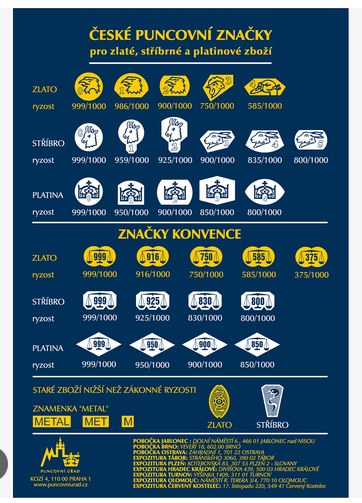
One of the trickiest aspects of hallmarking is that there is no single global rulebook. Hallmarking practices have evolved over seven centuries, leading to distinct national systems:
In the United Kingdom, hallmarking is governed strictly under the Hallmarking Act 1973. Almost every gold item weighing over one gramme must carry a full hallmark before it can legally be sold as gold.
In India, the world's second-largest gold jewellery market, hallmarking is mandatory through the Bureau of Indian Standards (BIS). Modern Indian pieces carry the triangular BIS logo, the purity grade (such as 22K916), and a unique six-digit alphanumeric Hallmark Unique Identification (HUID) code that buyers can check online.
In Switzerland, official testing is compulsory for precious metal watch cases, which bear the famous mark of a St Bernard dog's head, while jewellery carries registered maker marks alongside fineness numbers.
In Italy, there are no state assay offices. Instead, Italian law requires a purity stamp alongside a lozenge-shaped maker mark containing the manufacturer’s registration number and province code, such as AR for Arezzo or VI for Vicenza.
In the United States, government assaying does not exist. Under federal law, if a maker stamps a carat mark, they must include their registered trademark, but there is no third-party testing requirement.
For international trade, many nations participate in the Vienna Convention, using the Common Control Mark—a balance scales icon enclosing the fineness number—which allows hallmarked gold to pass between member countries without re-testing.
Not every mark stamped into metal represents solid gold. Plated items frequently carry abbreviations designed to indicate a thin layer of gold over base metal. Common markings include GP (gold plated), GEP (gold electroplated), HGE (heavy gold electroplate), GF (gold filled), and RGP (rolled gold plate). A stamp reading "18K GP" means the item is merely base metal with a thin 18 carat coating.
Furthermore, beware of fake or forged stamps. Red flags include blurred or shallow lettering, missing maker marks, odd symbol combinations, unexpected magnetic attraction, or gold colouring wearing away to reveal reddish or grey base metal underneath.
It is also worth noting that investment gold bars and bullion coins are exempt from traditional jewellery hallmarking. Instead, reputable mints and accredited refiners stamp bars with their logo, exact weight, fineness (typically 999.9), and a unique serial number.
Learning to decode gold hallmarks turns a mysterious set of tiny squiggles into a fascinating story of craftsmanship, origin, and guaranteed value. The next time you pick up a piece of gold jewellery, take a moment to examine its marks under magnification—you might just unlock the true history hidden within the metal.
Disclaimer: This article is provided for informational purposes only, mistakes may be made, and it's not offered or intended to be used as legal, tax, investment, financial, or any other advice.