x




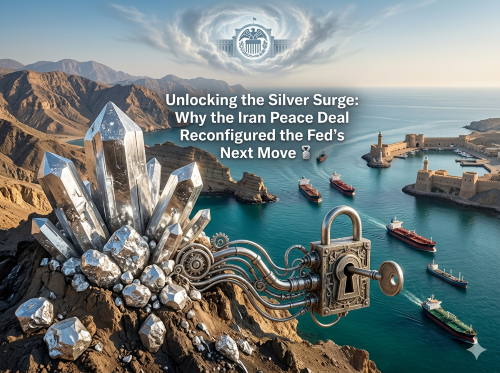
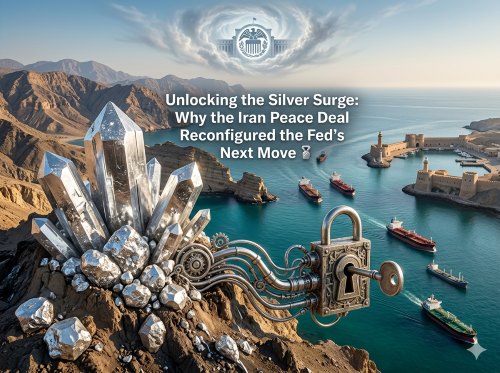
The financial headlines are buzzing. Silver prices have surged by 1.4%, whilst crude oil has plummeted by more than 5%. In the mainstream financial press, you will inevitably see this labelled as a classic "peace trade"—the idea being that as geopolitical tensions ease, investors are moving away from safe-haven assets.
However, this conventional framing is completely backwards.
To truly understand why silver is rising today, you have to look past the superficial narratives of market "fear". The real driver of silver’s recent roller-coaster ride isn’t geopolitical anxiety; it is a story of oil, inflation chains, and the shifting mathematics of the US Federal Reserve.
To understand why silver is rising now, we must first look at why it fell when the US-Iran conflict began earlier this year. When hostilities flared up on 28 February, silver was trading at a robust $84.50 per ounce. By early June, it had tumbled to roughly $65 per ounce—a staggering 23% decline during a period of intense geopolitical instability.
If silver were merely a traditional "fear metal", its price should have skyrocketed as war headlines dominated the news. Instead, it did the exact opposite.
The decline was triggered by a mechanical economic chain reaction:
It was not a lack of fear that suppressed silver; it was the reality of rising real yields.
The game changed on 14 June when a preliminary memorandum of understanding was signed with Iran, signalling the reopening of the Strait of Hormuz. Crude oil immediately plummeted, dropping around 5% to trade near a two-month low of $80.53 per barrel.
This drop in oil effectively caps the current inflation cycle. If energy costs are rolling over, the Fed's primary justification for hiking interest rates disappears.
The markets re-priced this reality instantly. In a single trading session, the implied probability of a December 2026 rate hike plummeted from nearly 90% down to roughly 60%. This massive 30-point compression in interest rate expectations is the exact mechanism lifting silver today. The peace deal did not just remove a war premium; it dismantled the entire rate-hike thesis that had been suppressing precious metals.
What makes silver unique compared to gold is that it relies on two separate demand engines simultaneously: monetary demand and industrial demand. For the first time in months, both engines are firing at the same time.
1. The Monetary Engine
With oil prices falling and inflation expectations easing, the Federal Reserve can comfortably hold interest rates rather than hike them. This compresses real yields, making non-yielding assets like silver far more attractive as a long-term store of value.
2. The Industrial Engine
Unlike gold, over 60% of annual silver demand comes from industrial applications. It is an indispensable component in solar panels, electric vehicles, AI data centre hardware, and consumer electronics. The closure of the Strait of Hormuz severely disrupted global manufacturing by spiking energy costs and snarling supply chains, which temporarily dampened industrial silver demand.
As the shipping lanes reopen, manufacturing is set to recover, restarting this vital industrial engine. This demand injection hits a market that is already incredibly tight. The Silver Institute’s World Silver Survey 2026 projects a sixth consecutive annual supply deficit of 46.3 million ounces. Furthermore, the cumulative drawdown from above-ground silver stockpiles has reached a massive 762.1 million ounces since 2021.
With the industrial engine adding powerful momentum to the monetary tailwind, silver is significantly outperforming gold today, gaining roughly twice as much as its yellow counterpart.
The immediate future of this trend hinges on the Federal Open Market Committee (FOMC) meeting, chaired for the first time by Kevin Warsh. While a interest rate hold at 3.50–3.75% is virtually locked in at a 97% probability, the real market mover will be the updated "dot plot" and the subsequent press conference.
The critical question for silver investors is how the Fed will frame the recent economic data. If Warsh views the recent energy-driven inflation as a temporary, geopolitical blip that has now been resolved by the reopening of the Strait, real yield expectations will likely fall further, giving silver an additional monetary boost. If he takes a more hawkish tone, treating the inflation as structural, interest rate anxieties may temporarily return, causing silver to consolidate.
Regardless of the short-term rhetoric from the Federal Reserve, the structural realities of the silver market remain unchanged. Six years of structural supply deficits, shrinking global stockpiles, and the dual alignment of monetary and industrial demand point to a powerful macroeconomic shift.
The mechanism that suppressed silver for the first half of the year has lost its fuel. This isn't a temporary peace trade—it is a fundamental real yield reset. For savvy investors looking at the bigger picture, that distinction makes all the difference.
For a deeper dive into this market analysis and to read the original insights that inspired this piece, view the full report on GoldSilver:
👉 Why Is Silver Up Today? The Iran Deal Changed the Fed Math
Disclaimer: This article is provided for informational purposes only, mistakes may be made, and it's not offered or intended to be used as legal, tax, investment, financial, or any other advice.