x



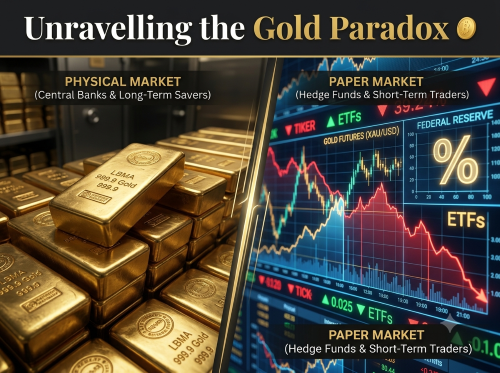
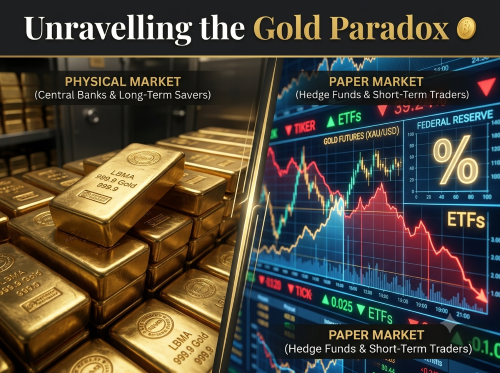
Escalating geopolitical conflicts, persistent inflation, and central banks purchasing gold at near-record volumes should theoretically create the ultimate backdrop for a soaring gold rally. Yet, precious metals investors recently witnessed a sharp contrast: gold experienced significant weakness, falling roughly 30 per cent from its record highs down towards the $4,000 mark.
If this leaves you bewildered, you are not alone. The question "Why isn't gold rallying?" has dominated financial discussions worldwide. The answer, however, is not that gold has lost its lustre or function. The reality is that most market participants are observing the wrong signals. To understand what is truly happening, one must realise that there is not just one gold market, but two distinct markets operating under a single quoted price.
The intuitive assumption is simple: crisis breeds fear, and fear drives investors into gold. However, geopolitical turmoil does not directly push bullion prices higher on a day-to-day basis. Instead, it ripples through financial markets via a chain reaction that can temporarily work against gold.
Because physical gold yields no yield or interest, higher real yields increase the opportunity cost of holding the metal. In the short term, algorithmic traders and macro hedge funds react to rising real yields by selling gold, completely overriding the headlines of global turmoil.
Over weeks and months, gold trades heavily on the price of money (interest rates). Only over years and decades does it trade on the trustworthiness of money.
The fundamental disconnect in precious metals stems from the coexistence of two radically different groups of buyers, both sharing the exact same benchmark price.
1. The Paper Market
The paper gold market consists of hedge funds, commodity trading advisers (CTAs), and leveraged institutional traders operating through futures contracts, options, and exchange-traded funds (ETFs).
2. The Physical Market
The physical market is comprised of central banks, sovereign institutions, family offices, and long-term savers exchanging paper currency for tangible, vaulted bullion.
Because benchmark spot prices are primarily discovered in highly liquid paper futures markets, short-term price movements reflect the rapid repositioning of leveraged paper money rather than a decline in actual physical demand. A flat or falling spot price simply indicates that fast financial capital is selling while patient physical capital continues to accumulate.
While financial television analysts obsess over whether interest rate cuts will happen next quarter, central bank reserve managers are operating on an entirely different timeline.
Central banks have been adding hundreds of tonnes of gold to their reserves annually, with survey data revealing that nearly half of global central banks intend to increase their gold holdings further. Institutions like the People's Bank of China have maintained multi-year buying streaks. Crucially, these institutions do not halt their purchases because interest rates tick higher, nor do they sell off reserves during market corrections.
This persistent accumulation stems from a fundamental shift in global monetary dynamics. The freezing of Western-held foreign exchange reserves in 2022 demonstrated to every central bank worldwide that sovereign debt assets held in foreign institutions can be turned off at will. In contrast, physical gold stored securely in a domestic vault carries zero counterparty risk and cannot be frozen by foreign governments. Central banks view gold not as a speculative vehicle, but as ultimate monetary insurance.
A 30 per cent drop in price may feel like a failure of the asset, but historical precedent shows that sizeable corrections are a normal feature of long-term gold bull markets:
In both instances, the underlying macro drivers—record government debt, currency debasement, and monetary mistrust—remained fully intact. Leverage in paper markets turns routine price pullbacks into forced liquidations, shaking out short-term traders. Meanwhile, fully paid physical owners who hold their metal outright face no margin calls and remain completely unaffected by paper volatility.
When institutional forecasts debate whether gold will rally in six months or two years, they agree on the structural direction while merely arguing over the timeline. Trying to out-guess short-term market timing in paper markets is a high-risk gamble.
The most prudent approach for long-term protection is direct, fully allocated ownership of physical bullion—held free of leverage, with clear legal title, in safe jurisdictions with robust property rights. While paper traders focus on today's headlines, central banks and wise savers focus on tomorrow's stability.
To explore the original analysis and read more about this financial phenomenon in detail, read the full article on BullionStar:
👉 The Gold Paradox: One Price, Two Markets
Disclaimer: This article is provided for informational purposes only, mistakes may be made, and it's not offered or intended to be used as legal, tax, investment, financial, or any other advice.