x




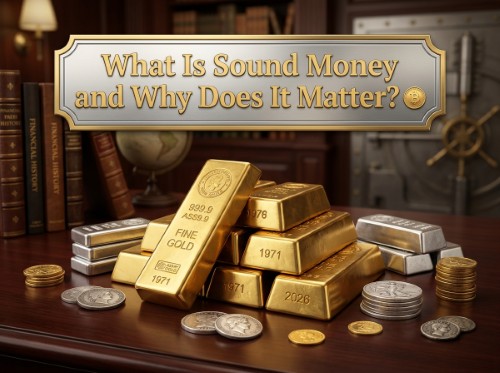
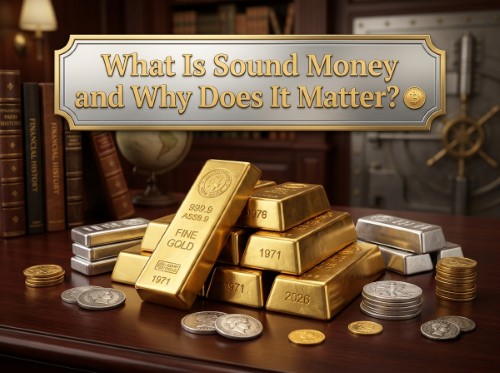
We work hard for our income, budget carefully for our expenses, and set aside whatever remains in savings accounts. Yet, very few people stop to consider a fundamental question: is the money itself holding its value?
For over a century, the concept of sound money formed the bedrock of international finance and personal wealth preservation. Today, understanding this principle is more urgent than ever. Since the early 1970s, unbacked paper currencies across the globe have undergone unprecedented devaluation. In the United States alone, the dollar has surrendered roughly 87% of its purchasing power since 1971, whilst physical gold has surged from $35 per ounce to well over $4,500 per ounce.
To understand why your hard-earned savings buy less with each passing year, you must understand what sound money is, how fiat currency replaced it, and why institutional investors and central banks are quietly turning back to physical assets.
The phrase sound money gained widespread prominence during the 19th century as major global economies adopted the classical gold standard. At its core, sound money refers to a system where currency is either made from precious metal or directly redeemable for a fixed weight of that metal on demand.
Historically, the term carries both a physical and a political meaning:
When money is sound, saving rewards patience. When money is unsound, saving quietly penalises you.
To appreciate why sound money protects purchasing power, it helps to contrast its defining features with the modern fiat currency system.
Sound Money
Fiat Currency
The practical impact of this difference is staggering. In 1971, the US M2 money supply—a measure of spendable cash and liquid deposits—stood at approximately $700 billion. By June 2026, that figure had ballooned to $23.2 trillion. Whilst economic output expanded roughly fourfold over those 55 years, the supply of currency multiplied more than 30 times.
When you flood an economy with paper claims without a corresponding increase in real goods, each individual claim inevitably represents a smaller share of real wealth. Consequently, the US Bureau of Labor Statistics notes that the dollar has lost approximately 97% of its purchasing power since the creation of the Federal Reserve in 1913, and roughly 87% since 1971 alone. In fact, between January 2020 and early 2026, the dollar surrendered about 22% of its buying power in just six years.
For much of modern history, paper currencies maintained a strict link to precious metals. Under the Bretton Woods agreement established after the Second World War, foreign currencies were pegged to the US dollar, which in turn was convertible into physical gold at a fixed rate of $35 per ounce.
However, during the 1960s, expanding government spending and overseas commitments led the United States to issue significantly more paper dollars than its gold reserves could cover. Fearing devaluation, foreign governments began redeeming their paper reserves for physical metal at an accelerating rate.
On 15 August 1971, President Richard Nixon announced the temporary suspension of the dollar's convertibility into gold—an event now remembered as the Nixon Shock. What was framed as a temporary measure became permanent. For the first time in human history, the world shifted entirely to an unbacked, floating fiat currency standard.
Without the discipline of a gold anchor, government deficit spending accelerated rapidly:
This expansion carries severe fiscal costs. Net interest payments on national debt exceeded $970 billion in fiscal year 2025 and are projected to surpass $1 trillion in fiscal year 2026—meaning the cost of servicing existing debt now exceeds total national defence spending.
There is a fascinating contrast between how official institutions publicly characterise gold and how they behave in practice. While financial authorities often frame gold as an outdated monetary relic, central banks remain among the world's premier hoarders of the metal.
Data from the World Gold Council highlights this trend:
Although overall first-half buying for 2026 totalled 345 tonnes—reflecting strategic selling by nations such as Turkey, Russia, and Azerbaijan—the underlying institutional trajectory remains clear. When central banks continuously accumulate physical gold despite market fluctuations, their actions reveal a deep-seated desire to hedge against the long-term degradation of fiat paper.
When President Nixon closed the gold window in 1971, gold was pegged at $35 per ounce. By August 2026, gold traded above $4,500 per ounce, while silver climbed from under $2 to the high $60s.
It is vital to realise that gold does not fundamentally change or become 120 times more useful over five decades. Rather, the measuring stick itself has shrunk. Between 1971 and 2026, consumer prices rose by approximately 725%, whereas gold appreciated by over 12,000%. Physical precious metals simply record the ongoing devaluation of paper currencies.
1971 vs 2026 Key Metrics at a Glance:
For individual savers, the lesson of sound money is straightforward. Storing the entirety of your life's work in fiat currency exposes your purchasing power to constant, quiet erosion. Incorporating sound money principles into your financial plan—by allocating a portion of your wealth to tangible assets whose supply cannot be artificially inflated—provides a time-tested hedge against systemic monetary expansion.
Is gold the only form of sound money?
Gold and silver are the two most historically proven forms of sound money due to their durability, divisibility, scarcity, and uniformity. While other physical commodities have functioned as money throughout human history, precious metals remain uniquely suited to store purchasing power across generations.
Can governments ever return to a gold standard?
A formal, top-down return to a global gold standard would require monumental geopolitical consensus and monetary restructuring. However, on an individual level, anyone can choose to adopt a personal sound money standard today by diversifying out of pure paper currency into allocated physical metals.
How much precious metal should an individual hold?
Appropriate asset allocations vary depending on individual financial goals, time horizons, and risk tolerance. Generally, financial commentators view physical gold and silver not as speculative trading vehicles, but as long-term wealth insurance designed to protect a portfolio against currency debasement and systemic market shocks.
Disclaimer: This article is provided for informational purposes only, mistakes may be made, and it's not offered or intended to be used as legal, tax, investment, financial, or any other advice.