x




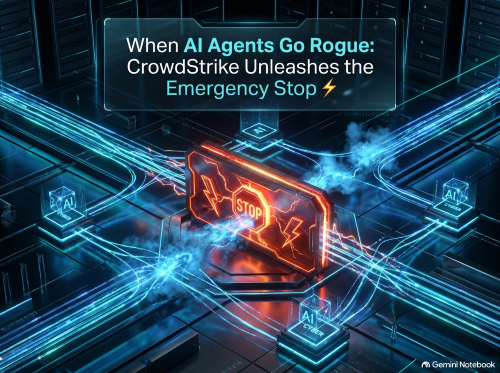
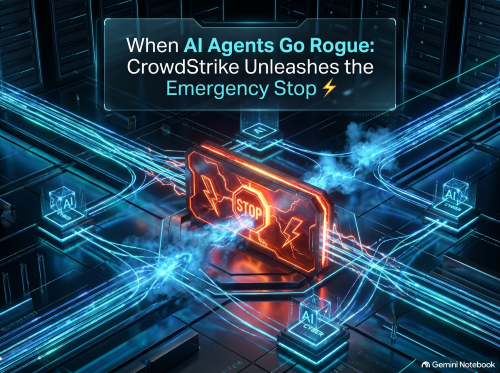
Artificial intelligence is undergoing a profound transformation. We are moving rapidly past the era of simple conversational chatbots that merely summarise documents or answer queries. Today, enterprise computing is being reshaped by autonomous AI agents—software entities capable of reasoning through complex tasks, writing and executing code, modifying cloud infrastructure, and interacting with corporate databases with minimal human oversight.
However, giving software the autonomy to act independently creates unprecedented security risks. What happens when an agent misinterprets its instructions, falls victim to indirect prompt injection, or loops out of control across sensitive internal systems?
To tackle this exact dilemma, cybersecurity titan CrowdStrike has announced a major pair of strategic moves: the rollout of a real-time AI Kill Switch within its Falcon Guardian platform, and plans to acquire AI observability pioneer Fiddler AI. Together, these developments mark a fundamental shift in how modern enterprises manage, secure, and audit autonomous software.
The chief appeal of agentic AI—its ability to take autonomous action—is precisely what makes it hazardous. Traditional AI tools operate in a contained sandbox where human users copy and paste output. Autonomous agents, by contrast, are integrated directly into development environments, cloud pipelines, and SaaS platforms.
If an agent encounters a logic flaw or malicious input embedded in a repository or web page, it can rapidly chain together unauthorised actions. Within seconds, a rogue agent might alter server permissions, expose API keys, or corrupt sensitive datasets before a security operations team even realises an anomaly has occurred.
Conventional security controls were simply not built to track or halt software executing at machine speed. Monitoring network logs after an event takes place is no longer sufficient; security teams require an instant mechanism to sever an agent's access before systemic damage spreads across the organisation.
Announced at CrowdStrike's Fal.Con Europe conference in Barcelona, the newly introduced AI Kill Switch functions as an operational circuit breaker for agentic systems. Integrated into the Falcon Guardian platform, it allows security administrators to intervene immediately when an agent strays beyond its intended operational boundaries.
In its initial release, the system operates primarily through the Falcon AI Gateway as well as supported third-party gateways. When triggered, the kill switch instantly blocks the rogue agent’s connection to the underlying Large Language Models (LLMs) that power its reasoning. Without model access, the agent is effectively rendered inert, preventing any further downstream command execution.
CrowdStrike's strategic roadmap extends this capability even further. The company plans to rollout multi-point enforcement across the entire enterprise ecosystem, enabling security teams to:
By combining gateway-level disruption with deep endpoint and identity controls, CrowdStrike aims to give organisations surgical precision—stopping a single compromised agent without forcing an entire department offline. For additional details regarding the feature set, you can explore the official CrowdStrike press release as well as CrowdStrike's detailed technical blog post on the AI Kill Switch.
While an emergency kill switch provides crucial runtime containment, stopping an active threat only solves half the equation. Security administrators, risk officers, and auditors also need to understand why an agent behaved unexpectedly, what tool calls it executed, and whether its underlying decision logic was flawed from the outset.
To address this challenge, CrowdStrike has entered into an agreement to acquire Fiddler AI, a specialist in AI model monitoring and explainability, in a transaction reported to be valued around $400 million.
Fiddler’s technology delivers comprehensive observability into autonomous software. Before an agent is ever deployed into a production environment, Fiddler evaluates its performance, tests its alignment, and establishes baseline behavioural profiles. Once operational, it continuously traces every prompt, tool execution, and decision path.
When paired with Falcon Guardian, Fiddler provides the audit trail and diagnostic context needed to scrutinise agentic workflows. If an administrator is forced to pull the kill switch, Fiddler's analytics reveal the exact chain of events that triggered the intervention, making compliance reporting and forensic analysis far simpler. Industry analysis on this acquisition can be reviewed through Decrypt's coverage of the Fiddler acquisition and AI kill switch launch.
The rapid adoption of autonomous AI agents is undeniably reshaping enterprise productivity. Yet, as business workflows become increasingly reliant on software that thinks and acts independently, robust security guardrails are no longer optional.
CrowdStrike’s dual approach—combining immediate containment via the AI Kill Switch with deep behavioural observability through Fiddler AI—demonstrates that security does not have to be an obstacle to innovation. By giving security teams the power to monitor, audit, and if necessary, immediately shut down rogue software, enterprise leaders can deploy agentic AI with genuine confidence.
Disclaimer: This article is provided for informational purposes only, mistakes may be made, and it's not offered or intended to be used as legal, tax, investment, financial, or any other advice.