x




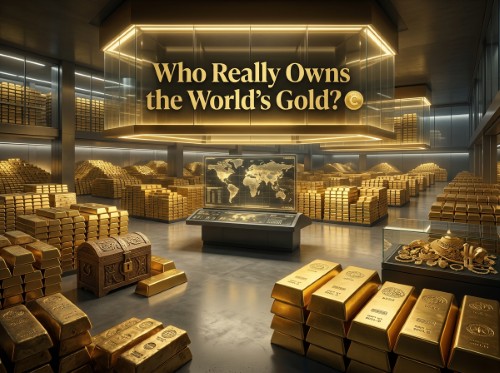
When people are asked to guess who holds the largest stockpiles of physical gold on Earth, the same usual suspects routinely top the list: central banks, the Chinese government, or high-flying Wall Street financial institutions.
While all three play vital roles in global bullion markets, none of them tells the complete story. The true distribution of physical gold ownership across the globe is vastly more intriguing—and far more decentralised—than most modern investors appreciate. Furthermore, examining where Western retail investors sit within this global picture reveals a surprising vulnerability in contemporary portfolio construction.
Here is a comprehensive breakdown of where the world's physical gold actually resides, tier by tier.
To understand global ownership dynamics, one must first grasp the strict physical limitations of the metal itself. According to data from the World Gold Council, all the gold ever mined in human history totals approximately 220,000 tonnes.
Because gold is virtually indestructible, almost all of this metal remains in existence in one form or another. However, the total global stock grows at an exceptionally sluggish pace. Annual mine output adds roughly 1.5% to the total above-ground supply each year.
This strict physical ceiling is the defining characteristic of monetary gold. When sovereign nations, institutional funds, and private citizens compete for real wealth preservation, they are all vying for a slice of an asset whose supply cannot simply be expanded at the press of a button.
Official monetary institutions and central banks collectively hold approximately 38,000 tonnes of gold—representing roughly 17% of all above-ground stock. The United States maintains the largest single national reserve, holding just over 8,133 tonnes stored predominantly at Fort Knox and the Federal Reserve Bank of New York. Notably, the size of America's stockpile has remained largely unchanged since the early 1970s.
However, the most compelling storyline in central banking is not the absolute size of existing reserves, but the aggressive pace of recent sovereign acquisitions.
Central banks have embarked on an unprecedented buying campaign, absorbing over 1,000 tonnes of physical gold annually in recent years—nearly double their average purchasing rate from the 2010s. Nations such as Poland have emerged as leading buyers, whilst the People's Bank of China has steadily expanded its official reserves by hundreds of tonnes (with many market analysts suspecting unrecorded purchases push the true total much higher).
In a historic milestone, gold’s share of global central bank reserves recently surpassed US Treasuries for the first time in the modern era, holding 27% compared to 22% for US sovereign debt. This signals a monumental structural pivot: nation-states are actively de-risking their balance sheets away from fiat paper assets and back towards physical monetary gold.
Exchange-Traded Funds (ETFs) and physical investment bars/coins combined account for roughly 22% of total above-ground supply. While ETFs offer convenient, liquid exposure to price movements without the logistical burden of private vaulting, they remain a modest component of overall ownership.
What is particularly revealing is the geographic divergence in ETF capital flows. Recent market data indicates that Asian institutions and retail buyers have set records for net gold ETF accumulation, whereas North American markets experienced persistent net outflows over the same period. The marginal buyer seeking convenient gold exposure is noticeably shifting away from traditional Western venues towards Eastern financial centres.
Beyond official reserves and public funds lies a powerful layer of gold ownership that operates quietly away from media headlines:
The most astonishing structural reality of global gold ownership often catches Western investors completely off guard: the largest pool of physical gold on the planet does not reside in deep underground vaults owned by governments or Wall Street banks.
It belongs to private households in Asia.
Estimates indicate that Indian households alone hold approximately 34,600 tonnes of gold—an extraordinary private treasury valued in the trillions of pounds. This single private sector holds significantly more physical gold than the top ten central banks in the world combined. Held predominantly in the form of high-purity jewellery, family heirlooms, and private bullion bars, this wealth is passed down across generations and secured within home safes, bank lockers, and temple trusts.
China presents a remarkably similar pattern. Decades of expanding middle-class prosperity have fuelled massive private accumulation of coins, bars, and traditional gold ornaments through state-approved retail channels.
In these societies, gold ownership is not merely a speculative financial asset allocation; it is an ingrained cultural imperative. Tied intimately to weddings, festivals, and deep-seated historical memories of paper currency collapses, Asian private demand provides a permanent, resilient floor beneath the global gold market.
In contrast to the heavy physical holdings of Eastern households and global central banks, Western retail portfolios remain strikingly under-allocated to precious metals.
This stark divide stems from a key historical pivot:
Today, however, that mental model is being rigorously re-evaluated. Major institutional asset managers now advocate strategic allocations of 8% to 10% in precious metals to safeguard portfolios against sovereign debt expansion and persistent inflation. Yet, studies reveal that average client portfolios in Western nations hold a tiny fraction of that target—often below 2%.
The broader implications for everyday investors come down to simple economics: supply and demand.
With annual mine production expanding global gold reserves by just 1.5% each year, a growing array of powerful, price-insensitive entities—ranging from sovereign central banks to family offices and Asian households—are systematically absorbing available physical liquidity.
When an individual investor decides to buy physical gold today, they are no longer competing against another retail buyer down the street. They are competing against sovereign governments rebalancing their balance sheets for the decade ahead. Understanding who holds the world's real wealth—and why they refuse to sell—is essential knowledge for anyone looking to secure their financial future.
GoldSilver: Who Actually Owns The World's Gold?
Most people assume the world's gold sits in Fort Knox, or in Chinese vaults, or in Wall Street portfolios. The real answer is stranger than any of those, and it says something uncomfortable about where Western investors sit in the line.
Megan King Diaz breaks down all 216,000 tons of gold ever mined, owner by owner: central banks, ETFs, sovereign wealth funds, family offices, and the households that quietly hold the deepest physical pools on the planet. By the end, the question stops being "what is gold worth" and becomes "who else is at the table, and why are they buying."
~ Timestamps ~
0:00 Who Actually Owns The World's Gold?
1:07 Central Banks
2:52 Gold-Backed ETFs
3:50 The Buyers Nobody Sees
5:15 Why Western Investors Own So Little
6:00 Where The Real Retail Gold Is
7:25 What Changed After 1971
8:23 What's Left For Retail Buyers
9:44 The Real Breakdown
Source: 👉 https://www.youtube.com/watch?v=oxWeTXsF69M
Disclaimer: This article is provided for informational purposes only, mistakes may be made, and it's not offered or intended to be used as legal, tax, investment, financial, or any other advice.